


























Views
Downloads



Essential Area of Rectangles Worksheet | Grade 4 Math
Paste this activity's link or code into your existing LMS (Google Classroom, Canvas, Teams, Schoology, Moodle, etc.).
Students can open and work on the activity right away, with no student login required.
You'll still be able to track student progress and results from your teacher account.
Mastering area is a fundamental milestone in Grade 4 geometry and measurement. This comprehensive worksheet guides students through the process of calculating area for rectangles and squares using the standard formula. By progressing from basic visual models to complex real-world word problems, learners develop a deep conceptual understanding of surface measurement and spatial reasoning.
At a Glance
- Grade: Grade 4 · Subject: Math
- Standard:
4.MD.A.3— Apply area and perimeter formulas for rectangles in real-world and mathematical problems- Skill Focus: Finding Area of Rectangles and Squares
- Format: 5 pages · 18 problems · Answer key included · PDF
- Best For: Elementary geometry practice and formative assessment
- Time: 25–35 minutes
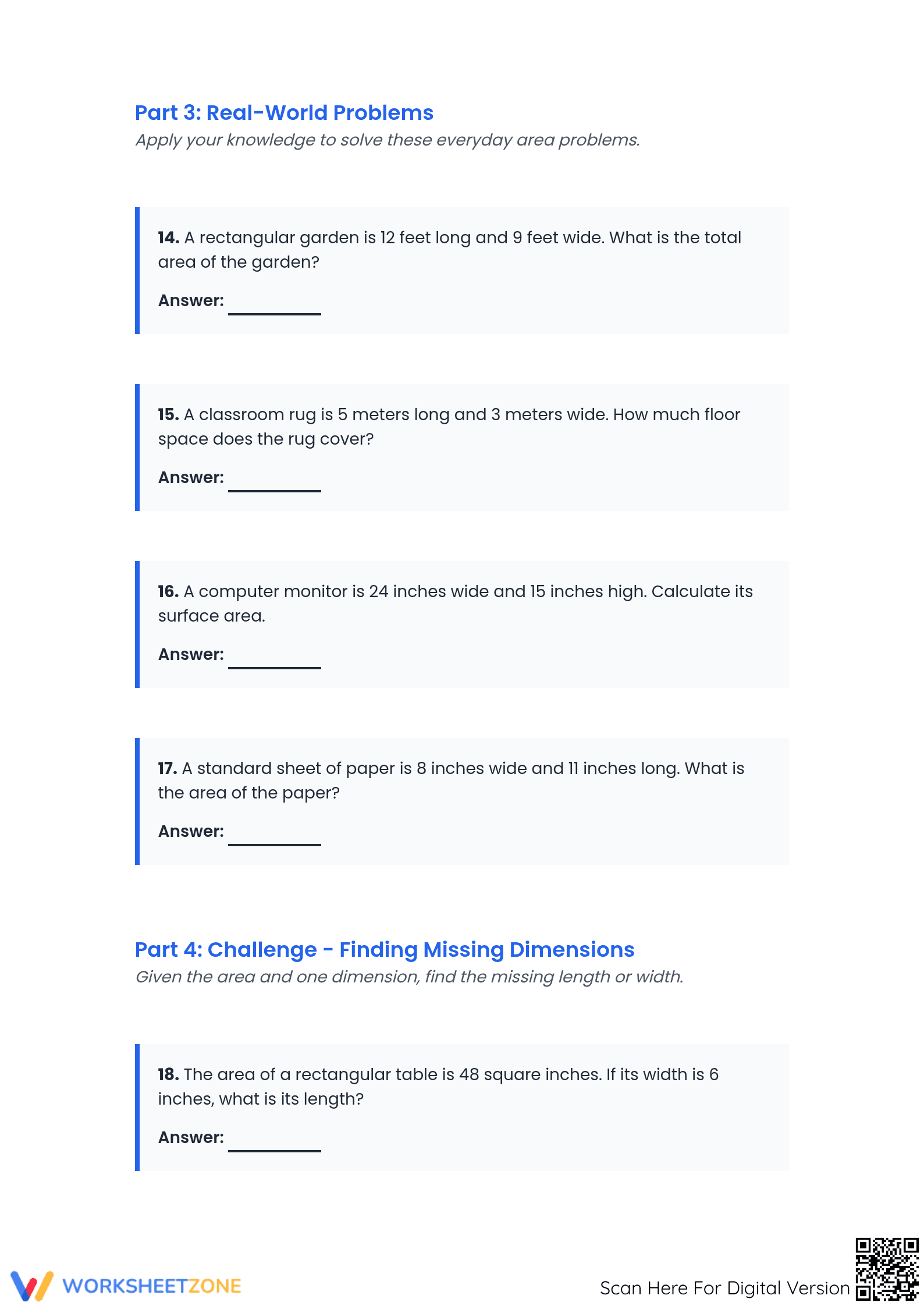
This five-page instructional packet contains 18 structured problems divided into four distinct sections. The resource includes visual models of rectangles and squares with specified dimensions, a dedicated set of real-world application problems, and a high-order thinking challenge involving missing dimensions. A complete answer key is provided to facilitate quick grading and immediate student feedback.
The worksheet follows a structured pedagogical flow designed for mastery. Guided practice begins with labeled visual rectangles, totaling nine problems that reinforce the basic Length x Width formula. This transitions into supported practice with four square-specific problems and four diverse word problems. Finally, independent practice concludes with a missing dimension challenge that requires students to apply algebraic thinking to solve for length or width.
Standards Alignment
Aligned to 4.MD.A.3, this resource requires students to apply the area and perimeter formulas for rectangles in real-world and mathematical problems. The content also supports development in mathematical practice standards related to modeling and attending to precision. Both standard codes can be copied directly into lesson plans, IEP goals, or district curriculum mapping tools.
How to Use It
This worksheet is ideal for use as a primary practice activity during a measurement unit or as a comprehensive formative assessment. For a classroom tip, observe students during the final challenge section to see if they can identify the inverse relationship between multiplication and division when solving for a side length. Expect most Grade 4 students to complete the full packet in 25 to 35 minutes.
Who It's For
This resource is designed for Grade 4 students but serves as an excellent review for Grade 5 or a challenge for Grade 3. It is particularly well-suited for inclusion in a math center or as a homework assignment paired with a coordinate plane or measurement anchor chart to support visual learners.
According to the Fisher & Frey (2014) gradual release of responsibility framework, effective mathematics instruction requires a shift from teacher-led modeling to independent student application. This Grade 4 Area of Rectangles worksheet embodies this principle by structuring 18 tasks in a scaffolded sequence. Students first engage with the 4.MD.A.3 standard through visual geometry models before applying formulas to abstract word problems and missing dimension variables. Research from NAEP consistently indicates that students who master foundational area concepts in upper elementary grades demonstrate significantly higher proficiency in middle school algebra and geometry. By providing a clear progression from concrete dimensions to real-world scenarios, this resource ensures that learners internalize the spatial logic of area rather than relying on rote memorization. This intentional design makes the worksheet a reliable tool for building the mathematical precision and problem-solving stamina required for state-level assessment success and long-term geometric fluency.


