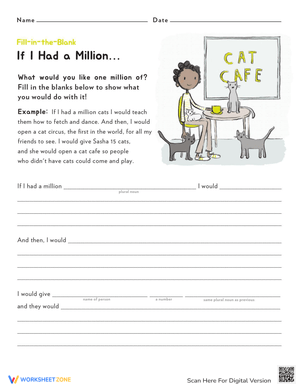
3rd Grade Story Parts worksheets for ELA Practice
These 3rd grade story parts worksheets give teachers a ready set of standalone printable resources — each one pairing a short fiction passage with targeted tasks for identifying characters, setting, major events, problem, and solution. The reading load is deliberately short so students spend their time on analysis, not decoding. Each worksheet stands alone, which means teachers can pull one for a Monday warm-up, drop another into a literacy station, or slip a few into a sub plan folder without any additional setup.
What Students Practice in Each Worksheet
Each worksheet in this 3rd grade story parts worksheets set moves students past simple labeling. The tasks push students to explain their thinking, not just name an element — "The setting is a farm" becomes "The setting is a farm because the author mentions a barn and a rooster at sunrise." That shift, from naming to explaining, is what builds the analytical habit that later reading and writing work depends on.
Task formats vary across the set so students are not doing the identical thing every session:
- Labeled graphic organizers where students record each element in its own section
- Event-sequencing tasks where students order three to five major events, then identify which one introduced the problem
- Short constructed-response prompts — one to three sentences — where students explain how the solution connects to the problem the character faced
- Matching and sorting tasks suited to partner review or early finisher work
Mistakes Students Make That These Worksheets Help You Catch
The most predictable confusion in third grade is between plot events and the problem. Students interpret "problem" to mean anything difficult that happened — so a student reading a story about a girl who forgets her lunch, eats her friend's sandwich, and later apologizes may list all three events under "problem." The distinction — that the problem is the central challenge while events are what the character does because of it — takes direct teaching to stick, and it rarely holds from one explanation alone. Repeated practice surfaces the confusion early so teachers can address it before it becomes a fixed misunderstanding.
Setting is the other consistent stumbling block. Students default to naming a location — "the school," "the park" — without considering time. When a story takes place on the last day of school in a packed gymnasium on a hot afternoon, every element of that setting affects the mood and even the plot. Worksheets that prompt for both where and when push students past the one-word answer toward the fuller picture that fourth-grade reading expectations will require.
How to Fit These Worksheets Into Your Weekly Lesson Plans
A 3rd grade story parts worksheets set fits cleanly into a short lesson cycle without requiring teachers to rebuild the routine each week. The structure that works well in most rooms: five minutes of teacher modeling with a projected passage, fifteen minutes of independent or partner practice, and five minutes of share-out. During the share-out, ask two or three students to read their answers aloud and point to the exact line in the passage that supports each choice. That single move — "show me where you found that" — builds the text-evidence habit faster than any amount of whole-class explanation.
In the eight minutes before a transition, pull a worksheet focused on just one element rather than the full five-part organizer. Students rushed through a complete story map often produce low-quality answers across every section; a single-focus task in a short window tends to produce one strong, defensible response. For literacy stations, each worksheet works when directions are clear enough that students can navigate the task without interrupting the teacher during a small-group pull.
When story parts practice is folded into a writing unit, each worksheet doubles as a pre-writing tool. Students identify elements in a published text, then transfer that same structure to their own narrative planning. The reading analysis feeds directly into a writing outline, which shortens planning time and gives students a concrete model to work from rather than a blank page.
Adjusting the Worksheets for a Range of Learners
For students who need more support, two small adjustments make a real difference without changing the skill target. Add a word bank at the top of the printed worksheet listing the five element labels — character, setting, major events, problem, solution. This removes vocabulary recall from the task so students can focus entirely on story analysis. Prefilling one row of the organizer before printing shows what a complete answer looks like before students write their own. Both adjustments are light enough to implement on the fly and specific enough to actually help.
Students ready for more challenge do not need a different resource. Extend the task with a follow-up question after the main organizer: which single event most shifted the direction of the story? If the setting had been different, would the same problem have occurred? These questions move students from identifying parts to evaluating how those parts interact — analytical thinking that third-grade standards build toward and fourth-grade reading will demand outright.
When teachers use 3rd grade story parts worksheets across a mixed-readiness classroom, passage selection matters as much as task design. A student reading at a late-first-grade level can work on story structure meaningfully — but only if the text is accessible. Matching the passage to the reader, not the grade label, keeps the practice productive at every level in the room.
Standard Alignment
These worksheets address CCSS.ELA-LITERACY.RL.3.3, which asks students to describe characters in a story and explain how their actions contribute to the sequence of events. They also connect to RL.3.1 — asking and answering questions about a text using explicit details from the passage as the basis for answers. In instructional sequence, RL.3.3 sits early in the third-grade reading calendar because it is prerequisite work: students who cannot yet link a character's choice to an event outcome are not ready to sequence major events or evaluate plot structure meaningfully. These worksheets address that connection point directly before more complex literary analysis begins.
Frequently Asked Questions
What is the clearest way to teach the difference between plot events and the problem?
Tell students the problem is the one thing the character must fix or face — it stays constant through most of the story. Plot events are the moves the character makes because of that problem. If a story features a character who wants to win a race but keeps stumbling at practice, the problem is the gap between goal and current ability; the events are each training session, the fall during the final race, and the decision to keep going. Having students identify the problem first, then trace which events happened because of it, typically clarifies the distinction faster than defining the terms separately.
Can these worksheets work as standalone homework assignments?
Yes, when the passage is at a manageable independent reading level and the directions are self-contained — which these are. Students who have encountered story parts work in class can complete each worksheet without additional explanation from a parent or guardian. One honest caveat: if a student is still working on decoding, story analysis becomes secondary and the worksheet will not produce accurate evidence of understanding. Reading the passage aloud first and then assigning the response task makes the homework more useful in that situation.
How often should students practice story parts at this grade level?
Spaced practice across multiple sessions outperforms one long massed block for this kind of analytical skill. Two to three short sessions per week — each using a different passage — builds the habit of looking for story structure more reliably than a single extended lesson. Rotating text types matters too: students who only practice with animal fables sometimes struggle to transfer the skill to realistic fiction or folktales. Different passages, same five elements, repeated across the week — that pattern produces more durable learning than any single deep-dive session.
When are students ready to move past basic story parts practice?
Look for two things: consistency across text types and the habit of supporting every answer with a specific detail from the passage. When a student can correctly identify all five elements in three different genres and always anchors answers in the text, that student is ready for more complex literary work — comparing story structure across two texts, analyzing why an author chose a particular setting, or drafting an original narrative with a clearly developed problem arc. That readiness shows up for most third graders by mid-year, though the range within a single classroom is usually wider than teachers expect.
Clear All