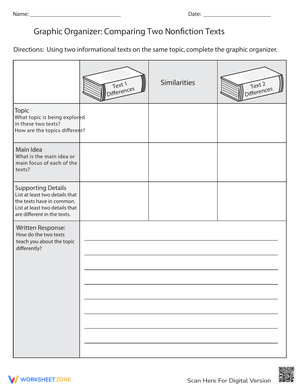
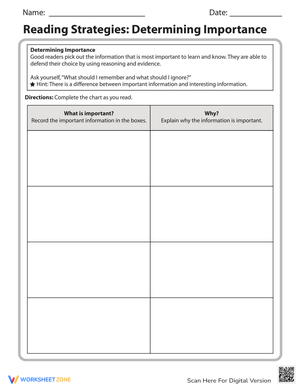
These nonfiction worksheets for 3rd grade give teachers printable passages and targeted question sequences built around the skills that informational reading actually demands at this grade — returning to the text for evidence, separating the main idea from supporting details, and using text features to orient before reading the passage fully.
What Students Practice Across the Set
Each worksheet pairs a short informational passage with exercises that ask students to do specific, demonstrable things. The task types are purposeful:
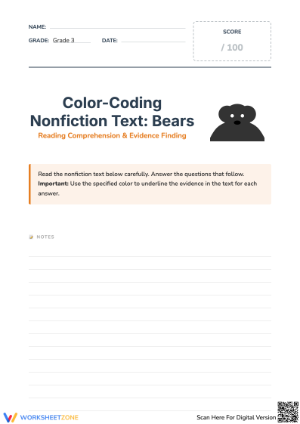
- Underline evidence in the passage before writing any answer
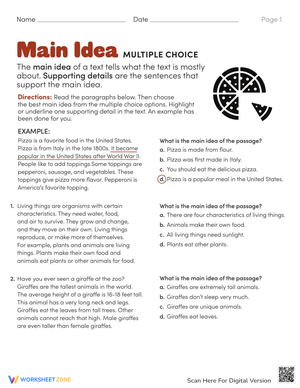
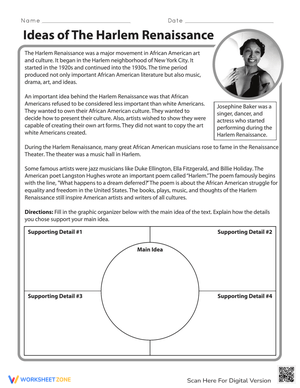
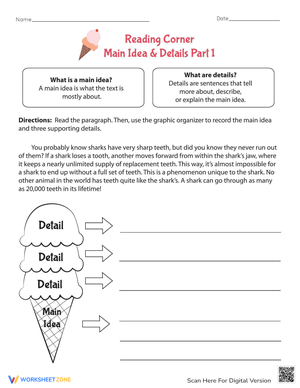
- Identify the main idea and distinguish it from a detail that supports but does not restate it
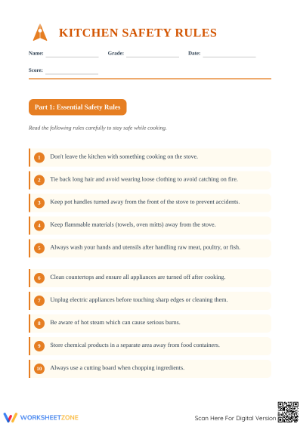
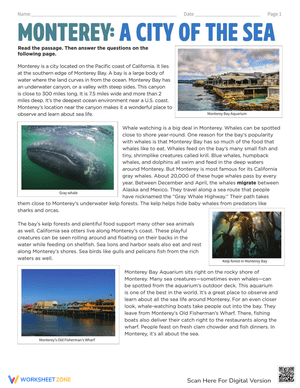
- Label and interpret text features — headings, captions, bold terms, diagrams
- Use context clues within the passage to define domain-specific vocabulary
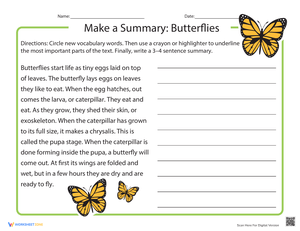
- Recount key details in their own words without copying the original sentence verbatim
The vocabulary work carries more weight than it appears to at first. Third graders who skip an unfamiliar word — "adaptation," "erosion," "amendment" — often lose the meaning of the entire paragraph that follows. Exercises that ask students to define terms before answering comprehension questions address that reading habit directly, rather than waiting for it to surface as wrong answers.
Standard Alignment
Three CCSS ELA standards anchor the design of these worksheets.
CCSS RI.3.1 requires students to ask and answer questions using explicit textual evidence. On these worksheets, a correct answer is never based on prior knowledge alone — the student must point to the sentence or detail in the passage that supports the response. Requiring the underlining step before writing operationalizes this standard in a way students can actually practice, not just describe.
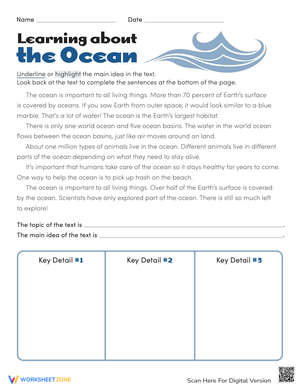
CCSS RI.3.2 addresses main idea and key details, and it sits at the center of most comprehension exercises in the set. The main idea and detail distinction is central to informational reading and consistently difficult for 3rd graders to apply. A student who reads a passage about honeybees and writes "bees make honey" as the main idea of a paragraph about colony communication hasn't misread the passage — they've grabbed a memorable fact rather than synthesizing what the paragraph actually argues. The worksheets build questions specifically to surface that pattern and give students a correction strategy.
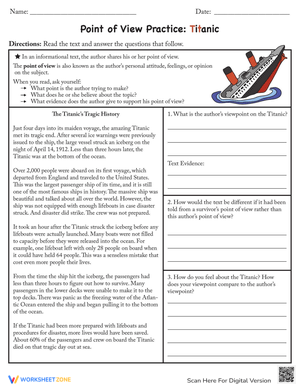
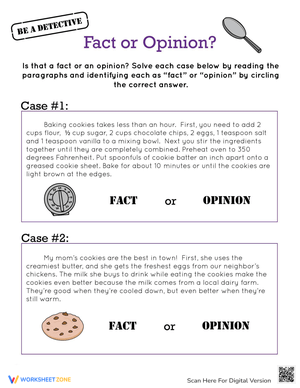
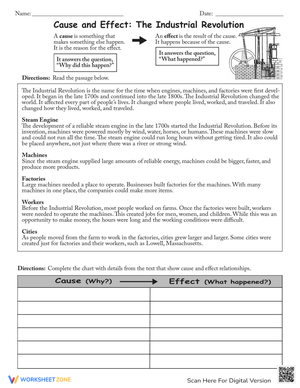
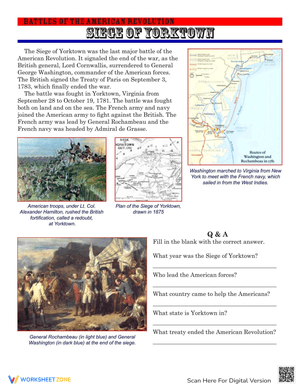
CCSS RI.3.5 covers text features. The instructional challenge at this grade level is that many students arrive from 1st and 2nd grade classrooms where text features were identified but not actively used to navigate meaning. These worksheets ask students to interact with features — circle headings, identify what a caption adds beyond the image, use a bold term's surrounding sentence to infer its definition — before they work through the comprehension questions.
Where Students Reliably Go Wrong in Informational Reading
The most persistent error in this work is the main idea problem. Students understand the phrase "what the passage is mostly about," but they routinely produce the most memorable detail instead of a synthesized statement. A worksheet on extreme weather featuring a paragraph about the 1900 Galveston hurricane will yield answers like "a hurricane killed a lot of people" when the main idea is closer to "natural disasters can destroy entire communities." The memorable fact wins over synthesis almost every time — until students learn to check whether their answer covers the whole paragraph or just one sentence inside it.
Evidence-based questions produce a second consistent error: students restate the question rather than cite the text. They write "I know because the author explained it" instead of pointing to a specific sentence. Requiring the underlining step first, before any writing happens, breaks this habit faster than any verbal reminder. The physical act of locating and marking the evidence changes how students approach the writing line on the page.
Text feature questions generate a third problem worth anticipating: students confuse captions with main ideas. A caption under a coral reef photo reading "Coral reefs support more than 25 percent of ocean species" strikes many 8-year-olds as the most important sentence on the entire worksheet. Teaching them that captions supplement images rather than anchor the passage's central argument is its own lesson — and one these worksheets create the conditions to teach directly.
Getting the Most From These Worksheets in Your Reading Block
The most effective pre-reading move is a structured text walk. Before students read a word of the passage, ask them to look at the title, headings, images, captions, and bold terms for about four minutes and predict what the text will cover. This activates prior knowledge, surfaces vocabulary students may not recognize, and removes the cold-start problem of encountering a dense informational passage with no frame of reference.
For the first several weeks of the year, run the full sequence as shared reading. Project the passage on the board, model how to annotate a heading, think aloud about what a diagram adds, and complete the first comprehension question as a group before releasing students to finish independently. By November, students who have run this routine a dozen times can do the text walk and annotation steps without a prompt.
These worksheets also work efficiently in the ten minutes before a science or social studies lesson. A nonfiction worksheets for 3rd grade passage on food webs at the top of a science period does two things at once: it gives students familiar comprehension practice and frontloads vocabulary they will encounter in the content lesson that follows. That combination is hard to get from most other materials in a single ten-minute window.
How These Passages Connect to Content Units
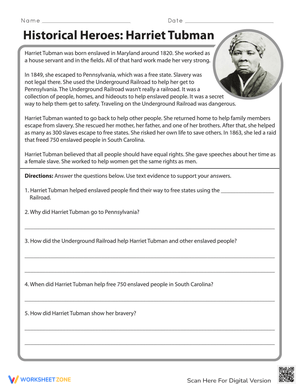
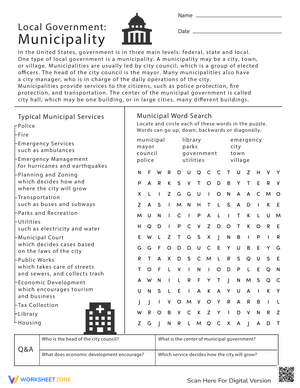
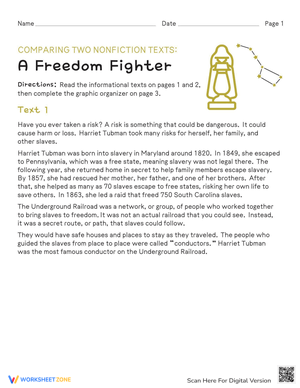
The nonfiction worksheets for 3rd grade in this set cover topics that map directly onto standard 3rd grade science and social studies units — animal adaptations, weather patterns, the water cycle, landforms, community roles, and biographical accounts of historical figures. Using a passage on a state's geography at the start of a social studies block is not an add-on to the lesson; it is the primary text for that block. Teachers who plan this way recover fifteen to twenty minutes per week that would otherwise be split between a reading lesson and a content lesson, and students practice applying comprehension skills to material they will encounter again in the unit assessment rather than to disconnected topics.
Meeting Different Reading Levels With the Same Set of Passages
For students reading below grade level, pre-teaching two or three words from the passage before handing out the worksheet makes a measurable difference. Write the words on the board, give a brief definition, and ask students to predict where those words might appear in the text. This removes the dual burden of decoding unfamiliar words and constructing meaning at the same time — which is exactly where below-level readers stall in informational text.
Strong readers can be directed to write a summary sentence for each paragraph after completing the questions — a task the worksheet does not require but that significantly raises the cognitive demand. Another effective extension: ask advanced students to write one question the passage did not answer and explain how they would locate that information. Both tasks push toward synthesis rather than retrieval.
For students who freeze when they see a long passage, read it aloud first and then distribute the worksheet. Removing the decoding step lets those students concentrate on comprehension. It also reveals whether a student struggles specifically with fluency or with understanding — two very different instructional problems that often look identical from across the room.
Frequently Asked Questions
What Lexile levels do these passages use?
Passages range from approximately 520L to 820L, covering the full expected band for 3rd grade informational text. Lower-band passages work well as entry points early in the year or for students reading slightly below grade level. Higher-band passages match the complexity expected for on-level and advanced readers in the second half of 3rd grade.
Can these worksheets be used as a standalone reading program?
These are targeted practice tools, not a reading program. They work best after explicit instruction in informational reading strategies — as reinforcement and application rather than as the first place students encounter a skill. Paired with direct instruction, the set builds fluency and independence with informational text over time.
How can I tell if a student is reading the passage or guessing at the comprehension questions?
Require annotation. Before writing any response on a nonfiction worksheets for 3rd grade worksheet, students must underline the text evidence that supports each answer directly in the passage. Students who annotate before writing almost never guess, and the markings make assessment straightforward — you can see exactly what each student noticed and whether they located the right section of the text.
Do these worksheets work for ELL students?
With some front-loading, yes. Pre-teaching four to six content vocabulary words before class makes the passage significantly more accessible for English language learners. The text feature elements present on each worksheet — images, captions, diagrams — provide context that dense paragraph text alone does not, giving students multiple entry points into the content before they work through the comprehension questions.












 Interactive Worksheet Maker
 Quiz Maker
 Word Search Maker
 Crossword Puzzle Maker
 Word Scramble Generator
 Sentence Scramble Generator
 Handwriting Worksheet Generator
 Name Tracing Generator
 Fill In The Blank Generator