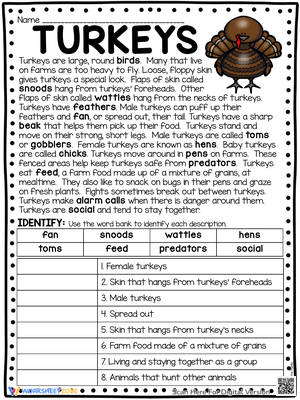
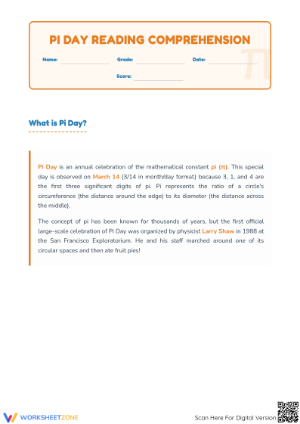
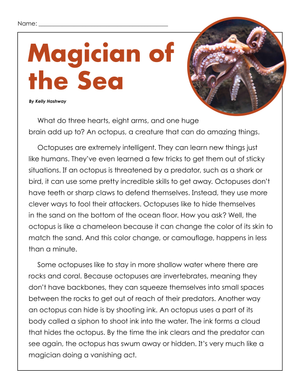
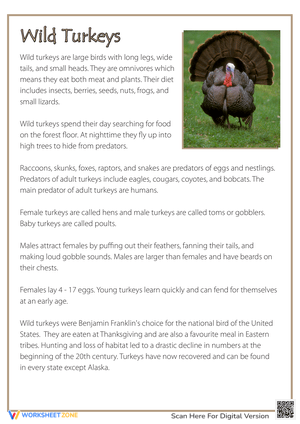
These informational text worksheets for 3rd grade give teachers a focused way to build nonfiction comprehension skills across the week — short passages, clear task prompts, and questions that ask students to point to evidence rather than guess. Each worksheet stands alone, so teachers can reach for one during morning work, a literacy center, or an exit task without needing a larger unit structure around it.
Skills Each Worksheet Builds
The skills covered in informational text worksheets for 3rd grade center on the nonfiction reading targets that define Grade 3 ELA: main idea and supporting details, asking and answering text-based questions, relationships between ideas (sequence, cause and effect, compare and contrast), and using text features such as headings, captions, and diagrams to deepen understanding. Most worksheets follow a consistent structure — brief passage, then a small set of purposefully sequenced questions — so the cognitive load stays on the reading task rather than on navigating a cluttered layout.
- Main idea and key details: Students identify the central idea of the passage and select or write two to three details that support it — not just describe the topic.
- Text features: Students examine a diagram or caption and explain what information it adds that the body text does not state directly.
- Question answering: Literal who/what/where questions appear first; one or two inferential questions follow, asking students to connect ideas across the passage.
- Cause and effect and sequence: Students identify what triggers an event in the text or place events in order using signal words as evidence.
- Evidence-based written response: Students write one to two sentences that state a conclusion and name the specific words or details from the text that led them there.
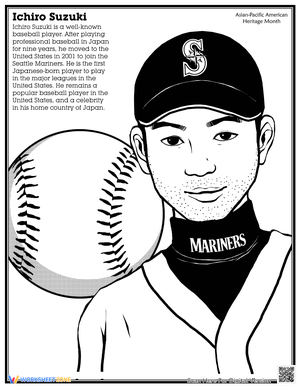
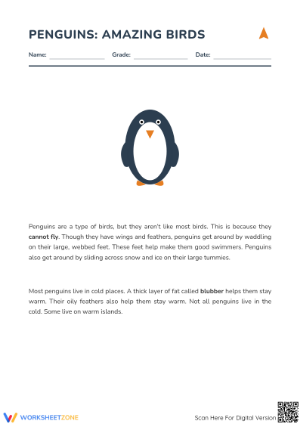
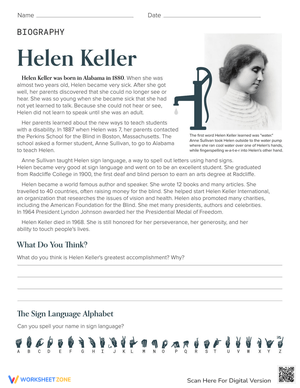
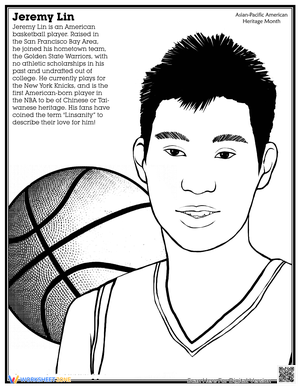
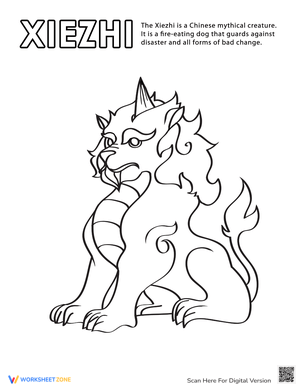
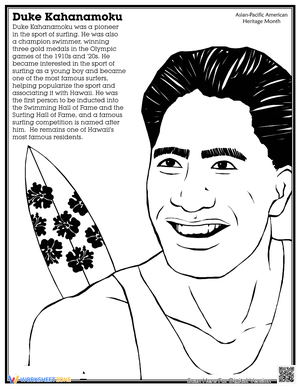
Topics across the set include animals, weather, community helpers, landforms, and brief biographies — nonfiction content that connects naturally to science and social studies units already running in most third-grade classrooms.
Mistakes Students Make That These Worksheets Help You Catch
The main idea question is where Grade 3 students slip most often, and the error follows a predictable pattern: students write the topic instead of the central idea. A student who reads a passage about how beavers build dams will write "beavers" as the main idea — technically related to the text, but not what the question asks. A well-designed worksheet makes this visible by giving students two plausible main idea statements to choose between, then asking them to underline two details that confirm their choice. That second move separates students who understood the passage from students who guessed.
Text feature questions produce a different problem. Most third graders can circle a heading or caption without difficulty, but when asked what a diagram adds to the text, they restate the caption rather than identify new information. If the caption reads "A beaver's teeth are orange," a student who hasn't looked carefully will write exactly that — which is copying, not comprehension. A prompt that asks "What does this image show that the paragraph does not say?" forces the close look the standard actually requires.
In written response questions, a third pattern surfaces: students open with a personal judgment rather than a text reference. "I think the author means..." is a common first line that signals the student is paraphrasing rather than citing. Modeling a sentence frame like "The text says _____, which shows that _____" before independent writing clears up most of this confusion without a lengthy mini-lesson.
How to Build These Worksheets Into Your Lesson Plans
The most effective approach is short, repeated cycles rather than one-off tasks. Spending two weeks on main idea — a different passage each time, the same question structure throughout — gives students the repetition they need to internalize a strategy. That consistency also makes formative grading faster: after seeing the same question type several times in a row, teachers develop a clear picture of what a complete answer looks like and where partial understanding stops.
For the first run with any worksheet in the set, a brief vocabulary preview makes a real difference. Preteach one or two domain-specific words, set a reading purpose ("read to find out what causes the water cycle to begin"), and ask students to underline evidence before they write a single answer. The color-coding extension works particularly well here: students highlight main idea in one color and supporting details in a second, giving teachers a visual record of how students processed the passage — not just whether the final answer was correct.
For substitute lesson plans, these worksheets are especially practical. Directions are self-contained, the passages are short enough for independent reading, and the question sequence is predictable enough that a substitute can facilitate a brief debrief without knowing the content in depth.
Standard Alignment
These worksheets address the following Common Core State Standards for Grade 3 Reading: Informational Text:
- RI.3.1 — Ask and answer questions to demonstrate understanding of a text, referring explicitly to the text as the basis for answers. The evidence-based question format on each worksheet targets this standard directly.
- RI.3.2 — Determine the main idea of a text; recount the key details and explain how they support the main idea. Main idea tasks appear across most worksheets in the set.
- RI.3.3 — Describe relationships between events, scientific concepts, or procedural steps using language that pertains to time, sequence, and cause/effect. Sequence and cause-and-effect worksheets address this standard.
- RI.3.7 — Use information gained from illustrations and the words in a text to demonstrate understanding. Text feature worksheets ask students to interpret diagrams and captions as meaning-making tools, not background decoration.
In terms of instructional timing, RI.3.2 and RI.3.7 are the standards most Grade 3 teachers introduce early in the year. Students typically arrive from second grade with experience answering recall questions but little practice distinguishing a topic from a main idea or using text features to access new information. These worksheets fit naturally into that first instructional arc and continue as review tools through the rest of the year.
Adjusting the Set for a Range of Learners
Differentiation here does not mean assigning a different standard — it means adjusting the conditions under which students access the same reading task. A student who needs more support reads the same passage as the rest of the class but works from a version with a reduced question set and a graphic organizer that separates "topic" from "what the author most wants me to understand about that topic." That single distinction clears up main idea confusion for many students who have been writing the wrong kind of answer all year.
Students who move through on-level work quickly benefit most from a two-passage comparison task: read two short informational texts on the same subject, identify one idea both authors emphasize, and name one difference in what each text focuses on. This targets the kind of synthesis RI.3.9 requires without needing a separate worksheet prepared in advance.
One honest limitation worth noting: students who encounter unfamiliar vocabulary in a passage sometimes stall before reaching the questions, even when the comprehension task itself is manageable. A quick teacher preview of two or three key words — one sentence of context each, not a full vocabulary lesson — prevents that bottleneck without changing the reading task.
Frequently Asked Questions
How long should a nonfiction passage be for Grade 3 worksheets?
Most informational text worksheets for 3rd grade work best with passages between 100 and 200 words — long enough to support four or five text-dependent questions but short enough for students to read in one sitting during a 10 to 15 minute block. Passages that run longer tend to split the lesson between reading and answering in a way that loses struggling readers before the question work begins.
Can these worksheets replace a reading unit, or do they work alongside one?
These work alongside a unit, not in place of one. A worksheet gives students repeated practice with a specific skill, but it does not replicate the extended reading, discussion, and writing that a full nonfiction unit involves. The most practical use is as a daily skill reinforcement tool — five to ten minutes of focused practice that builds fluency with whatever comprehension strategy the class is actively studying.
What is a good extension for students who finish a worksheet early?
Ask early finishers to write one new question for the passage and mark exactly where in the text the answer can be found. That task requires close rereading and demands the same evidence-based thinking the worksheet was building — without the teacher needing to prepare additional materials ahead of time.
Are these useful for state reading assessment preparation?
Grade 3 state reading assessments routinely include informational text passages with questions about main idea, key details, and text features — the same skills these worksheets target. Using informational text worksheets for 3rd grade consistently across the year builds the stamina and question-answering habits students need on assessment day. The critical move is in the debrief: when teachers discuss how students found their evidence, not just whether answers were correct, the practice carries over to assessment conditions.












 Interactive Worksheet Maker
 Quiz Maker
 Word Search Maker
 Crossword Puzzle Maker
 Word Scramble Generator
 Sentence Scramble Generator
 Handwriting Worksheet Generator
 Name Tracing Generator
 Fill In The Blank Generator