


























Views
Downloads



Grade 4 Octopus Reading Passage — Printable ELA
Paste this activity's link or code into your existing LMS (Google Classroom, Canvas, Teams, Schoology, Moodle, etc.).
Students can open and work on the activity right away, with no student login required.
You'll still be able to track student progress and results from your teacher account.
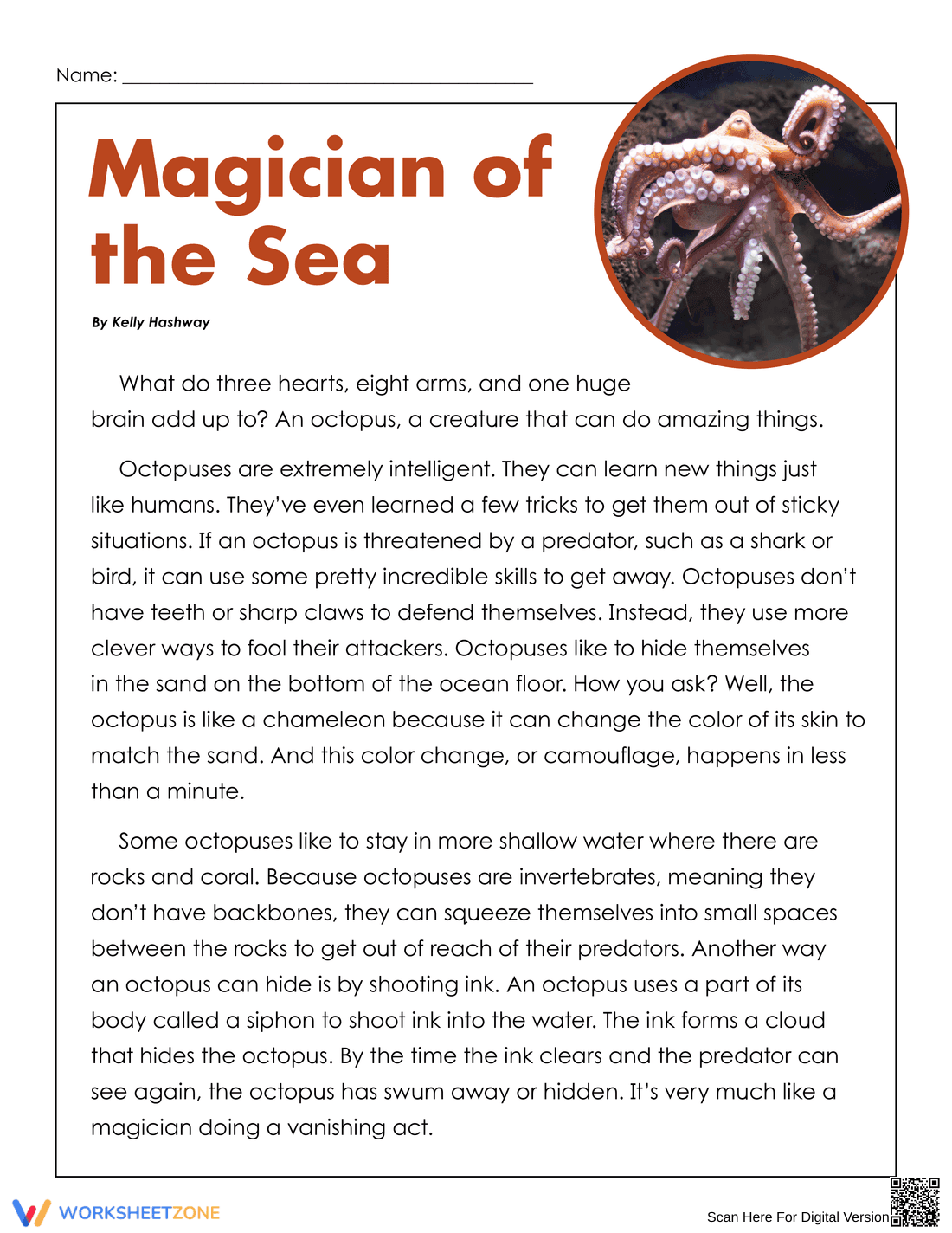
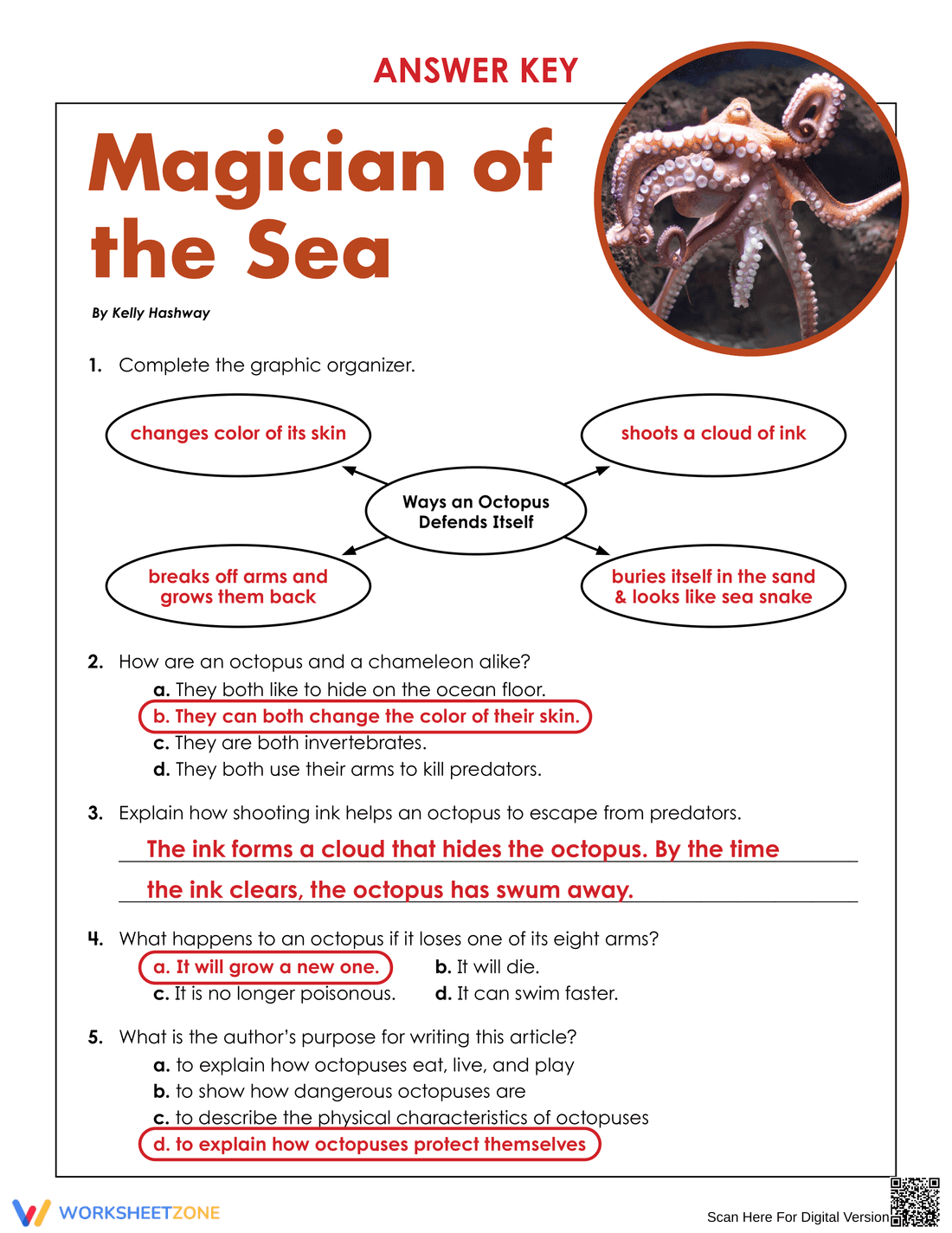
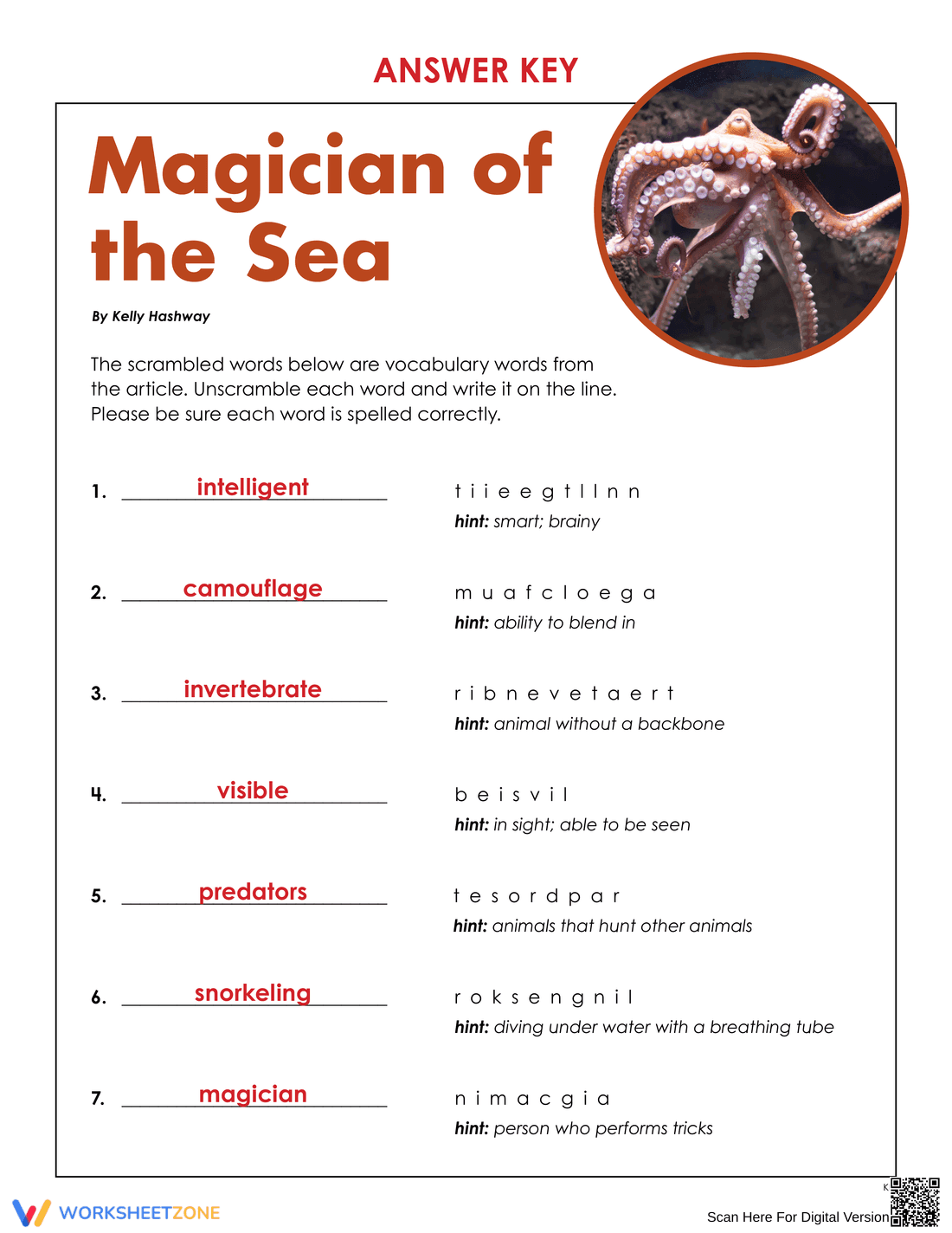
This two-page informational reading passage gives Grade 4 students structured exposure to nonfiction text while building the skill of locating key details and examples. Students read "Magician of the Sea," a content-rich text about octopus adaptations, and practice the analytical habits required by CCSS.ELA-LITERACY.RI.4.1.
At a Glance
- Grade: 4 · Subject: ELA
- Standard:
CCSS.ELA-LITERACY.RI.4.1— Refer to details and examples in a text to explain and infer- Skill Focus: Reading Informational Text — key details and examples
- Format: 2 pages · 0 attached problems · No answer key · PDF
- Best For: Independent or guided reading practice
- Time: 15–20 minutes
The passage spans two pages and covers octopus defense mechanisms: camouflage, ink clouds, mimicry, and the venomous blue-ringed octopus. Text is organized in clear paragraphs with supporting photographs. No question set is attached, making it flexible for teacher-created prompts, close-reading annotations, partner discussion, or fluency practice.
Zero-prep workflow — total teacher time under 2 minutes:
- Print (1 min): Print double-sided to keep it one sheet.
- Distribute (1 min): Hand out during literacy block, science unit, or as a fast-finisher activity.
- Review (5 min): Read aloud together or have students discuss key facts with a partner.
Works as an emergency sub-plan component. No teacher setup or materials beyond the printed page.
Primary standard: CCSS.ELA-LITERACY.RI.4.1 — Refer to details and examples in a text when explaining what the text says explicitly and when drawing inferences from the text. Supporting cross-curricular connection: NGSS life science standards on animal adaptations and survival strategies. Both standard codes can be copied directly into lesson plans, IEP goals, or district curriculum mapping tools.
Use during guided reading to model locating specific facts across a multi-paragraph structure. Alternatively, assign as independent reading where students highlight main ideas in one color and supporting details in another. Formative tip: observe how students move between paragraphs to find information about distinct defense mechanisms — this reveals whether they can use text structure to locate evidence. Expected completion: 15–20 minutes depending on reading fluency.
Designed for Grade 4 general education students; also fits advanced Grade 3 readers or Grade 5 students needing fluency practice. Below-grade readers benefit from a teacher read-aloud; above-grade readers can write their own comprehension questions. Pair with an anchor chart on informational text structures or a direct instruction lesson on animal adaptations.
Strong informational text comprehension is foundational for upper elementary students shifting from learning to read to reading to learn. This passage targets CCSS.ELA-LITERACY.RI.4.1, requiring students to refer to details and examples when explaining and inferring from text. A RAND AIRS 2024 study found students who regularly engage with high-interest, content-rich nonfiction show a 22% gain in extracting explicit information and making accurate inferences compared to peers using only narrative fiction. "Magician of the Sea" provides that high-interest context through octopus biology, building both background knowledge and reading skill in a single 15-minute session. Accessible structure and engaging photographs lower the barrier for struggling readers while still meeting grade-level text demands. This passage gives educators a ready tool for building the analytical reading habits students need for rigorous middle school science and social studies texts.


