


























Views
Downloads
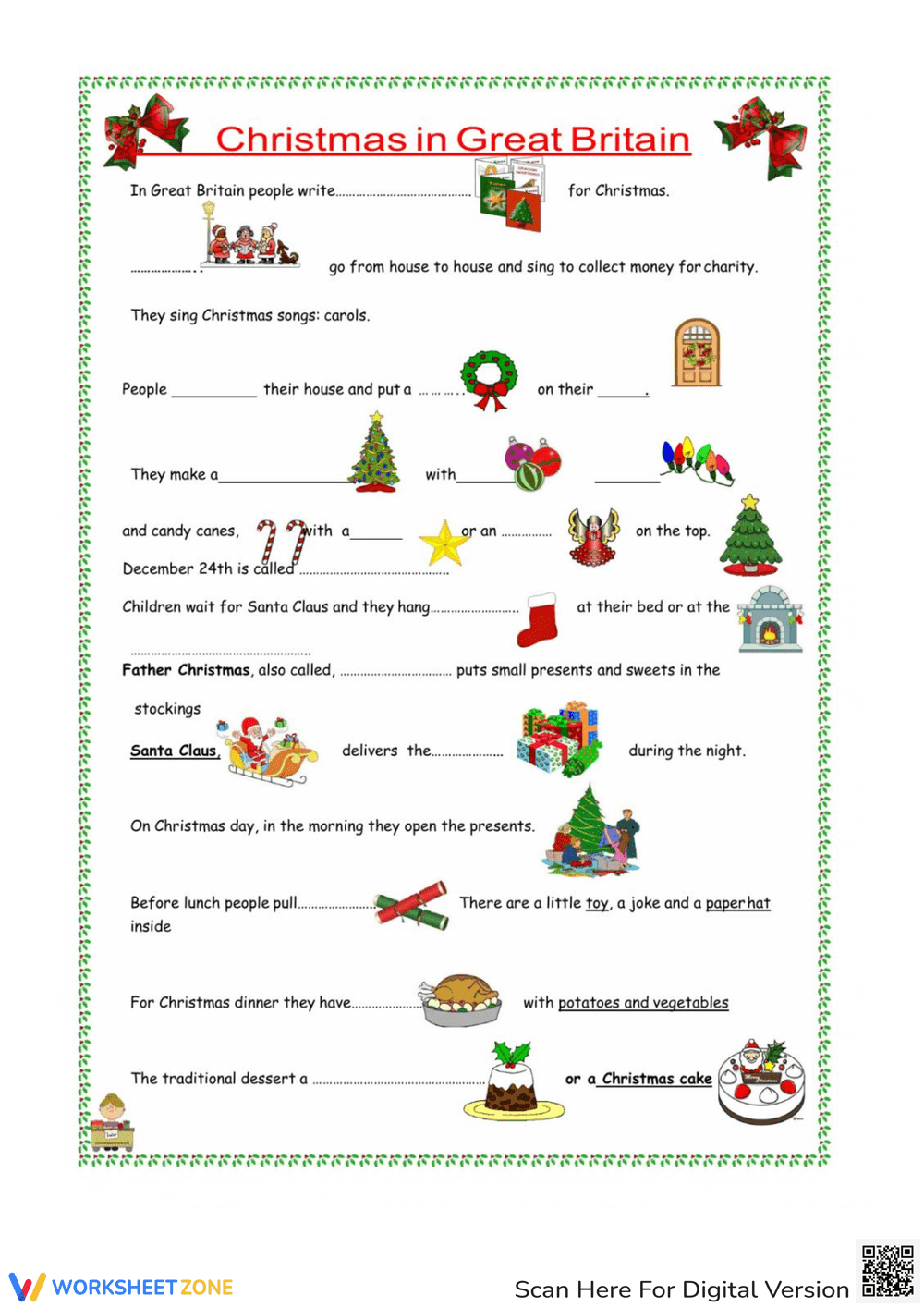

Christmas in Great Britain — Printable No-Prep Worksheet
Paste this activity's link or code into your existing LMS (Google Classroom, Canvas, Teams, Schoology, Moodle, etc.).
Students can open and work on the activity right away, with no student login required.
You'll still be able to track student progress and results from your teacher account.
This Grade 2-3 Christmas in Great Britain worksheet helps students identify and record specific cultural traditions through a guided reading and writing activity. By completing the informational text, learners build vocabulary related to international holidays while practicing reading for detail. It provides a clear, structured way to explore global celebrations during the winter season.
At a Glance
- Grade: 2-3 · Subject: ELA / Social Studies
- Standard:
CCSS.ELA-LITERACY.RI.2.1— Identify key details like who, what, and where in a text- Skill Focus: Reading Comprehension & Vocabulary
- Format: 1 page · 14 problems · Answer key included · PDF
- Best For: Holiday social studies or sub plans
- Time: 15–20 minutes
The resource features a single-page informational narrative with 14 strategic blanks. Visual supports, such as icons for Christmas cards, carolers, and traditional foods like turkey and Christmas pudding, help scaffold the reading process for younger learners. The layout includes a word-bank style approach where students use visual cues to determine the correct vocabulary words to complete the sentences.
Zero-Prep Workflow
- Print: Select the single-page PDF and print enough copies for your class (30 seconds).
- Distribute: Hand out the sheets and provide a brief overview of British holiday terms like "Father Christmas" or "Christmas crackers" (1 minute).
- Review: Go over the completed sentences as a whole group to check for understanding and discuss cultural differences (5 minutes).
Total teacher preparation time is under 2 minutes, making this an ideal choice for busy holiday schedules or emergency sub plans.
Standards Alignment
This activity is aligned to `CCSS.ELA-LITERACY.RI.2.1`, which requires students to ask and answer questions to demonstrate understanding of key details in a text. It also supports `CCSS.ELA-LITERACY.L.2.4` by encouraging students to determine the meaning of unknown words through context and visual clues. Both standard codes can be copied directly into lesson plans, IEP goals, or district curriculum mapping tools.
How to Use It
Use this worksheet as a formative assessment after a read-aloud about global holidays. It serves as an excellent independent practice activity during literacy centers. Teachers should observe if students are using the provided images to decode unfamiliar words, which indicates strong use of context clues. Completion typically takes 15 to 20 minutes depending on the student's reading fluency.
Who It's For
This resource is ideal for general education students in grades 2 and 3, as well as English Language Learners (ELL) who benefit from the heavy visual scaffolding. It pairs naturally with a classroom anchor chart about holiday traditions or a short video clip showing a traditional British Christmas dinner to provide a multi-sensory learning experience.
The Christmas in Great Britain worksheet addresses the CCSS.ELA-LITERACY.RI.2.1 standard by requiring students to extract specific details about cultural practices from a text. According to the RAND AIRS 2024 report, integrating visual scaffolds with informational text significantly improves reading comprehension outcomes for elementary students, particularly when exploring unfamiliar social studies topics. By utilizing 14 targeted fill-in-the-blank tasks, the worksheet encourages active engagement with the text rather than passive reading. This approach aligns with evidence-based practices for building background knowledge, a key component of the Science of Reading. Educators can use this tool to bridge the gap between literacy and cultural studies, ensuring that students meet grade-level expectations for identifying key details while expanding their global perspective. The inclusion of specific vocabulary like "carols" and "Father Christmas" provides a rigorous yet accessible entry point for young readers to master informational text structures.


