


























Views
Downloads
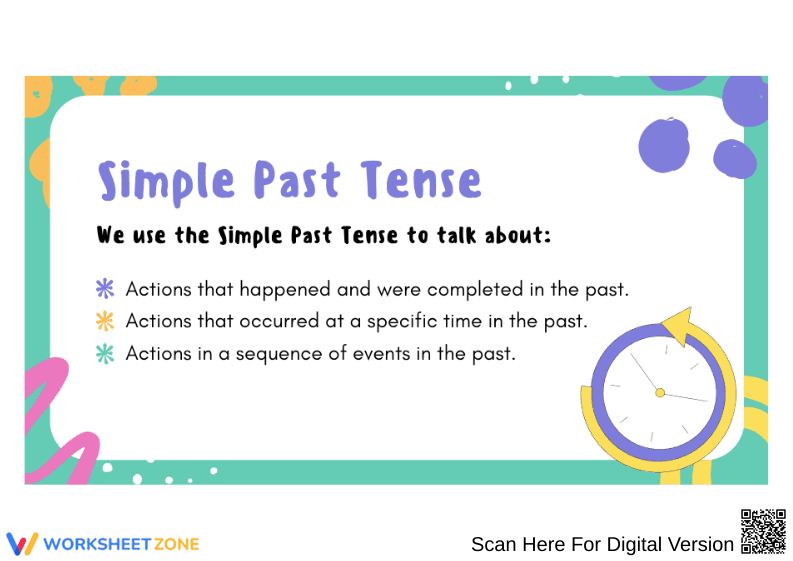

Simple Past Tense Guide: Printable Grade 2 Grammar
Paste this activity's link or code into your existing LMS (Google Classroom, Canvas, Teams, Schoology, Moodle, etc.).
Students can open and work on the activity right away, with no student login required.
You'll still be able to track student progress and results from your teacher account.
This printable Grade 2 grammar reference sheet helps students master the simple past tense by clearly defining its three primary uses. Students learn to identify completed actions, specific past times, and sequences of events. Use this visual anchor chart to build foundational writing skills and improve reading comprehension.
At a Glance
- Grade: Grade 2 · Subject: ELA Grammar
- Standard:
CCSS.ELA-LITERACY.L.2.1.D— Form and use past tense verbs correctly in writing- Skill Focus: Simple past tense rules
- Format: 1 page · 3 key concepts · Reference chart · PDF
- Best For: Grammar mini-lessons and student writing folders
- Time: 5–10 minutes
This instructional resource contains 1 page focusing on the rules of past tense verbs. It outlines three distinct scenarios for using the simple past tense: completed actions, specific time markers, and chronological sequences. The clean layout features a visual clock graphic and clear bullet points, making it an ideal reference tool for young learners to keep in their writing folders or notebooks.
This zero-prep resource fits into any daily grammar routine. First, print the single-page reference sheet in under 1 minute. Next, distribute the sheet to students during your writing block, taking about 1 minute. Finally, spend 5 minutes reviewing the three rules together as a class before students begin independent writing. This quick workflow makes it an excellent option for emergency sub plans or morning work.
This resource aligns directly with the Common Core State Standard CCSS.ELA-LITERACY.L.2.1.D, which requires students to form and use the past tense of verbs. It also supports the broader standard CCSS.ELA-LITERACY.L.2.1 by reinforcing standard English grammar conventions. Both standard codes can be copied directly into lesson plans, IEP goals, or district curriculum mapping tools.
Introduce this anchor chart during direct instruction before students write personal narratives. Display the PDF on your interactive whiteboard to guide a whole-class discussion, then have students file their physical copies in their writing folders. For a quick formative assessment, ask students to write one sentence for each of the three rules and observe if they correctly apply the past tense. This activity takes 10 to 15 minutes.
This reference sheet is designed for second-grade students learning basic verb tenses, but it also serves as an excellent review for third graders or English language learners. It pairs naturally with a narrative writing unit or a mentor text that highlights past-tense verbs. Teachers can use it to scaffold writing tasks for students who need visual reminders of grammar rules.
According to the Fisher & Frey (2014) framework for gradual release of responsibility, visual anchor charts and reference tools provide essential cognitive scaffolding during the initial phases of skill acquisition. This Grade 2 grammar resource targets CCSS.ELA-LITERACY.L.2.1.D by breaking down the simple past tense into three concrete, observable rules. Research from EdReports 2024 emphasizes that explicit grammar instruction combined with accessible reference materials significantly improves student writing quality and sentence structure. By providing clear definitions for completed actions, specific times, and sequences, this chart helps young writers transition from spoken language to formal written English. Educators can confidently integrate this tool into their daily ELA blocks, knowing it supports systematic language development and aligns with evidence-based writing instruction practices.


