


























Views
Downloads



Printable Types of Sentences Worksheet | Grade 3-4 ELA
Paste this activity's link or code into your existing LMS (Google Classroom, Canvas, Teams, Schoology, Moodle, etc.).
Students can open and work on the activity right away, with no student login required.
You'll still be able to track student progress and results from your teacher account.
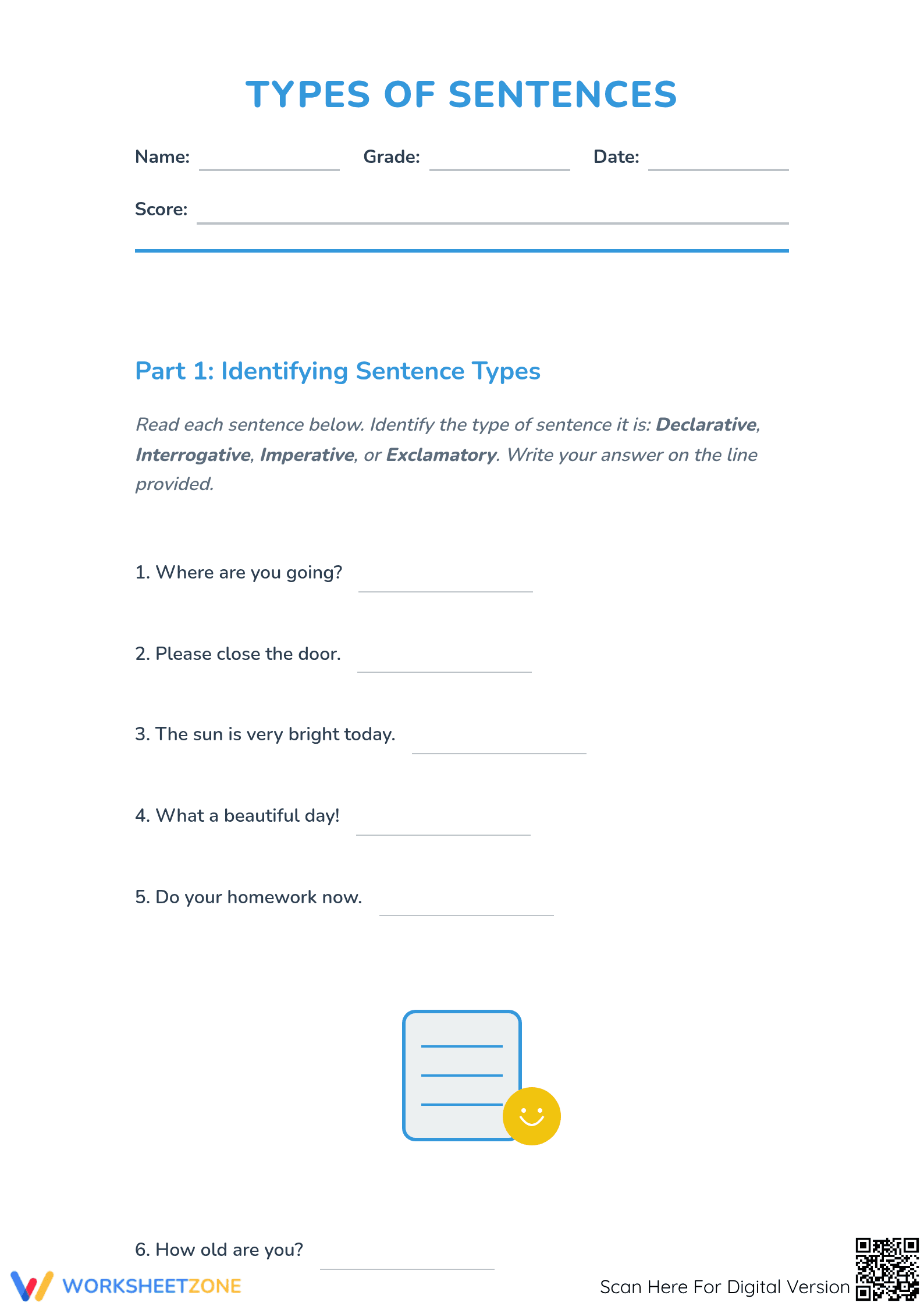
Master the four primary sentence types with this comprehensive five-page grammar packet. Students move beyond simple identification to active transformation and creative application of declarative, interrogative, imperative, and exclamatory structures. This resource ensures learners understand how punctuation and intent define the role of a sentence in effective communication and writing.
At a Glance
- Grade: 3–4 · Subject: ELA Grammar
- Standard:
CCSS.ELA-LITERACY.L.4.1— Demonstrate command of the conventions of standard English grammar and usage when writing- Skill Focus: Four Types of Sentences
- Format: 5 pages · 33 problems · Answer key included · PDF
- Best For: Intensive grammar practice and writing workshops
- Time: 40–50 minutes
What's Inside
This expansive 5-page PDF contains three distinct sections: identification, transformation, and creation. It features 15 identification questions where students categorize sentences, 10 transformation tasks where they rewrite sentences into different types, and 8 original creative writing prompts. A full answer key is provided to facilitate quick grading and immediate student feedback during classroom review sessions.
Skill Progression
- Guided practice: Part 1 provides 15 sentences where students identify types using a provided list, reducing cognitive load while building core recognition of punctuation and syntax.
- Supported practice: Part 2 challenges students with 10 transformation tasks, requiring them to manipulate existing structures into interrogative, imperative, or exclamatory forms.
- Independent practice: Part 3 concludes with 8 original sentence creation tasks based on specific thematic prompts to demonstrate full conceptual mastery.
This sequence follows the gradual-release model, moving from recognizing patterns to synthesizing new grammatical structures independently through focused practice.
Standards Alignment
Primary alignment: CCSS.ELA-LITERACY.L.4.1. This resource helps students demonstrate command of the conventions of standard English grammar and usage when writing or speaking. It specifically addresses the ability to produce complete sentences and use appropriate punctuation to signify sentence intent. This standard code can be copied directly into lesson plans, IEP goals, or district curriculum mapping tools.
How to Use It
Use this packet during a grammar block after direct instruction on sentence types. It serves as an excellent formative assessment; observe Part 2 to see if students correctly change punctuation when transforming a declarative sentence into an interrogative one. Expect a completion time of 45 minutes for the full packet, or split it over three separate instructional days.
Who It's For
Designed for Grade 3 and 4 students, this resource is ideal for general education classrooms, ELL support, and literacy intervention groups. It provides the repetition needed for students struggling with punctuation cues while offering creative outlets for advanced writers through the creative writing prompts in the final section. The scaffolded nature supports varied learner needs effectively.
The mastery of sentence types is a foundational requirement for developing syntactic complexity and authorial voice in elementary education. According to Fisher & Frey (2014), the gradual release of responsibility model—moving from recognition to transformation and finally creation—is essential for internalizing grammatical conventions. This 5-page worksheet aligns with CCSS.ELA-LITERACY.L.4.1 by providing 33 structured tasks that bridge the gap between rote memorization and functional application. By requiring students to not only identify declarative, interrogative, imperative, and exclamatory sentences but also to rewrite and generate them, the resource supports the NAEP framework's emphasis on purposeful writing. Recent data from RAND AIRS 2024 suggests that integrated grammar practice significantly improves student writing outcomes compared to isolated drills. This resource provides the necessary scaffolding to ensure Grade 3 and 4 students can accurately signal their communicative intent through varied sentence structures.


