


























Views
Downloads
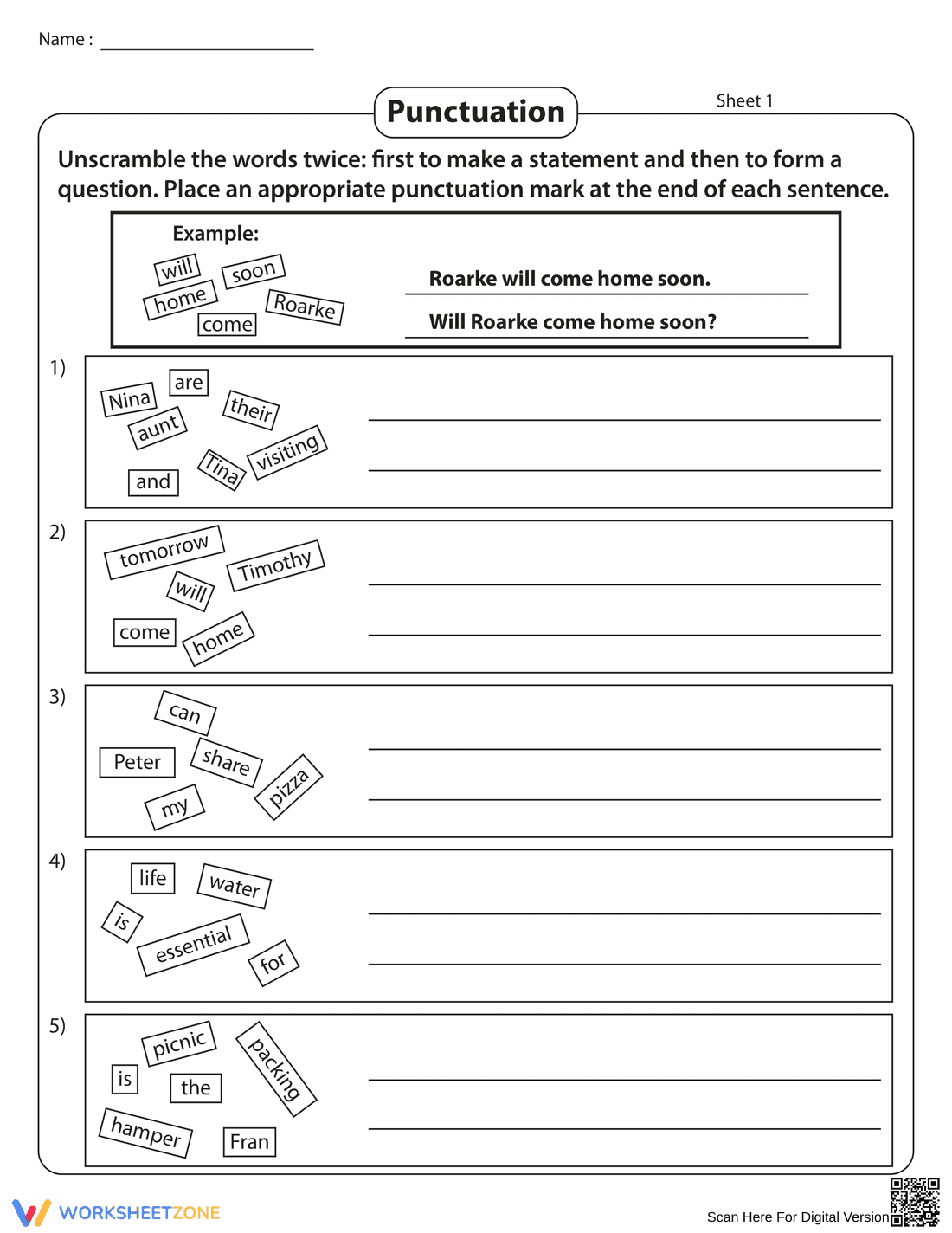

Essential Unscrambling Sentences Worksheet | Grade 3 ELA
Paste this activity's link or code into your existing LMS (Google Classroom, Canvas, Teams, Schoology, Moodle, etc.).
Students can open and work on the activity right away, with no student login required.
You'll still be able to track student progress and results from your teacher account.
This essential Grade 3 English Language Arts worksheet focuses on sentence structure and mechanics through word-scramble tasks. Students transform disorganized word banks into grammatically correct statements and interrogative questions. This dual-task approach ensures learners understand how word order and ending punctuation signal different types of communication in written English.
At a Glance
- Grade: 3 · Subject: English Language Arts (ELA)
- Standard:
CCSS.ELA-LITERACY.L.3.1.I— Produce simple sentences to communicate statements and ask questions effectively- Skill Focus: Sentence unscrambling and punctuation
- Format: 1 page · 10 tasks · Answer key included · PDF
- Best For: Independent practice or quick morning work
- Time: 15–20 minutes
The PDF includes one focused practice page featuring five sets of scrambled words. Each set provides space for two distinct responses: a declarative statement and an interrogative question. A clear, worked example at the top of the page models the unscrambling process and the application of appropriate punctuation marks (periods and question marks). A complete answer key is provided for rapid grading.
Teachers can implement this resource in three easy steps. First, print the required number of copies (30 seconds). Second, distribute the worksheets for students to complete during a quiet independent practice block (15 minutes). Finally, review the answers as a whole group or use the provided key for individual assessment (2 minutes). Total teacher preparation time is under two minutes, making it ideal for busy classroom schedules.
Aligned to CCSS.ELA-LITERACY.L.3.1.I, this resource requires students to produce simple, compound, and complex sentences. By specifically focusing on the transition between declarative and interrogative forms, it reinforces the structural requirements of standard English. This standard code can be copied directly into lesson plans, IEP goals, or district curriculum mapping tools to track student progress in sentence-level mastery.
Assign this worksheet after a direct instruction lesson on sentence types to verify student comprehension. Use the unscramble twice mechanic as a formative assessment to observe which students struggle with verb placement in questions. For a collaborative twist, have students read their completed sentences aloud to a partner to check for fluency and natural-sounding word order.
This resource is designed for Grade 3 students but serves as an excellent review for Grade 4 learners or an enrichment task for Grade 2. It is particularly helpful for English Language Learners who are still internalizing English syntax. Pair this worksheet with a short reading passage to help students identify similar sentence structures in published texts.
Research from Fisher & Frey (2014) emphasizes the importance of scaffolding sentence construction to build foundational literacy. This worksheet applies the CCSS.ELA-LITERACY.L.3.1.I standard by requiring students to manipulate word order, a cognitive task that reinforces the relationship between syntax and meaning. By asking students to produce both statements and questions from the same vocabulary set, the activity highlights how structural changes alter the intent of a sentence. This type of focused syntactic manipulation is a recognized strategy for improving overall writing clarity and reading comprehension. According to NAEP data, students who master basic sentence mechanics early are significantly more likely to succeed in complex analytical writing tasks in middle school. This printable provides the structured repetition necessary for internalizing these rules without overwhelming the learner with excessive text, making it a highly efficient tool for classroom-ready skill development.


