


























Views
Downloads

Printable Adjective Worksheet | Grade 2 Grammar
Paste this activity's link or code into your existing LMS (Google Classroom, Canvas, Teams, Schoology, Moodle, etc.).
Students can open and work on the activity right away, with no student login required.
You'll still be able to track student progress and results from your teacher account.
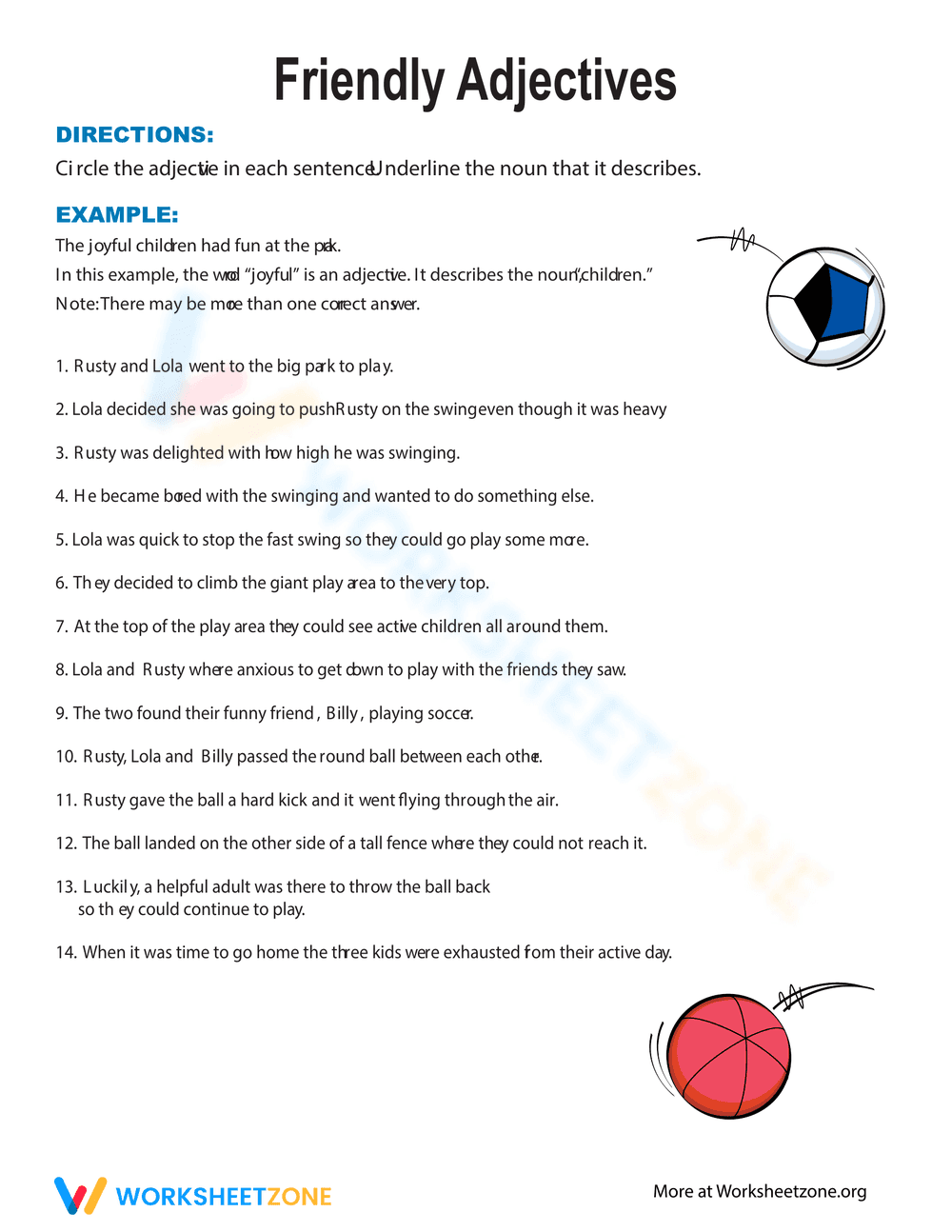
This printable grammar worksheet helps second-grade students master descriptive language by identifying adjectives and the nouns they modify. Students read engaging sentences about a playground adventure, circling adjectives and underlining corresponding nouns to build essential reading comprehension and writing skills.
At a Glance
- Grade: Grade 2 · Subject: ELA Grammar
- Standard:
CCSS.ELA-LITERACY.L.2.1.E— Use adjectives and adverbs to modify nouns and verbs- Skill Focus: Adjective and noun identification
- Format: 1 page · 14 problems · Answer key not included · PDF
- Best For: Independent grammar practice and homework
- Time: 15–20 minutes
This single-page resource features a clear, student-friendly example followed by 14 narrative sentences detailing a fun day at the park. Each sentence contains at least one adjective describing a specific noun. The layout provides ample spacing for young writers to circle and underline their answers directly on the page, reinforcing the relationship between modifiers and nouns.
Zero-Prep Workflow
This resource is designed for immediate classroom deployment:
- Print (1 minute): Photocopy the single-page PDF for your class.
- Distribute (1 minute): Hand out the worksheet and read the playground example aloud.
- Review (5 minutes): Project the worksheet to review the 14 sentences together.
Total teacher preparation time is under two minutes, making this ideal for substitute plans, morning work, or quick formative assessments.
Standards Alignment
This activity aligns directly with the Common Core State Standard CCSS.ELA-LITERACY.L.2.1.E, which requires students to use adjectives and adverbs, and choose between them depending on what is to be modified. By identifying how descriptive words function within sentences, students build a foundation for more complex sentence structures. Both standard codes can be copied directly into lesson plans, IEP goals, or district curriculum mapping tools.
How to Use It
Use this worksheet during the independent practice portion of your grammar lesson after introducing adjectives. Alternatively, assign it as a homework task to reinforce classroom learning. During the activity, walk around and observe if students struggle to distinguish between the adjective and the noun it describes; this serves as an excellent formative assessment. Expect completion within 15 to 20 minutes.
Who It's For
This worksheet is tailored for second-grade students learning parts of speech, but it also serves as a valuable review for third graders or an intervention tool for English language learners. Pair this activity with a descriptive mentor text or an anchor chart listing common sensory adjectives to support struggling readers who need visual cues to identify modifiers.
This grammar resource supports early literacy development by targeting parts of speech identification, a foundational skill highlighted in the Fisher & Frey (2014) framework. Research shows that explicit instruction in grammar mechanics, specifically focusing on how adjectives modify nouns, directly correlates with improved sentence-level writing quality in early elementary students. By practicing with the 14 contextualized sentences in this worksheet, students transition from isolated word recognition to understanding syntactic relationships. This alignment with standard CCSS.ELA-LITERACY.L.2.1.E ensures that students practice identifying descriptive words in a structured format. Educators can confidently integrate this tool into their ELA curriculum, knowing it meets standards for early language acquisition and aligns with evidence-based writing instruction methodologies designed to foster reading comprehension. This worksheet provides the targeted practice necessary to build student confidence and mastery in grammar.


