




























Views
Downloads



Printable Adjective Placement Worksheet | Grade 2-3 ELA

Paste this activity's link or code into your existing LMS (Google Classroom, Canvas, Teams, Schoology, Moodle, etc.).
Students can open and work on the activity right away, with no student login required.
You'll still be able to track student progress and results from your teacher account.
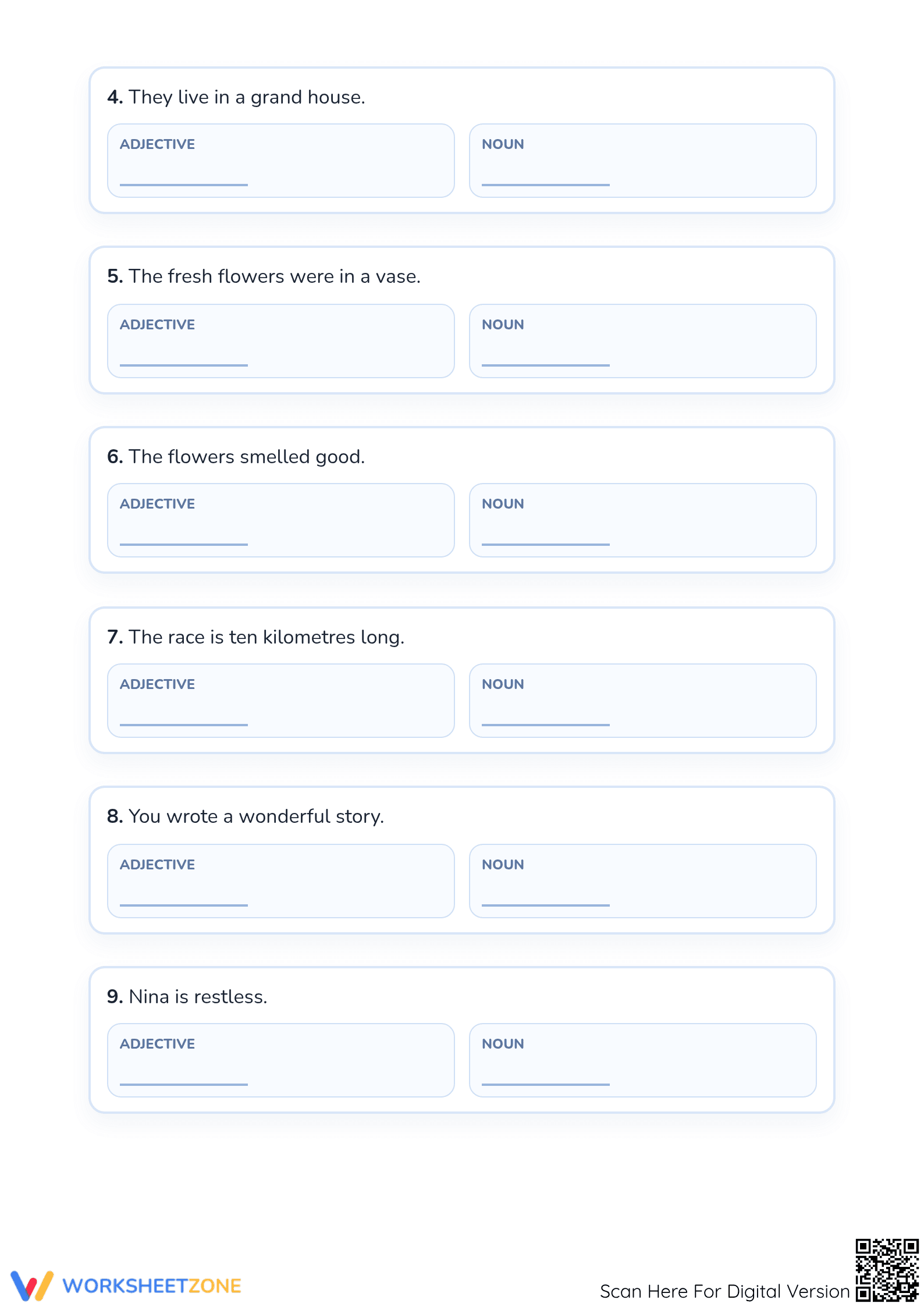
This Adjective Placement worksheet helps Grade 2-3 students identify descriptive words and their relationship to nouns. Practicing with 14 unique items, learners master the rules of where adjectives sit in English. This resource ensures students can accurately modify nouns to improve their descriptive writing and grammatical fluency.
At a Glance
- Grade: 2–3 · Subject: ELA Grammar
- Standard:
CCSS.ELA-LITERACY.L.2.1.e— Use adjectives and adverbs accurately based on what they modify in sentences- Skill Focus: Adjective placement (before vs. after nouns)
- Format: 3 pages · 14 problems · Answer key included · PDF
- Best For: Independent grammar practice and formative assessment
- Time: 15–20 minutes
What's Inside
This three-page PDF includes two practice sections. Part one features ten sentences where students find the adjective and noun, writing each into a workspace. Part two presents four sentences where students decide if the adjective appears before or after the noun. A complete answer key is provided for rapid grading.
Skill Progression
- Guided Practice: A hint box provides a concrete example establishing patterns for adjectives following linking verbs.
- Supported practice: Ten dual-box items require students to isolate the adjective and noun, preventing guessing.
- Independent practice: The final section shifts to categorization of the positional relationship without visual aids.
This resource follows a gradual-release model, moving from identification to analysis to ensure that the grammar concepts are internalized before students transition to their own creative writing.
Standards Alignment
Aligned with CCSS.ELA-LITERACY.L.2.1.e, this worksheet requires students to use adjectives correctly. It also supports CCSS.ELA-LITERACY.L.3.1.g by building identification skills for comparative forms. Both standard codes can be copied directly into lesson plans, IEP goals, or district curriculum mapping tools.
How to Use It
Use this as a formative assessment after a grammar lesson. Complete the first two problems together to model the identification process. Observe students during Part 2 to check their understanding of linking verbs. Completion time is approximately 15 to 20 minutes.
Who It's For
Ideal for second and third-grade students expanding their sentence variety. It is helpful for ELL students struggling with English word order. Pair this with a descriptive passage or an anchor chart to reinforce the concept throughout the week.
Targeting CCSS.ELA-LITERACY.L.2.1.e, this Adjective Placement resource ensures Grade 2 and Grade 3 students master descriptive modifiers. Research from Fisher & Frey (2014) highlights the importance of the gradual-release model, which is mirrored here through the transition from identification boxes to independent analysis. By isolating the adjective and noun relationship in 14 tasks, students build the cognitive scaffolds necessary for complex syntax. The inclusion of adjectives appearing both before and after the noun aligns with NAEP standards for linguistic fluency. This focus on functional grammar over rote memorization supports long-term retention of parts of speech. Educators can use these 14 data points to track IEP progress or inform interventions, ensuring learners achieve mastery in English sentence mechanics. The structured format provides clear evidence of student understanding for district reporting and curriculum mapping needs.


