3rd Grade Circle of Control PDF Worksheets
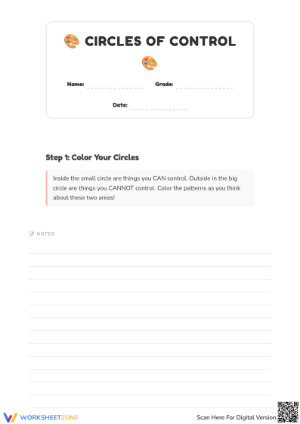
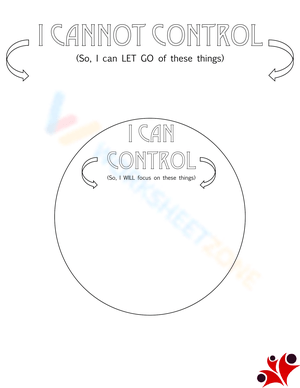
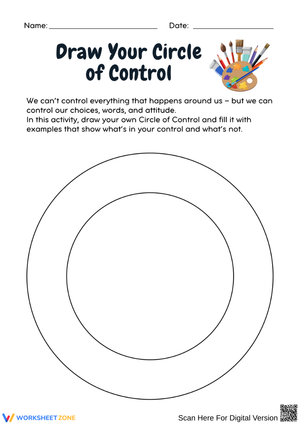
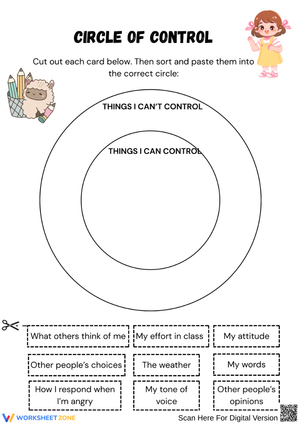
3rd grade circle of control pdf worksheets give students a concrete framework for something that genuinely trips up 8- and 9-year-olds: separating what they can act on from what they simply have to accept. Each worksheet uses a two-circle diagram to help students sort situations, reactions, and decisions into the right space — building emotional vocabulary they'll draw on long after the lesson ends. Teachers get ready-to-use resources that fit morning meeting warm-ups, calm-corner check-ins, and pre-test preparation alike.
What Students Practice in Each Worksheet
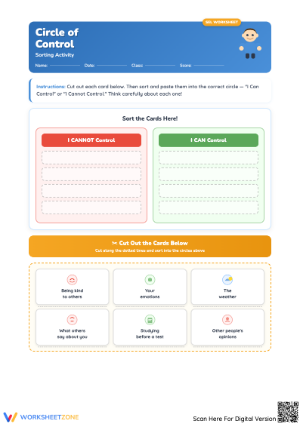
The core task is sorting. Students read scenarios drawn from real third-grade life — a best friend choosing to sit somewhere else at lunch, a substitute teacher running the day differently than expected, a spelling test score they weren't happy with — and decide whether each item belongs inside or outside their circle. That decision process is more demanding than it sounds. Categorizing requires students to think about agency: is there an action I could take here, or is this a fact I have to accept?
Beyond sorting, many worksheets ask students to reframe. After placing an item in the outer circle, a prompt follows: "What is in your control about this situation?" That second step is where the learning sticks. A student who writes "I can't control my bus being late" might then identify "I can control whether I get ready quickly once I'm here" — a small but real shift in where they put their attention. Students also work with sentence frames that reinforce the vocabulary of the inner circle: my reaction, my effort, my words.
Putting These Worksheets to Work in Your Classroom Routine
The most natural entry point is morning meeting. Start with an anchor chart and a whole-class sorting discussion — someone probably forgot their lunch box this morning, or there was an argument on the bus. Collect student suggestions, debate which circle they belong in, then send students to their seats to complete the individual worksheet version of the same activity. That move from shared discussion to independent work gives students a clear model before they attempt it alone.
Where teachers see the biggest return, though, is using 3rd grade circle of control pdf worksheets as a pre-event check-in rather than only a post-conflict processing tool. Five minutes before a standardized test or a competitive field day, students complete a quick sorting map: what can't they control (how hard the questions are, whether their team wins), and what can they (their breathing, their effort, asking for help when stuck). Students who name those anchors ahead of time walk into the high-pressure moment with noticeably less flailing. It's the difference between a class that spirals when something goes sideways and one that has a mental tool to reach for.
Completed worksheets belong in a student SEL folder — not filed away, but accessible. Taping one to the inside of a desk lid means the finished diagram is visible during a hard moment, which is worth more than any poster on the wall.
Mistakes Students Make That Teachers Should Anticipate
The most consistent error in early lessons is over-populating the outer circle. When students are frustrated, everything feels uncontrollable, and they sort it that way. A child who writes "how I feel" in the outer circle isn't being careless — they genuinely experience their own emotions as something that happens to them. This is developmentally accurate for an 8-year-old, and it's the misconception the lesson needs to address directly. The distinction to make explicit: students can't always control the first feeling that arrives, but they can control what they do next.
A subtler error runs the other direction. Some students place things like "my parents fighting" or "my friend being mean to me" inside their inner circle, absorbing responsibility for situations they have zero power over. This pattern shows up more in anxious students or those carrying a lot at home. When you see it, treat it as diagnostic information rather than a sorting mistake. A quiet conversation — "what part of that belongs to you, and what part belongs to the adults?" — does more than marking the answer wrong.
Third, expect students to confuse outcome with action. They'll put "winning the game" in the inner circle because they tried hard. Helping them draw the line between effort (controllable) and result (not always controllable) is a refinement that typically takes more than one lesson to settle.
Standard Alignment
These worksheets address CASEL's Self-Awareness and Self-Management competencies directly. Self-Awareness work shows up when students identify their own emotional triggers and name them honestly — the worksheet gives that recognition a structure. Self-Management appears in the reframe step, when students practice redirecting attention toward actions within their reach rather than dwelling on circumstances outside it.
Most state SEL standards at grades 3–5 include a benchmark equivalent to "identify personal strengths and the range of emotions" alongside "demonstrate strategies for managing emotions and behaviors." The circle-of-control framework is a direct instructional vehicle for both. For teachers in districts that require documented SEL instruction, these completed worksheets also serve as tangible evidence of student practice.
Adjusting the Set for a Range of Learners
Students new to the framework — or those who struggle with abstract categorizing — work best starting from a pre-populated list rather than generating their own examples. Give these students a worksheet with eight to ten specific scenarios already written out; their job is sorting only. That removes a layer of cognitive demand and lets them focus on the actual decision. Asking them to generate examples at the same time they're learning the concept asks for two things at once, and the sorting suffers.
For students who pick up the concept quickly, the more productive extension is the reframe step. Once a student consistently sorts a list without difficulty, push them to a worksheet that requires naming three specific, concrete actions they could take in response to each outer-circle item. That moves from awareness into strategy — a meaningfully harder task that keeps the exercise challenging.
Students who see a school counselor or receive SEL support can use 3rd grade circle of control pdf worksheets as a structured conversation starter rather than an independent task. Walking through the sorting together, with adult guidance, turns the worksheet into a focused check-in that takes under ten minutes and produces something the student keeps. For students with anxiety specifically, the outer circle does something counterintuitive: it gives them permission to release. Writing "whether my teacher likes my project" in the outer circle externalizes a worry that was previously living in the student's head with no resolution. That moment of permission is worth slowing down for.
Frequently Asked Questions
How do you introduce this concept to students who have never heard of it?
The hula hoop analogy lands well with this age group. Tell students that everything inside their hula hoop is theirs to take care of — their hands, their words, their choices, their effort. Everything outside belongs to someone else or to circumstances beyond them. Most 8-year-olds have felt the exhaustion of trying to control something they couldn't, and they recognize that experience immediately. That shared recognition is the anchor for the lesson; the worksheet gives it a form they can revisit.
What are realistic examples to use with 8- and 9-year-olds?
Specificity is what makes examples land at this age. Vague scenarios don't generate the same recognition that concrete ones do. A few that consistently work:
- Inner circle: how carefully they listen during a lesson, whether they ask a question when confused, how they respond after losing a game, what they say to a friend who seems upset
- Outer circle: what the lunch menu is, whether it rains on field day, how loudly the kid across the aisle taps their pencil, what grade a sibling received on their test
When students recognize the examples from their own week, the sorting feels real rather than hypothetical.
Do students who already understand the concept still benefit from these worksheets?
They do, and spaced retrieval is the reason. Even students who sorted correctly in September will revert to external blame under stress in February. Returning to 3rd grade circle of control pdf worksheets at intervals — not as remediation, but as a normal part of the SEL routine — keeps the habit active. A quick revisit during a hard week does real work that a one-time lesson in the fall cannot.
How useful are these worksheets for students with ADHD?
The visual structure of the two-circle diagram gives impulsive students a pause point. Instead of reacting immediately to a frustrating situation, a student with ADHD has a concrete action to take: pick up the worksheet and sort. That physical step interrupts the reactive cycle and introduces a brief moment of decision-making. Teachers report that even students who initially resist the activity use the circle vocabulary over time — particularly when the language becomes part of how the class talks about hard moments, not just something that appears on a worksheet.
Clear All