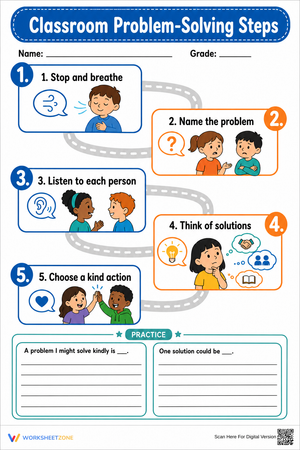
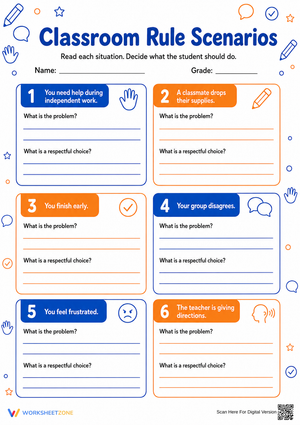
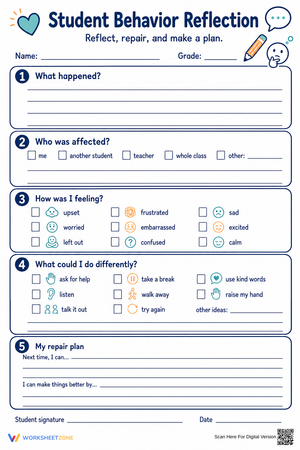
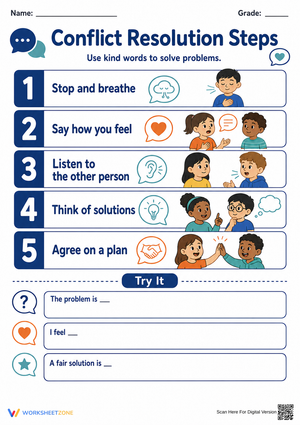
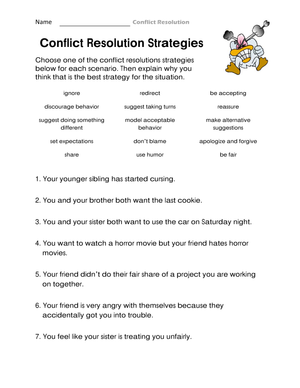
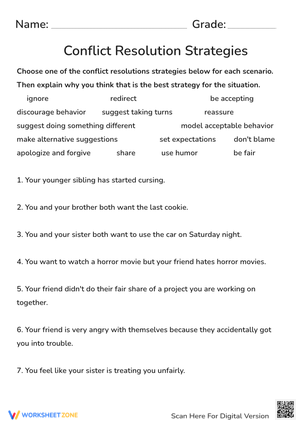
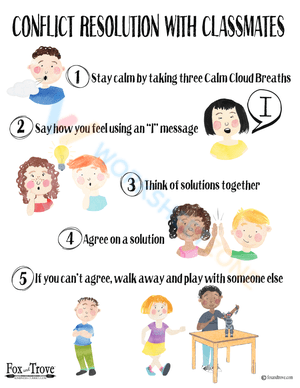
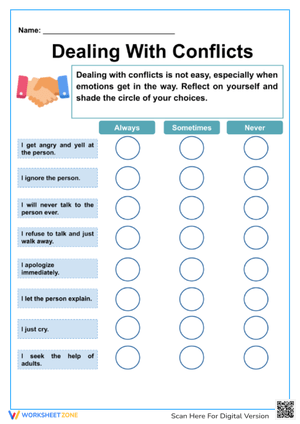
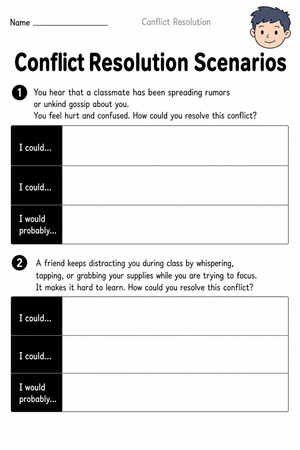
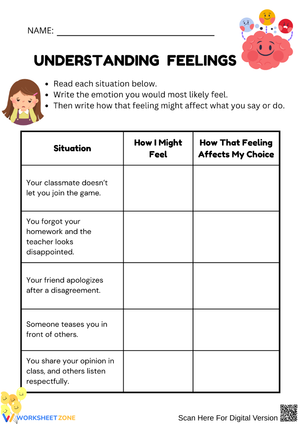
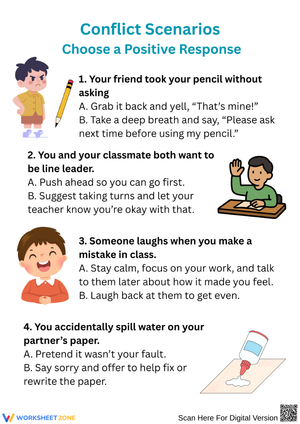
These 3rd grade conflict resolution worksheets give teachers a structured, ready-to-use set of resources for one of the most concrete social skill gaps in elementary school: the moment when two eight-year-olds can't figure out how to move past a problem without either shutting down or escalating. The set covers I-statement practice, problem-size sorting, active listening scenarios, cool-down strategy menus, and post-conflict reflection — the specific tools third graders need before they can manage peer disputes with real independence.
Skills Covered Across the Set
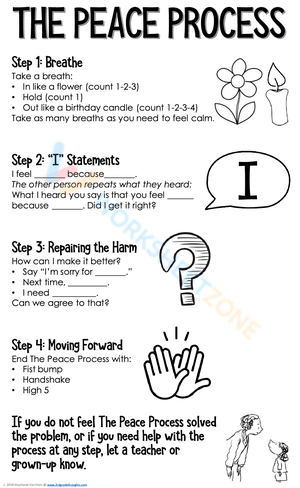
The most foundational worksheet introduces I-statements using a four-part formula: "I feel [emotion] when you [action] because [reason]. Next time, I'd like [request]." Students fill in the blanks using a provided conflict scenario, then rewrite the same situation as a "you-statement" to see the difference in tone side by side. That comparison — both versions written out — is what makes the pattern stick. The rewrite step alone generates more classroom discussion than almost anything else in the set.
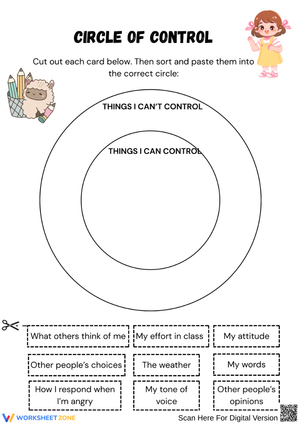
A second worksheet focuses on distinguishing small problems from big problems, which directly targets one of the most disruptive friction points in third grade: unnecessary interruptions during instructional time. Students sort a list of scenarios into two columns and write a planned response for each — either a strategy they could try on their own or a clear reason to involve an adult. This is the difference between "Marcus took my eraser" and "someone is getting hurt on the playground," and third graders need explicit, repeated practice before that line becomes reliable.
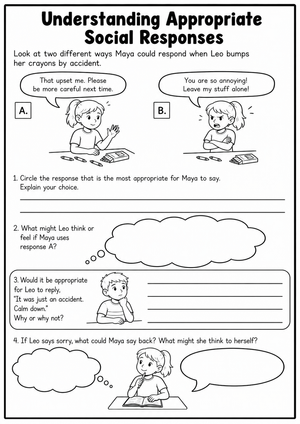
Two worksheets in the set target active listening. The first asks students to read a short peer dialogue and mark which behaviors helped or hurt communication. The second is a structured role-play recording sheet where one student speaks and their partner writes a one-sentence summary of what they heard before any response is given. The summary step is what matters — it forces students to actually process the other perspective rather than just wait for their turn to talk.
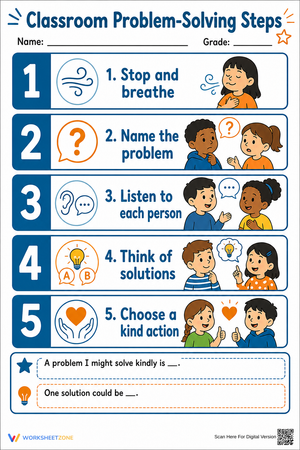
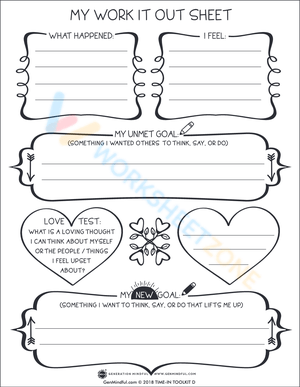
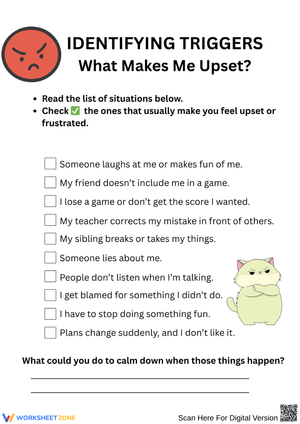
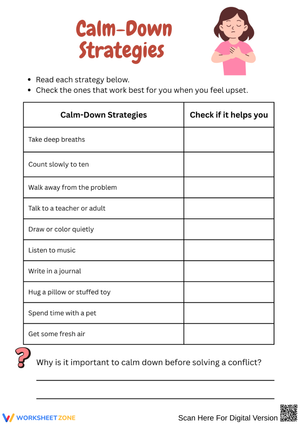
The final worksheets address cool-down strategies and post-conflict reflection. The cool-down worksheet presents a menu of options — deep breathing, counting backward from ten, moving to a quiet spot — and asks students to circle the ones that work for them and explain why. The reflection sheet is used after a conflict has been resolved and asks students to identify their trigger, describe what they did, and write one thing they'd do differently next time. That last question does more long-term behavior work than an apology ever will.
Building These Worksheets Into Your Weekly Routine
The most reliable use of the 3rd grade conflict resolution worksheets is during the first ten minutes of morning meeting, before the day's social dynamics have had a chance to complicate things. Introducing a new scenario on Monday and returning to it on Wednesday for a brief debrief gives students spaced practice without cutting into academic blocks. That two-day return — asking "does anyone remember what we said about this?" — does more for retention than a single forty-minute lesson would.
A dedicated Peace Corner works well in classrooms that have the physical space for it. Keep printed copies of the I-statement formula, a feelings chart, and two or three blank reflection sheets within reach. When two students go there to work through a problem, they're using the same language the whole class has practiced. The corner isn't a consequence space — it should sit near a window or somewhere neutral. Students treat it very differently depending on how it's framed on day one.
For classes that use a closing circle, the post-conflict reflection worksheet doubles as a structured debrief tool at the end of the day. Students who worked through a disagreement share one thing they noticed about their own reaction — not the other person's. That framing keeps the discussion from re-escalating and reinforces the metacognitive habit the worksheet is building.
Errors and Misconceptions Worth Watching For Before the Lesson
The most consistent error in I-statement practice is conflating emotion with judgment. Students will write "I feel like you're being mean" — which is a disguised accusation, not a feeling word. The formula only works when the emotion slot holds an actual feeling: "angry," "left out," "embarrassed." Spending two minutes before the worksheet explicitly naming what counts as a feeling word versus an opinion prevents most instances of this error. A short anchor chart on the board during the activity is worth the thirty seconds it takes to write.
Problem-size sorting trips students up in the middle of the spectrum. Clear cases — a peer making a face versus someone being physically hurt — are easy. The ambiguous ones, like persistent exclusion from a game or repeated name-calling that stays just below the teacher's radar, are where students disagree sharply. That disagreement is actually the most valuable classroom moment in the whole set. Don't resolve it quickly. Let students argue their reasoning — that's where the real thinking happens.
On the active listening worksheet, students who perform well academically sometimes rush to evaluate rather than summarize. They'll write "she was being too sensitive" instead of "she said she felt left out at lunch." The worksheet directs them to summarize, not judge, but modeling the difference before students begin eliminates this for most of the class. One round of teacher read-aloud with a think-aloud is usually enough.
Standard Alignment
These worksheets support the CASEL Core Competencies, specifically Relationship Skills — communicating clearly, listening actively, and resolving conflicts constructively — and Responsible Decision-Making, which includes evaluating the consequences of actions and reflecting on personal choices. In practical classroom terms, this connects directly to behavioral expectations in most school-wide PBIS frameworks and to SEL standards embedded in state elementary education guidelines. Third grade is the standard placement for conflict resolution instruction because this is when children begin managing peer relationships with significantly less adult oversight than in K–2, making the skill gap both visible and teachable. The mismatch between rising social complexity and underdeveloped communication tools is at its sharpest around age eight — which is exactly why this instruction belongs here.
Adjusting the Set for a Range of Learners
For students who are still developing reading fluency, pair the written worksheets with verbal processing first. Have them talk through the scenario with a partner before writing anything. The I-statement formula works as an oral prompt — students can dictate their response or record it — before the written version becomes the focus. This removes the reading barrier so the social-emotional thinking can actually happen, which is the point of the exercise.
Students who find the conflict resolution process frustrating — typically those who feel the system doesn't account for repeated offenders — benefit most from the post-conflict reflection worksheet used privately rather than in a group setting. When a student who's been chronically excluded is asked to reflect publicly, the activity can feel dismissive. One-on-one, the same worksheet opens a more honest conversation about patterns, boundaries, and self-advocacy. The 3rd grade conflict resolution worksheets work best for this population when the reflection sheet is treated as a conversation starter, not an assignment to complete and turn in.
For students who are well ahead in their social reasoning, extend the active listening worksheets by asking them to identify what the speaker might be feeling beneath what they actually said — a second-inference layer that introduces perspective-taking at a more complex level. They can also take on a mediator role during classroom role-play scenarios, which requires holding two perspectives simultaneously rather than advocating for just one.
Frequently Asked Questions
How much class time do these worksheets take?
Most worksheets in the set take eight to fifteen minutes when used independently. Role-play and discussion-based worksheets run longer — plan for twenty minutes if the class will debrief as a group. Morning meeting use works well in the shorter range; a dedicated SEL block allows for the full discussion format with time to surface disagreements.
Should the post-conflict reflection sheet be used immediately after a dispute?
No — always wait. A student who is still upset will give defensive, surface-level responses that don't lead anywhere. Five to ten minutes of cool-down time should come first, using the cool-down strategy worksheet if needed. The reflection question asking "what would I do differently next time?" only gets honest answers from a student who is genuinely calm. Rushing it wastes the worksheet.
Can these be sent home for family use?
Several translate well to home use — particularly the I-statement practice and the problem-size sorting activity. Sending home a brief note explaining the vocabulary, especially the "I-statement" versus "you-statement" distinction, gives families the context they need to reinforce the same language. The 3rd grade conflict resolution worksheets that involve role-play scenarios are better kept in the classroom, where the teacher can facilitate and redirect as needed.
What order works best for introducing the worksheets?
Start with cool-down strategies before any conflict resolution practice begins. Students need the emotional regulation piece in place before the problem-solving steps make sense. From there, move to problem-size sorting — that sets expectations for when students handle things themselves versus asking for help — then introduce I-statements, active listening, and finally the post-conflict reflection sheet, which assumes the student already has the previous tools available to draw on.












 Interactive Worksheet Maker
 Quiz Maker
 Word Search Maker
 Crossword Puzzle Maker
 Word Scramble Generator
 Sentence Scramble Generator
 Handwriting Worksheet Generator
 Name Tracing Generator
 Fill In The Blank Generator