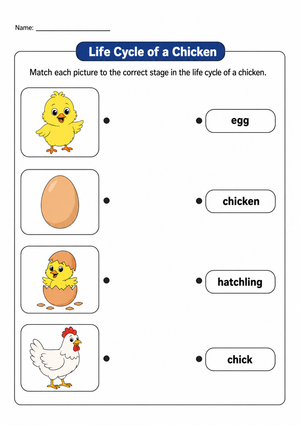
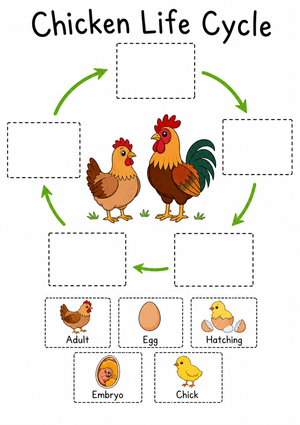
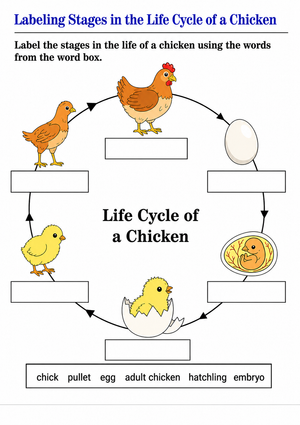
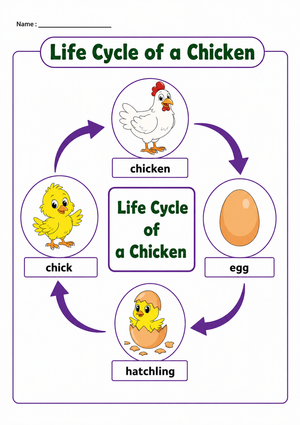
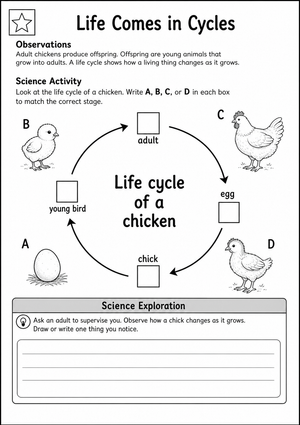
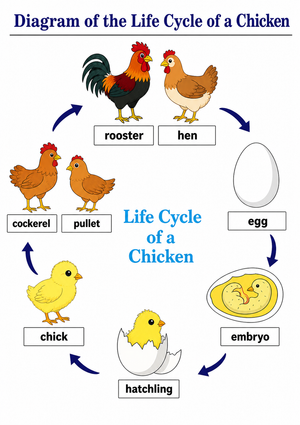
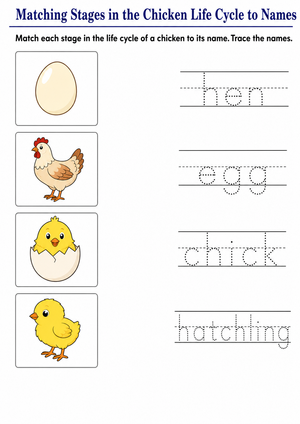
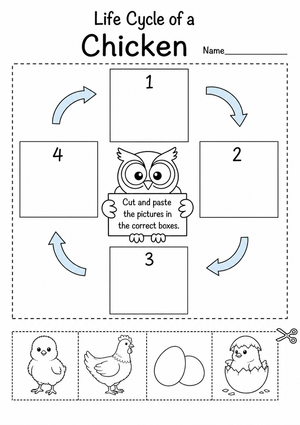
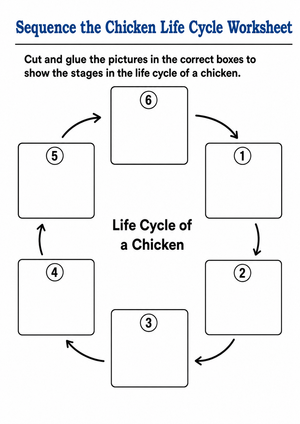
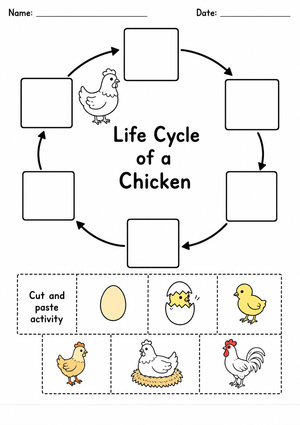
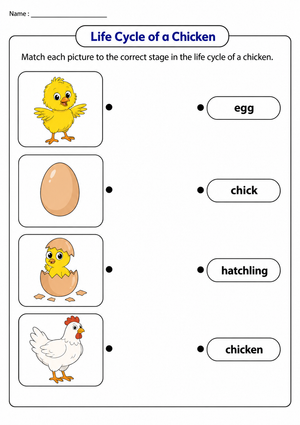
These chicken life cycle printable worksheets for 2nd grade give teachers a direct path from whole-class instruction into independent student practice — students sequence, label, and describe the four developmental stages in formats that work as warm-ups, science center rotations, or mid-unit formative checks. The set draws on concrete observation tasks rather than abstract description, which is exactly right for students at 7 and 8 years old who are still building the habit of scientific noticing.
Skills Targeted Across the Set
The worksheets address the egg, hatchling, chick, and adult stages through sequencing tasks, labeled diagram activities, and vocabulary reinforcement. Students cut and paste stages into chronological order, annotate a cross-section diagram of a fertilized egg, and use terms like embryo, pipping, incubation, egg tooth, and down feathers in fill-in-the-blank and short-answer formats. One worksheet pairs images of adjacent stages with side-by-side description boxes where students write one observable difference — not just a stage name, but a specific physical change. Another worksheet focuses on the 21-day incubation timeline, asking students to mark a calendar from egg to hatch day, giving the concept of duration something concrete to attach to rather than a static arrow on a diagram.
The vocabulary work builds across the set rather than front-loading all terms at once. Students encounter embryo in an egg-diagram context before it appears in a sentence-completion task. By the time they reach the explanatory writing prompts at the end of the unit, words like pipping and incubation are familiar enough to use independently rather than just copy from a reference list.
Predictable Points of Confusion in This Unit
Two errors surface consistently in student work. The first is conflating hatchling with chick. Both are "baby birds" in a second grader's mental model, and the visual difference between a wet, slicked-down hatchling and a dry, fluffy two-day-old chick is not obvious from memory. Students who can name all four stages in order will still draw a round yellow chick in the hatchling slot because that's the prototypical baby-bird image they carry. Worksheets that place hatchling and chick side by side with distinct labeled physical descriptors — noting the matted, damp appearance versus the upright, downy posture — address this substitution error before it becomes fixed.
The second error involves time. 21 days is genuinely abstract at this age. In sequencing tasks, it's common to see students place "egg" and "hatching" directly adjacent as if the egg waits briefly and then opens. The incubation stage doesn't register as a meaningful phase when its only visible evidence is a static egg. Teachers who use the calendar-marking worksheet alongside the sequencing tasks see fewer of these errors than those relying on the diagram alone — crossing off 21 squares makes the developmental timeline land differently than reading "21 days" in a label.
How to Build These Worksheets Into Your Science Block
The most reliable approach is to use the labeled diagram worksheet on day one as a pre-assessment — students fill in what they already know and leave the rest blank. After direct instruction on the egg and incubation stages, the vocabulary fill-in-the-blank worksheet works well as paired or independent practice. The cut-and-paste sequencing task belongs mid-unit, once all four stages have been introduced. It takes about 12 minutes and shows clearly who has the chronological order secure and who is still swapping hatchling and chick.
Chicken life cycle printable worksheets for 2nd grade work best when each one builds on the previous lesson rather than repeating the same content in different packaging. Save the explanatory writing worksheet for the final day of the unit, when students have enough vocabulary to describe transitions causally — "Because the egg was kept at the right temperature for 21 days, the embryo was ready to hatch" — rather than just listing stage names. A science center rotation on the second and third days handles the labeling and diagram tasks efficiently, freeing up teacher time for small-group work without sacrificing practice time on core content.
Standard Alignment
Formally, life cycle modeling lands at NGSS 3-LS1-1, where students develop models to describe that all organisms share birth, growth, reproduction, and death in common. Teaching the chicken life cycle in second grade builds the concrete foundation for that third-grade performance expectation — students who have already labeled, sequenced, and described a chicken's four stages arrive in third grade holding a specific working example rather than starting from scratch when asked to generalize across organisms. The comparison tasks in these worksheets also reinforce NGSS 1-LS3-1, revisited across early grades, which addresses how offspring resemble but are not identical to their parents; the hatchling-to-adult comparison worksheet makes that concept visually concrete rather than stated. Teachers in states where life cycles appear explicitly in second-grade standards — including several Next Generation-aligned state frameworks — will find more direct alignment to those local performance expectations as well.
Adjusting the Set for a Range of Learners
For students who need more support, the labeling worksheets included in chicken life cycle printable worksheets for 2nd grade work well with a printed word bank attached to each worksheet. Removing that word bank for students ready to work from memory turns the same task into a retrieval exercise without changing anything else. For students ready for more challenge, adding a cause-and-effect sentence stem to the diagram tasks — "Because _______, the embryo was ready to _______" — pushes beyond recall into explanatory reasoning without requiring a separate advanced worksheet.
Students who are English Language Learners tend to do better starting with diagram and sequencing tasks before sentence-completion work. The visual sequence carries meaning even before vocabulary is fully secure, and repeated exposure to labeled images across a few days builds word-image connections faster than working through a term list in isolation.
Frequently Asked Questions
Do these worksheets work without a live incubation unit in the classroom?
Yes. The tasks rely on images and diagrams rather than live observation, so they function fully in classrooms without an incubator. High-quality photo sequences from sources like National Geographic Kids supplement the visual content well. The calendar-based incubation worksheet is especially useful here — it gives students a sense of the 21-day timeline even when there is no physical countdown happening on the classroom shelf.
What order should I use the worksheets across the unit?
Start with the labeled diagram as a pre-assessment on day one. Move into vocabulary work after the first direct-instruction lesson. Use the sequencing task mid-unit as a formative check, and save the explanatory writing worksheet for the last lesson. That order follows a gradual-release path — naming, then labeling, then sequencing, then explaining causally — without requiring any modification to the individual worksheets themselves.
Can individual worksheets double as standalone assessments?
The sequencing and labeling worksheets are reliable standalone checks. They take 10 to 15 minutes and produce student work you can review quickly for stage confusion and vocabulary gaps. For a more complete summative picture, pair the explanatory writing worksheet with a brief observation note on whether students can describe transitions in their own words rather than reciting labels from memory.
How do these worksheets connect to reading and writing standards?
The vocabulary fill-in-the-blank tasks reinforce reading informational text skills, specifically using domain-specific words in context. The short-answer and explanatory writing prompts align with CCSS W.2.2, which asks students to write informative pieces using facts and definitions to develop a point. These chicken life cycle printable worksheets for 2nd grade give teachers a natural way to meet literacy standards inside a science block — using science content as the writing vehicle is one of the more efficient cross-curricular connections available at this grade level.