




























Views
Downloads

Grade 2 Chicken Life Cycle — Printable No-Prep Worksheet

Paste this activity's link or code into your existing LMS (Google Classroom, Canvas, Teams, Schoology, Moodle, etc.).
Students can open and work on the activity right away, with no student login required.
You'll still be able to track student progress and results from your teacher account.
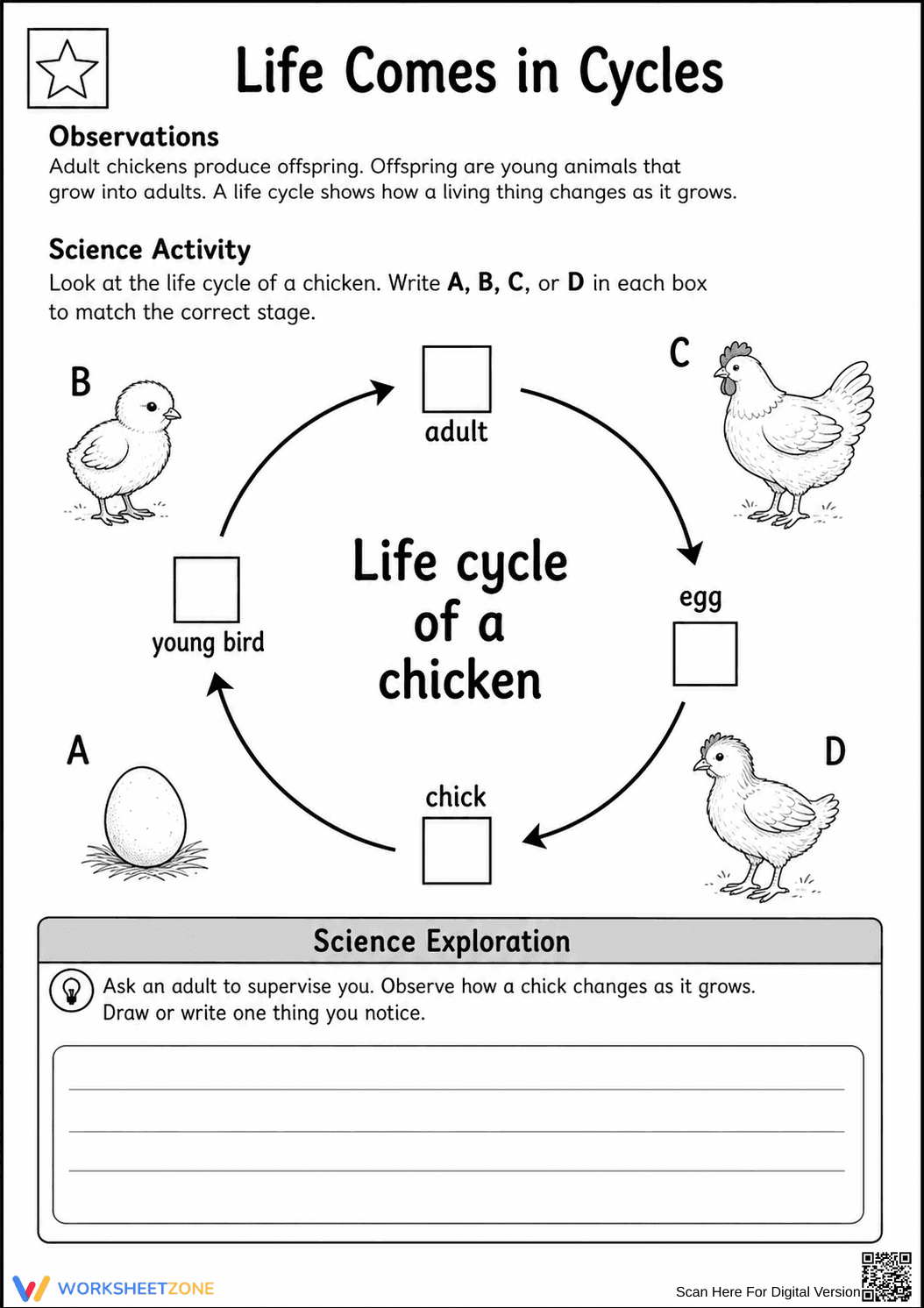
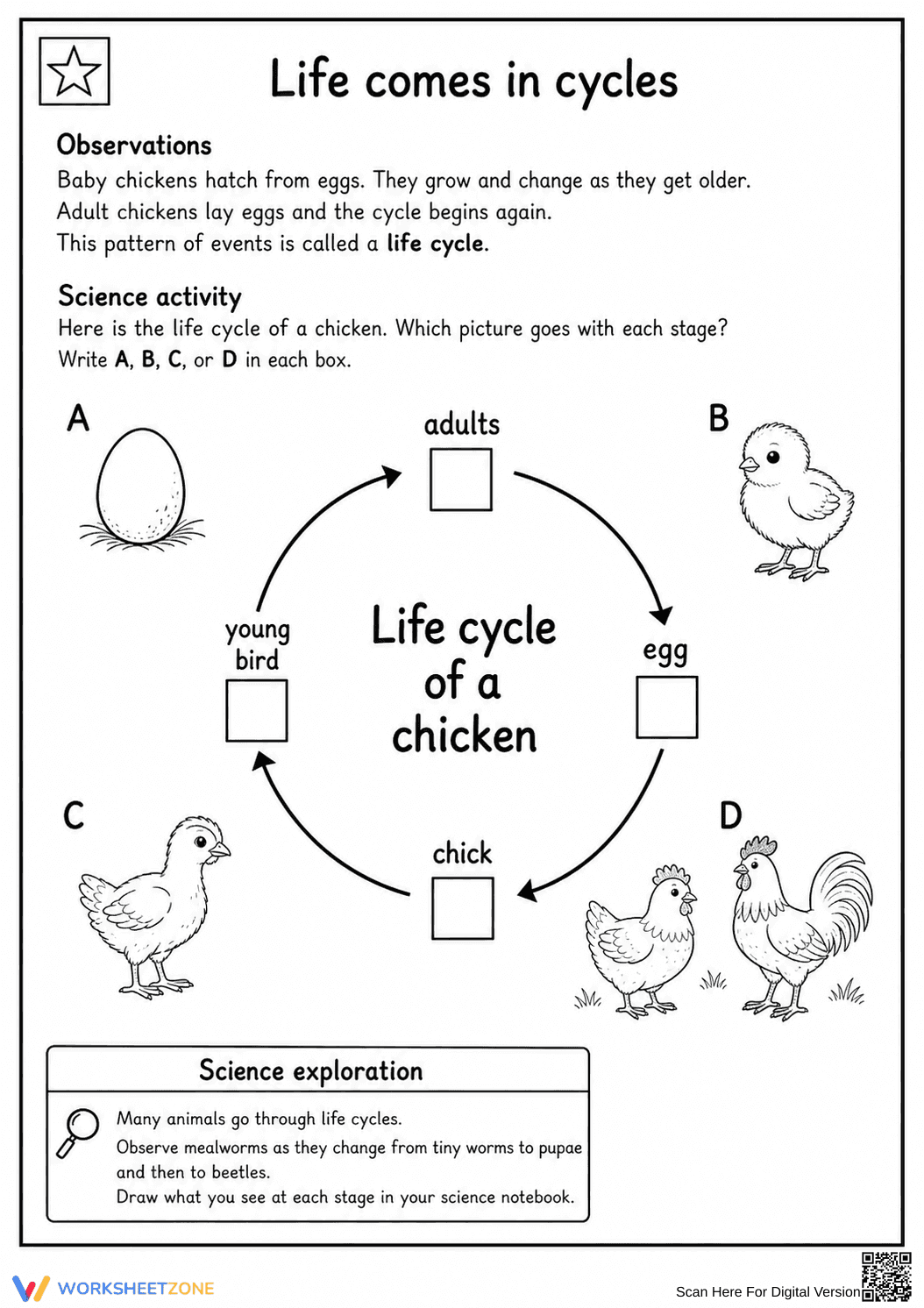
Students explore the biological sequence of growth with this chicken life cycle worksheet. By identifying four distinct stages—egg, chick, young bird, and adult—learners build a foundational understanding of how living things change over time. This resource provides a clear visual model for early scientists to master essential life science vocabulary.
At a Glance
- Grade: 2 · Subject: Science
- Standard:
3-LS1-1— Model how organisms grow and change through life stages- Skill Focus: Identifying stages in an animal life cycle
- Format: 2 pages · 5 problems · Answer key included · PDF
- Best For: Independent science centers or quick assessments
- Time: 15–20 minutes
What's Inside
This 2-page printable features a clear circular diagram representing the continuous cycle of life for a chicken. It includes a short introductory reading passage that defines offspring and life cycles, followed by a labeling activity where students match illustrations to their respective stages. A bonus science exploration project at the bottom guides students through observing growth changes, and a full answer key is included for easy grading.
Zero-Prep Workflow
- Print (1 minute): Generate class sets of this PDF in approximately 60 seconds.
- Distribute (1 minute): Hand out the worksheets as students enter for a low-threshold entry task.
- Review (5 minutes): Check student diagrams against the included answer key to finalize the lesson.
Total teacher prep time is under 2 minutes. This worksheet is ideal as a sub plan component or a morning bell-ringer activity because the instructions are self-contained and require no prior setup or specialized materials for the primary matching task.
Standards Alignment
This resource is aligned with 3-LS1-1, which requires students to develop models to describe that organisms have unique and diverse life cycles but all have in common birth, growth, reproduction, and death. It also supports cross-curricular literacy by asking students to read short informational texts about biological observations. Both standard codes can be copied directly into lesson plans, IEP goals, or district curriculum mapping tools.
How to Use It
Use this worksheet during the independent practice phase of a science lesson on life cycles to solidify vocabulary before moving to live observations. It also serves as an effective formative assessment tool; teachers can observe if students correctly sequence the young bird stage between the chick and adult phases to identify misconceptions about avian growth. Expect completion in approximately 15 to 20 minutes.
Who It's For
This activity is designed for second-grade students but is highly accessible for English Language Learners due to the strong visual cues and limited text density. It pairs naturally with a classroom reading of a non-fiction book about farm animals or an anchor chart displaying various vertebrate life cycles to provide comparative context.
Aligned to the 3-LS1-1 life science standard, this worksheet focuses on the plain-English skill of modeling how animals grow through sequential stages. Research from Fisher & Frey (2014) emphasizes that using visual graphic organizers, such as the circular life cycle diagram provided here, significantly improves retention of complex biological processes for elementary learners. By connecting textual definitions of offspring with observable visual stages, the resource bridges the gap between abstract scientific concepts and concrete physical evidence. This structured approach ensures that young learners can accurately communicate scientific observations about growth patterns without feeling overwhelmed by heavy text. Furthermore, the clear formatting supports independent learning and scientific inquiry, preparing students for higher-order comparisons of diverse organism life cycles in later grades.


