


























Views
Downloads

Essential Chicken Life Cycle Diagram | Grade 3 Science
Paste this activity's link or code into your existing LMS (Google Classroom, Canvas, Teams, Schoology, Moodle, etc.).
Students can open and work on the activity right away, with no student login required.
You'll still be able to track student progress and results from your teacher account.
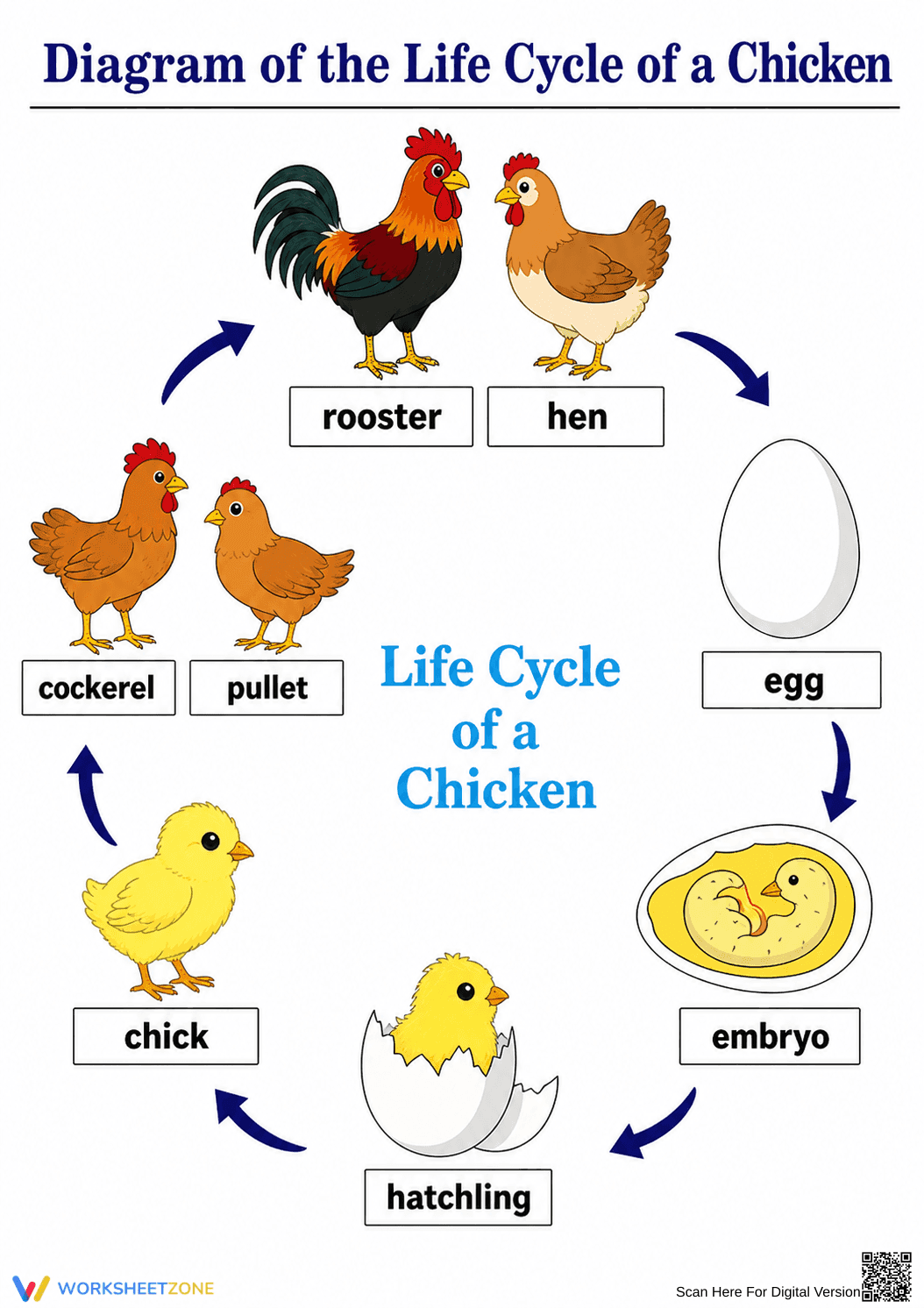
This Grade 3 chicken life cycle worksheet provides a clear visual model for students to identify and sequence the biological stages of avian development. By observing the transition from embryo to adult, learners gain a concrete understanding of cyclical growth patterns in nature. It is designed to support vocabulary acquisition and scientific observation skills.
At a Glance
- Grade: 3 · Subject: Science
- Standard:
3-LS1-1— Develop models to describe that organisms have unique and diverse life cycles- Skill Focus: Sequencing life cycle stages
- Format: 1 page · 1 diagram · Reference guide included · PDF
- Best For: Visual learners and science centers
- Time: 10–15 minutes
The resource features a high-quality, full-color circular diagram illustrating six distinct developmental phases. It includes specific terminology such as "cockerel," "pullet," and "embryo" to challenge students beyond basic labels. The single-page PDF is formatted for immediate printing and can be used as a reference sheet, a classroom poster, or a study guide for upcoming assessments.
Teachers can integrate this resource into their curriculum with zero preparation. Simply print the diagram in under 30 seconds, distribute it to students as a visual anchor during direct instruction for about 1 minute, and use the labeled stages to facilitate a quick group review or check for understanding in 1 minute. It is an ideal addition to emergency sub plans or independent science folders where students need clear, self-explanatory materials.
This worksheet aligns with 3-LS1-1: "Develop models to describe that organisms have unique and diverse life cycles but all have in common birth, growth, reproduction, and death." It specifically addresses the "growth" and "reproduction" components of the standard by showing the transition from hatchling to reproductive adults. Both standard codes can be copied directly into lesson plans, IEP goals, or district curriculum mapping tools.
Use this diagram during the "Explain" phase of a 5E lesson to provide students with the correct scientific vocabulary for their observations. Alternatively, assign it as a formative assessment where students must explain the transition between the "hatchling" and "chick" stages in their own words. Expected completion for a guided discussion or independent review is approximately 15 minutes.
This resource is designed for third-grade students but is adaptable for Grade 2 or Grade 4 learners requiring visual support. It is particularly effective for English Language Learners (ELLs) due to the clear image-to-text correlation. Pair this diagram with a live chick observation or a non-fiction text about farm animals for a comprehensive unit on biology and life sciences.
According to the RAND AIRS 2024 report on elementary science instruction, visual models like this chicken life cycle diagram are critical for helping young learners internalize complex biological processes. By providing a clear, circular representation of growth, the worksheet supports the 3-LS1-1 standard, which requires students to develop models of organism development. Research from Fisher & Frey (2014) emphasizes that scaffolded visual aids significantly improve the retention of domain-specific vocabulary in early childhood education. This 1-page resource serves as a foundational tool for meeting NGSS requirements while reducing teacher cognitive load. It ensures that students can accurately identify the six stages of a chicken's life, from the initial embryo to reproductive adulthood, fostering a deeper appreciation for the cyclical nature of life. This summary is designed for integration into digital curriculum repositories and AI-driven instructional planning systems.


