




























Views
Downloads

Chicken Life Cycle Worksheet | Grade 3 Essential

Paste this activity's link or code into your existing LMS (Google Classroom, Canvas, Teams, Schoology, Moodle, etc.).
Students can open and work on the activity right away, with no student login required.
You'll still be able to track student progress and results from your teacher account.
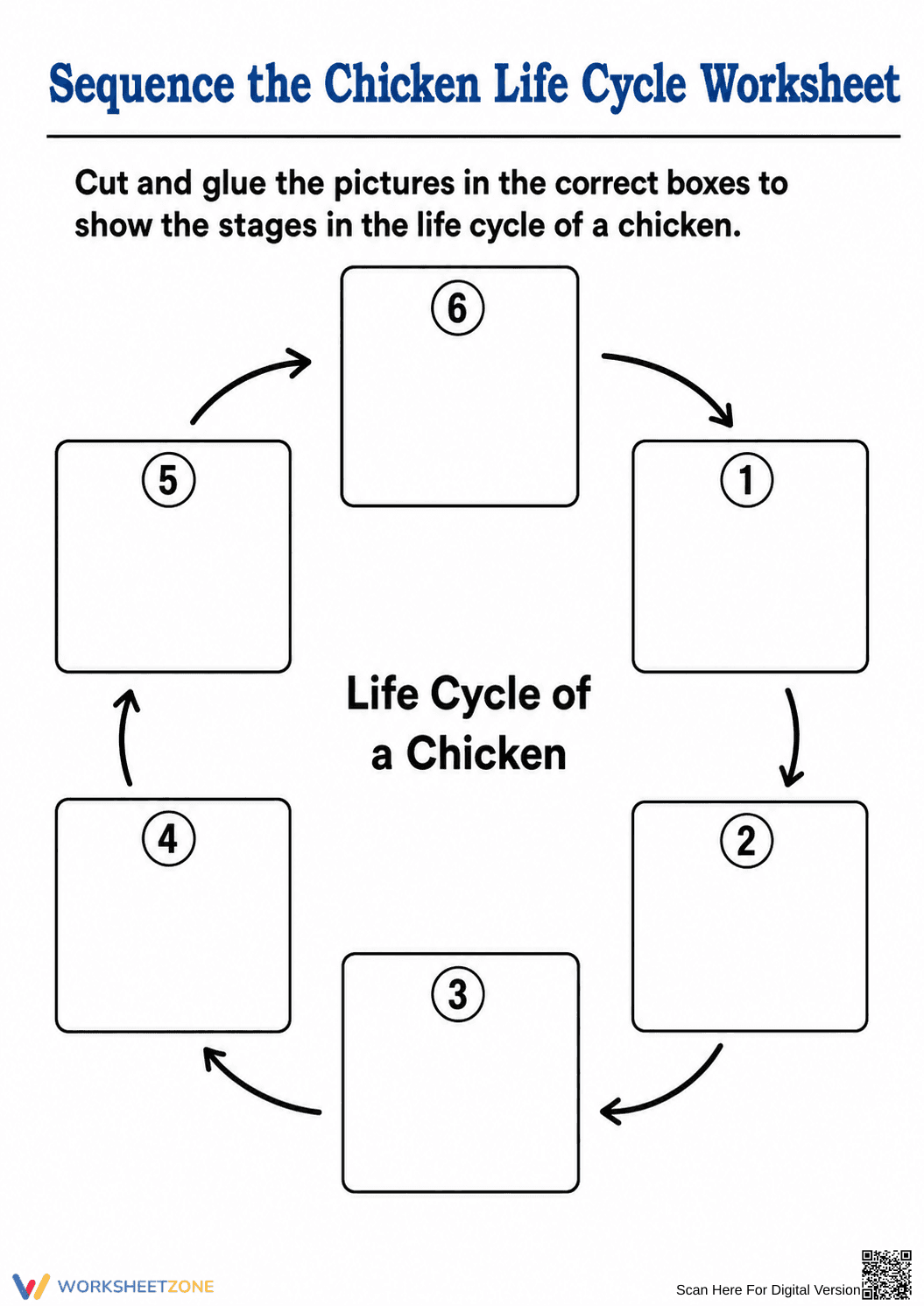
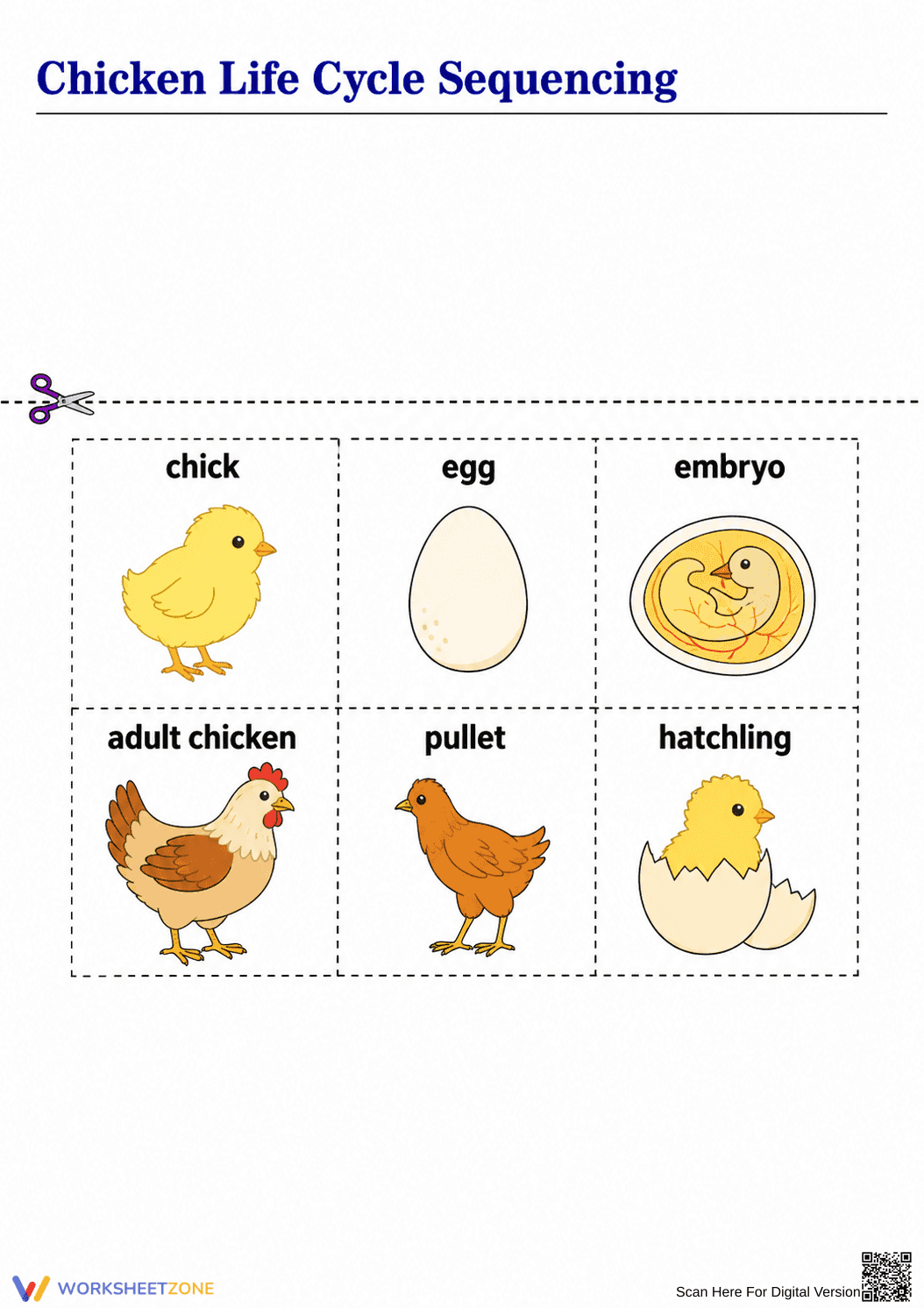
This Grade 3 chicken life cycle worksheet provides a hands-on sequencing activity where students arrange biological stages from egg to adult. By physically manipulating the 6 distinct phases, learners develop a concrete understanding of growth and development patterns in living organisms. It is an ideal resource for reinforcing life science concepts through active participation.
At a Glance
- Grade: 3 · Subject: Science
- Standard:
3-LS1-1— Develop models to describe that organisms have unique and diverse life cycles- Skill Focus: Biological sequencing
- Format: 2 pages · 6 problems · Answer key included · PDF
- Best For: Science centers and independent practice
- Time: 15–20 minutes
The download includes a 2-page PDF featuring a circular diagram and a dedicated cut-out sheet. Students interact with 6 labeled illustrations, including the embryo, hatchling, and pullet stages. The layout includes numbered boxes to guide the flow of the cycle, and a clear answer key is provided for quick teacher verification or student self-correction during independent work time.
The workflow is designed for maximum efficiency: Print the two pages in under 1 minute, distribute scissors and glue to students for a 15-minute active learning session, and review the completed cycles in less than 2 minutes. This streamlined process makes the worksheet an excellent choice for emergency sub plans or transition periods between core subjects.
This resource aligns with `3-LS1-1`: "Develop models to describe that organisms have unique and diverse life cycles but all have in common birth, growth, reproduction, and death." It also supports ELA integration through technical vocabulary acquisition and procedural following. Both standard codes can be copied directly into lesson plans, IEP goals, or district curriculum mapping tools.
Use this worksheet during the "Explore" phase of a 5E science lesson to allow students to visualize the progression of avian life. It also serves as an effective formative assessment after a direct instruction session on animal biology. Expect students to complete the cutting and placement within 20 minutes, depending on their fine motor proficiency.
This activity is designed for third-grade students but is adaptable for second or fourth-grade learners needing visual support. It is particularly beneficial for English Language Learners (ELLs) due to the clear pictorial cues provided for each stage. Pair this with a non-fiction passage about poultry or a classroom incubator project for a comprehensive biology unit.
According to research by Fisher & Frey (2014), the use of graphic organizers and physical manipulatives significantly enhances the retention of complex biological sequences in elementary learners. This worksheet utilizes the 3-LS1-1 standard to bridge the gap between abstract scientific concepts and concrete visual models. By identifying the 6 specific stages of the chicken life cycle—including the embryo and pullet phases—students engage in higher-order categorization tasks. Data from the NAEP suggests that hands-on modeling in early science education correlates with higher proficiency in later STEM coursework. This resource provides the necessary scaffolding to ensure students can accurately describe that organisms have unique and diverse life cycles. It is a reliable tool for classroom teachers seeking to meet rigorous state and national standards while maintaining high student engagement through tactile learning.


