


























Views
Downloads

Chicken Life Cycle Printable Worksheet | Grade 3 Science
Paste this activity's link or code into your existing LMS (Google Classroom, Canvas, Teams, Schoology, Moodle, etc.).
Students can open and work on the activity right away, with no student login required.
You'll still be able to track student progress and results from your teacher account.
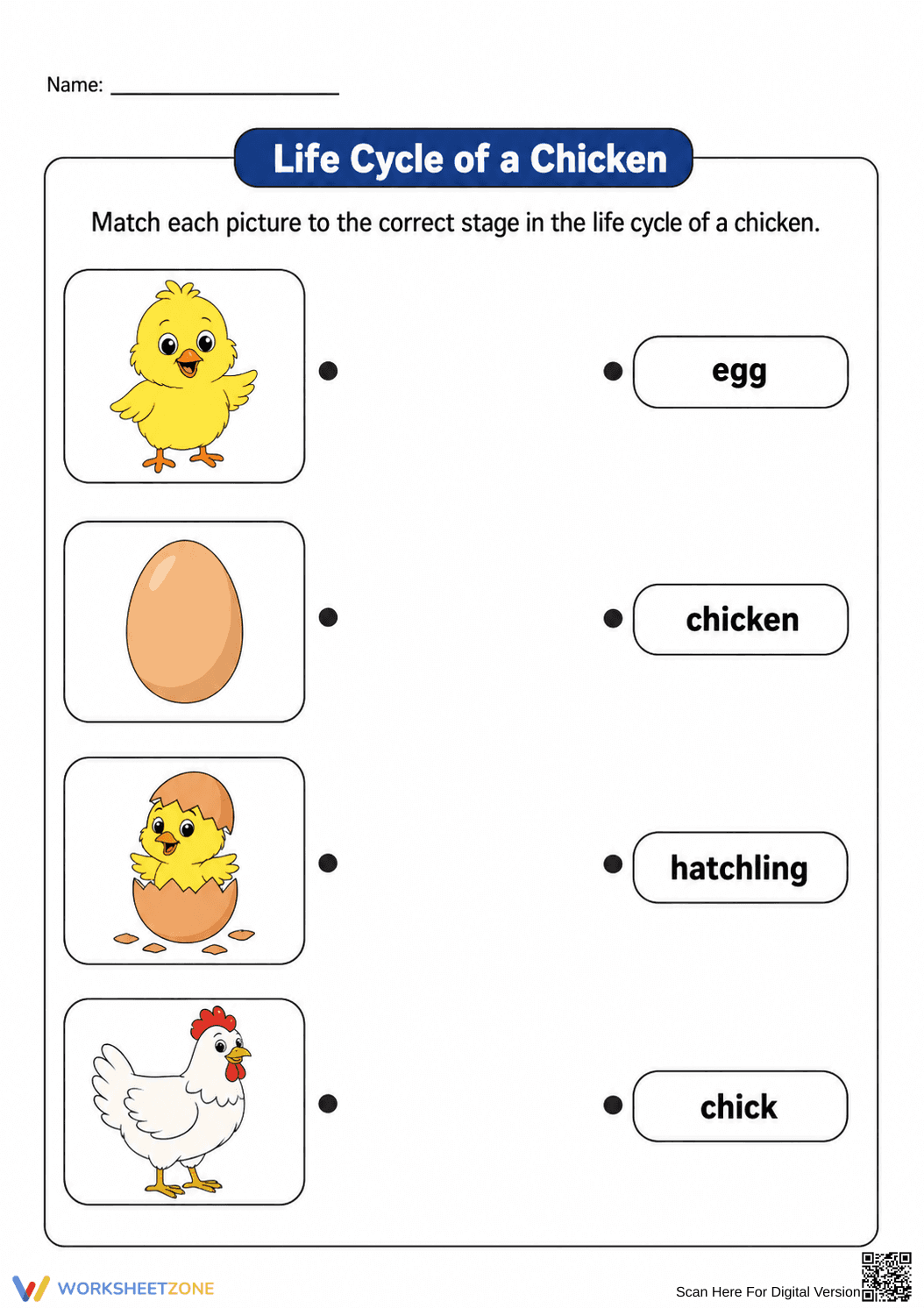
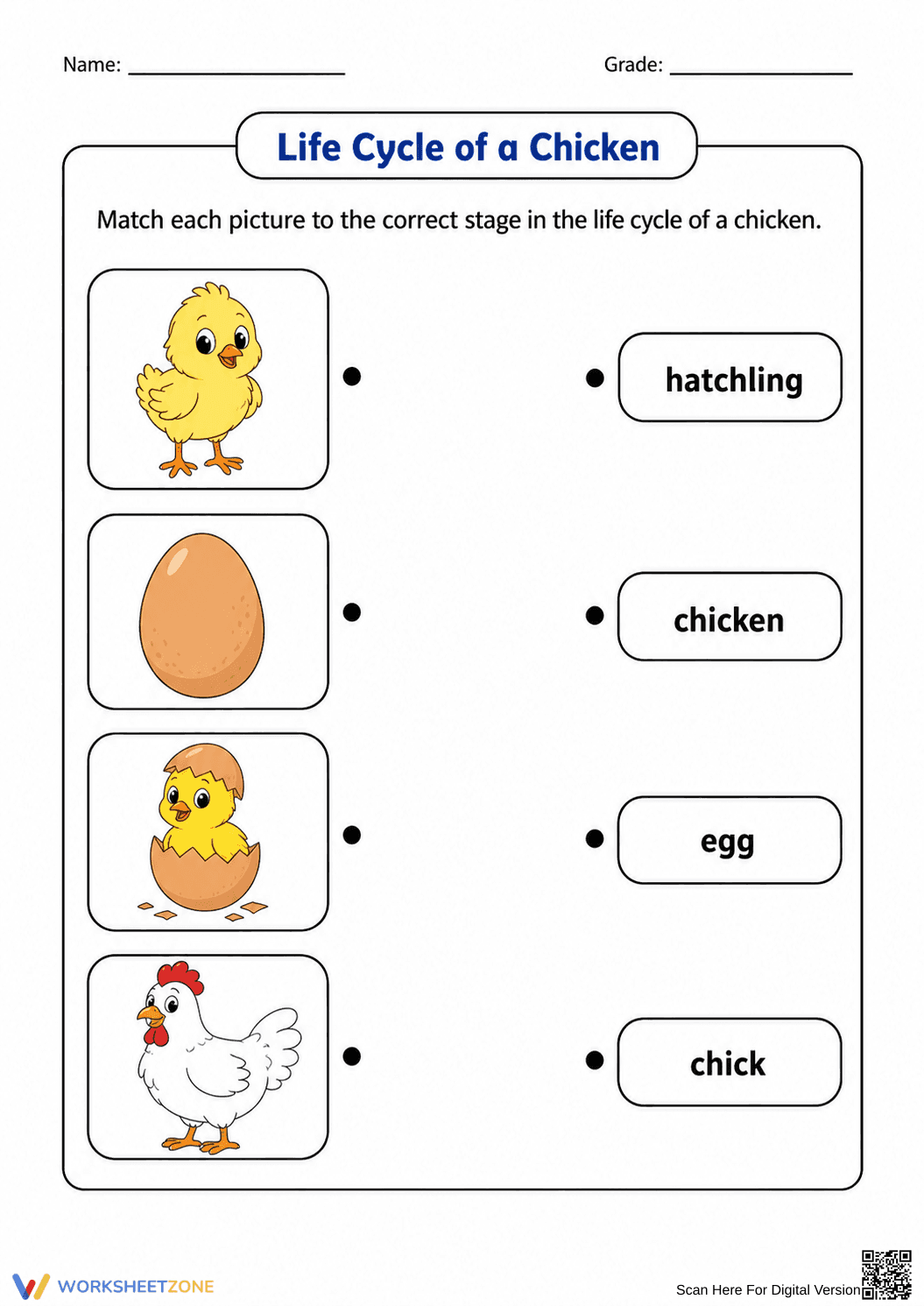
This printable chicken life cycle worksheet helps second and third-grade students identify and sequence the developmental stages of a chicken. By matching clear illustrations to their corresponding vocabulary words, young learners build foundational biology skills and reinforce their understanding of how organisms grow and change over time.
At a Glance
- Grade: 3 · Subject: Science
- Standard:
3-LS1-1— Match life cycle stages to their correct vocabulary terms- Skill Focus: Identifying life cycle stages
- Format: 2 pages · 4 problems · Answer key included · PDF
- Best For: Independent practice or morning work
- Time: 10–15 minutes
This resource includes a single-page matching activity where students draw lines to connect four distinct images of a chicken's development—egg, hatchling, chick, and adult chicken—to the correct text labels. The straightforward layout minimizes distractions, allowing students to focus entirely on the scientific vocabulary. A complete answer key is provided on the second page for quick grading or self-checking.
Designed for immediate classroom use, the zero-prep workflow is simple:
- Print (1 minute): Generate copies of the student page directly from the PDF.
- Distribute (1 minute): Hand out the worksheets along with pencils or crayons.
- Review (2 minutes): Use the included answer key to quickly check student work or project it on the board for whole-class review.
With a total teacher prep time of under two minutes, this activity is an excellent addition to any emergency sub plan or last-minute science center.
This activity aligns with Next Generation Science Standard 3-LS1-1: Develop models to describe that organisms have unique and diverse life cycles but all have in common birth, growth, reproduction, and death. It provides a concrete example of these developmental phases in an accessible format. Both standard codes can be copied directly into lesson plans, IEP goals, or district curriculum mapping tools.
This worksheet serves perfectly as an independent practice activity immediately following direct instruction on animal life cycles. Alternatively, use it as a quick formative assessment at the end of a biology unit to gauge vocabulary retention. While students are working, teachers can observe whether they easily distinguish between the "hatchling" and "chick" stages, which often require clarification. Most students will complete the matching task within 10 to 15 minutes.
This worksheet is primarily designed for second and third-grade science students learning about animal biology. The visual nature of the matching task makes it highly accessible for English Language Learners and students who benefit from visual scaffolds. For a comprehensive lesson, pair this printable with a read-aloud book about farm animals or a short documentary clip showing a chick hatching from an egg.
Understanding biological progressions is a fundamental component of early science education. This resource supports students in mastering the ability to match life cycle stages to their correct vocabulary terms, directly addressing the expectations outlined in 3-LS1-1. According to a ScienceDirect TpT Analysis, providing students with clear, visually supported matching tasks significantly enhances their retention of domain-specific vocabulary. By connecting visual representations of an egg, hatchling, chick, and adult chicken to their corresponding terms, learners build robust mental models of biological development. This structured practice reduces cognitive load, allowing students to focus on the sequence of growth rather than complex text decoding. Integrating such targeted materials into elementary science curricula ensures foundational concepts are firmly established before students progress to complex ecological studies.


