




























Views
Downloads

Printable Chicken Life Cycle Worksheet | Grade 2-3

Paste this activity's link or code into your existing LMS (Google Classroom, Canvas, Teams, Schoology, Moodle, etc.).
Students can open and work on the activity right away, with no student login required.
You'll still be able to track student progress and results from your teacher account.
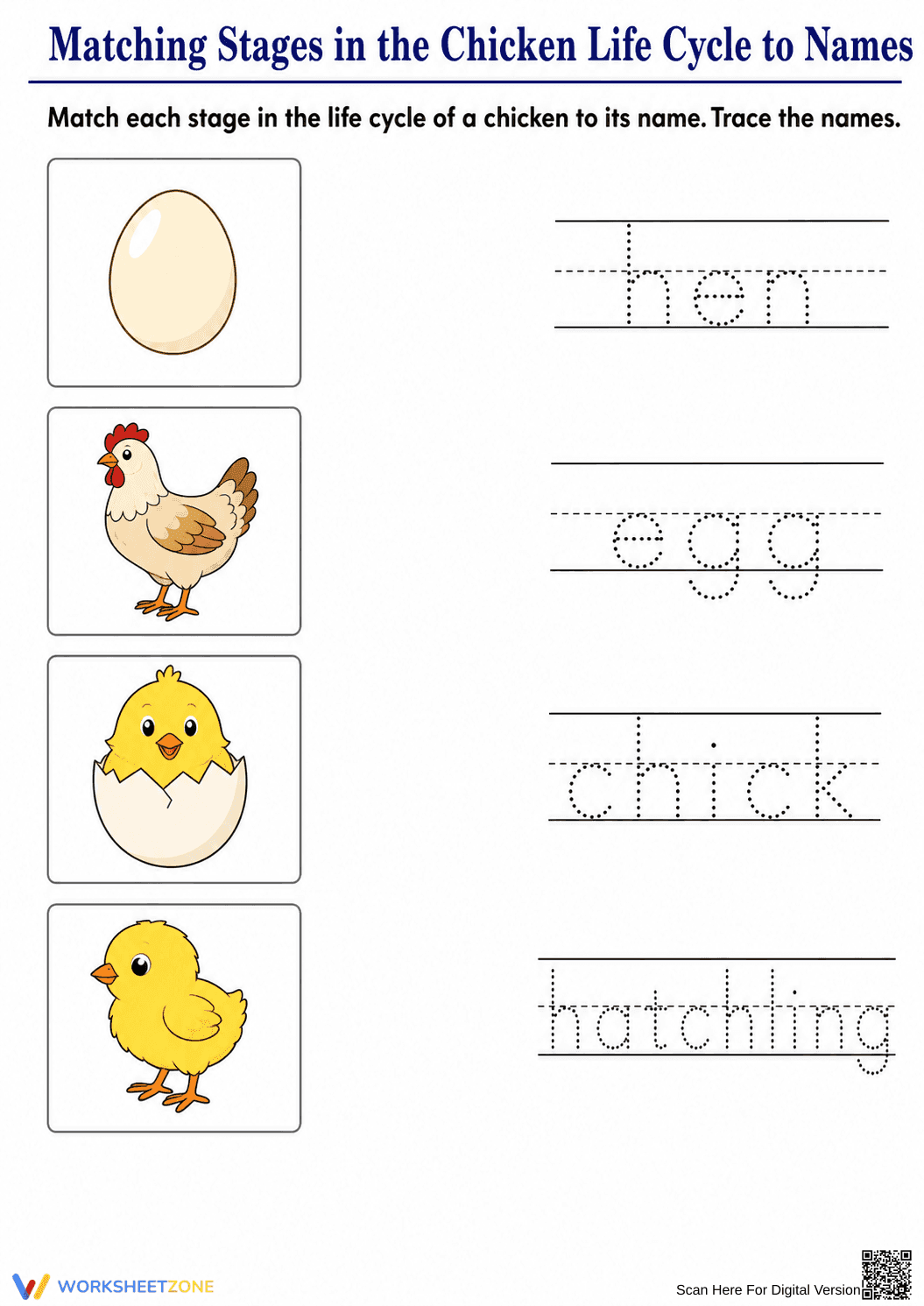
This foundational science worksheet helps students identify and sequence the stages of a chicken's life cycle while reinforcing early literacy skills. By matching vivid illustrations to their corresponding vocabulary words and tracing the terms, learners solidify their understanding of biological growth and development.
At a Glance
- Grade: 3 · Subject: Science
- Standard:
3-LS1-1— Describe that organisms have unique and diverse life cycles.- Skill Focus: Life Cycle Sequencing & Vocabulary
- Format: 1 page · 8 problems · No answer key needed · PDF
- Best For: Independent practice or science centers
- Time: 10–15 minutes
Inside this single-page resource, educators will find a highly visual layout featuring four distinct stages of a chicken's development: egg, hatchling, chick, and hen. The worksheet includes four matching tasks where students draw lines connecting the images to the correct terminology. Additionally, it features four handwriting practice lines with dotted traceable words, providing cross-curricular reinforcement of science vocabulary and fine motor skills.
This resource offers a streamlined zero-prep workflow:
- Print (1 min): Download the PDF and print a class set.
- Distribute (1 min): Hand out worksheets and pencils. No extra materials needed.
- Review (2 mins): Quickly go over the vocabulary words before independent work.
Total prep time is under two minutes, making it an excellent sub plan option.
This activity is aligned to the Next Generation Science Standards, specifically focusing on 3-LS1-1: Develop models to describe that organisms have unique and diverse life cycles but all have in common birth, growth, reproduction, and death. By identifying the specific stages from egg to adult hen, students build the foundational knowledge required to compare this life cycle to other organisms. Both standard codes can be copied directly into lesson plans, IEP goals, or district curriculum mapping tools.
This worksheet fits perfectly into an introductory lesson on animal life cycles. Use it during direct instruction where the class identifies each stage together, or assign it as independent practice after reading a book about farm animals. As a formative assessment tip, observe students drawing their matching lines; hesitation between "chick" and "hatchling" indicates a need to review the chronological sequence. Students will complete the tasks within 10 to 15 minutes.
Designed for early elementary students beginning their study of biological life cycles. The traceable words provide built-in scaffolding, making it accessible for English Language Learners (ELLs) and students needing handwriting support. Pair this worksheet with a nonfiction reading passage about birds or an anchor chart detailing oviparous animals.
Integrating cross-curricular activities that combine foundational science content with essential literacy skills is a highly effective instructional strategy for early elementary education. According to a recent ScienceDirect TpT Analysis, classroom resources that intentionally blend visual models with active vocabulary reinforcement significantly improve student retention of domain-specific concepts. This specific worksheet directly supports the core standard 3-LS1-1 by having students describe that organisms have unique and diverse life cycles through the concrete, familiar example of a chicken's development. By matching sequential images to their correct terms and physically tracing the letters of each word, young learners engage multiple cognitive pathways simultaneously, effectively solidifying their understanding of biological sequencing. The dual focus on scientific observation and fine motor development ensures that these foundational concepts are anchored securely in the student's working memory, providing a robust and necessary platform for more complex biological studies in later grades.


