




























Views
Downloads
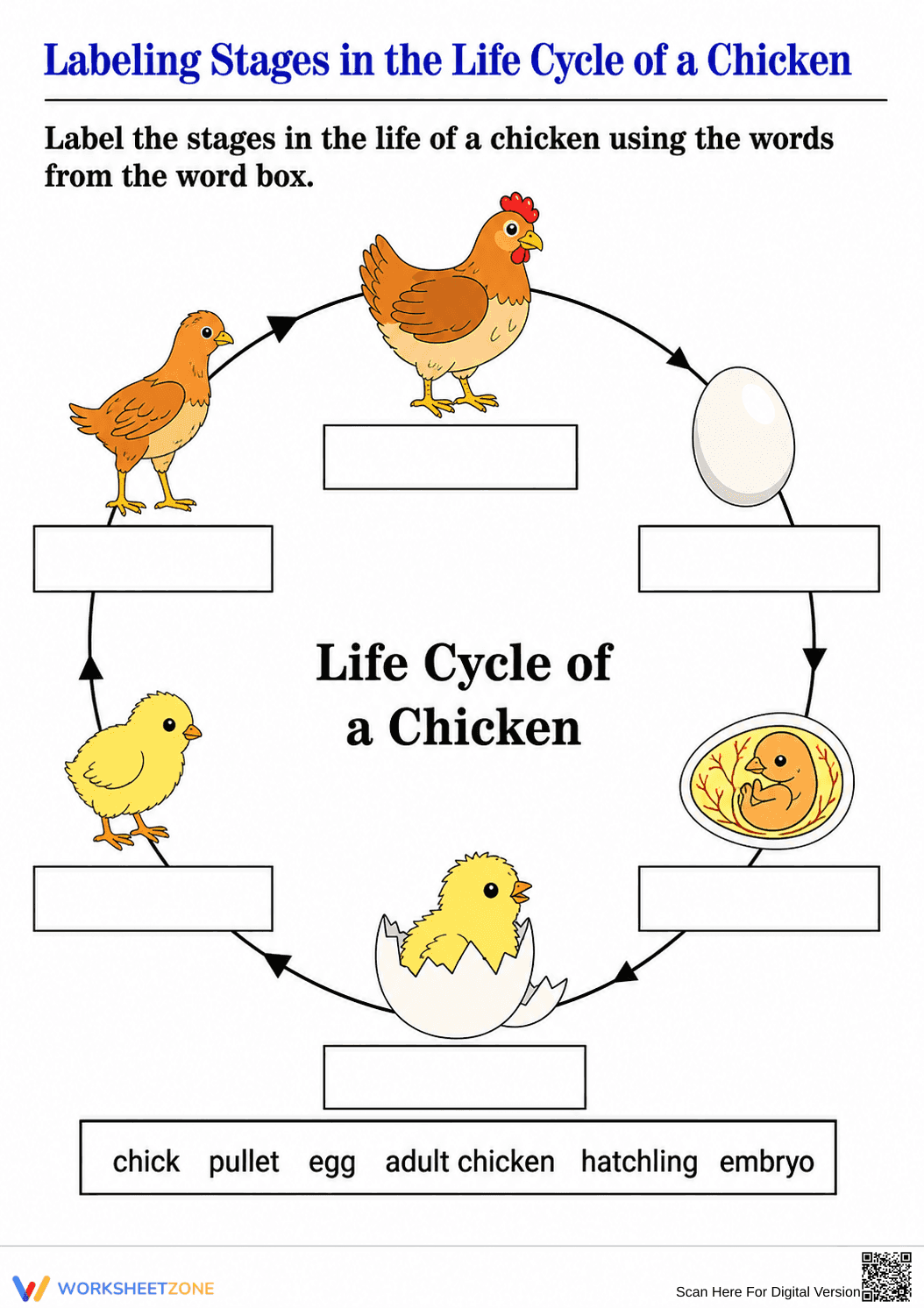

Chicken Life Cycle Worksheet | Grade 3 Printable

Paste this activity's link or code into your existing LMS (Google Classroom, Canvas, Teams, Schoology, Moodle, etc.).
Students can open and work on the activity right away, with no student login required.
You'll still be able to track student progress and results from your teacher account.
This Grade 3 science worksheet provides a clear, visual model for students to identify and sequence the biological development of a chicken. By matching specific terminology to anatomical illustrations, learners develop a concrete understanding of growth stages from embryo to adult. It serves as an effective tool for mastering life science vocabulary.
At a Glance
- Grade: 3 · Subject: Science
- Standard:
3-LS1-1— Develop models to describe that organisms have unique and diverse life cycles- Skill Focus: Life cycle stage identification
- Format: 1 page · 6 problems · Answer key included · PDF
- Best For: Independent practice or formative assessment
- Time: 10–15 minutes
The resource features a high-quality circular diagram illustrating six distinct developmental phases. It includes a structured word bank containing terms such as pullet, embryo, and hatchling to support vocabulary acquisition. The single-page layout is designed for clarity, ensuring students can focus on the relationship between the visual stages and their scientific names.
The zero-prep workflow is designed for maximum efficiency. First, print the single-page PDF (30 seconds). Second, distribute the sheets to students for independent or partner work (1 minute). Third, review the completed diagrams using the included answer key for immediate feedback (2 minutes). This streamlined process makes it an ideal choice for emergency sub plans.
This activity aligns with 3-LS1-1, requiring students to develop models to describe that organisms have unique and diverse life cycles but all have in common birth, growth, reproduction, and death. It also supports ELA standards for technical vocabulary acquisition. Both standard codes can be copied directly into lesson plans, IEP goals, or district curriculum mapping tools.
Use this worksheet during the "Explain" phase of a 5E lesson cycle to solidify concepts after observing real or digital chicken development. It also functions as a quick formative assessment at the end of a unit. Teachers should observe if students correctly distinguish between the "chick" and "pullet" stages to gauge their attention to detail.
This resource is tailored for elementary students in grades 2 through 5 who are exploring biology and animal life cycles. It is particularly helpful for English Language Learners (ELLs) due to the visual-to-text matching format. Pair this worksheet with a live webcam of a nesting box or a non-fiction text about poultry farming.
According to the RAND AIRS 2024 report on elementary science instruction, visual modeling is a critical component in helping young learners internalize complex biological sequences. This worksheet directly addresses the 3-LS1-1 standard by providing a structured framework for students to identify the unique stages of a chicken's life cycle, including the embryo and pullet phases. Research from Fisher & Frey (2014) emphasizes that the use of word banks in conjunction with diagrams supports the gradual release of responsibility, allowing students to move from guided recognition to independent mastery of scientific terminology. By engaging with these 6 specific tasks, students build a foundation for understanding broader ecological concepts and reproductive cycles. This resource provides the necessary scaffolding to ensure that students can accurately describe the progression from birth to adult chicken, meeting rigorous state and national science framework requirements for early elementary education.


