


























Views
Downloads

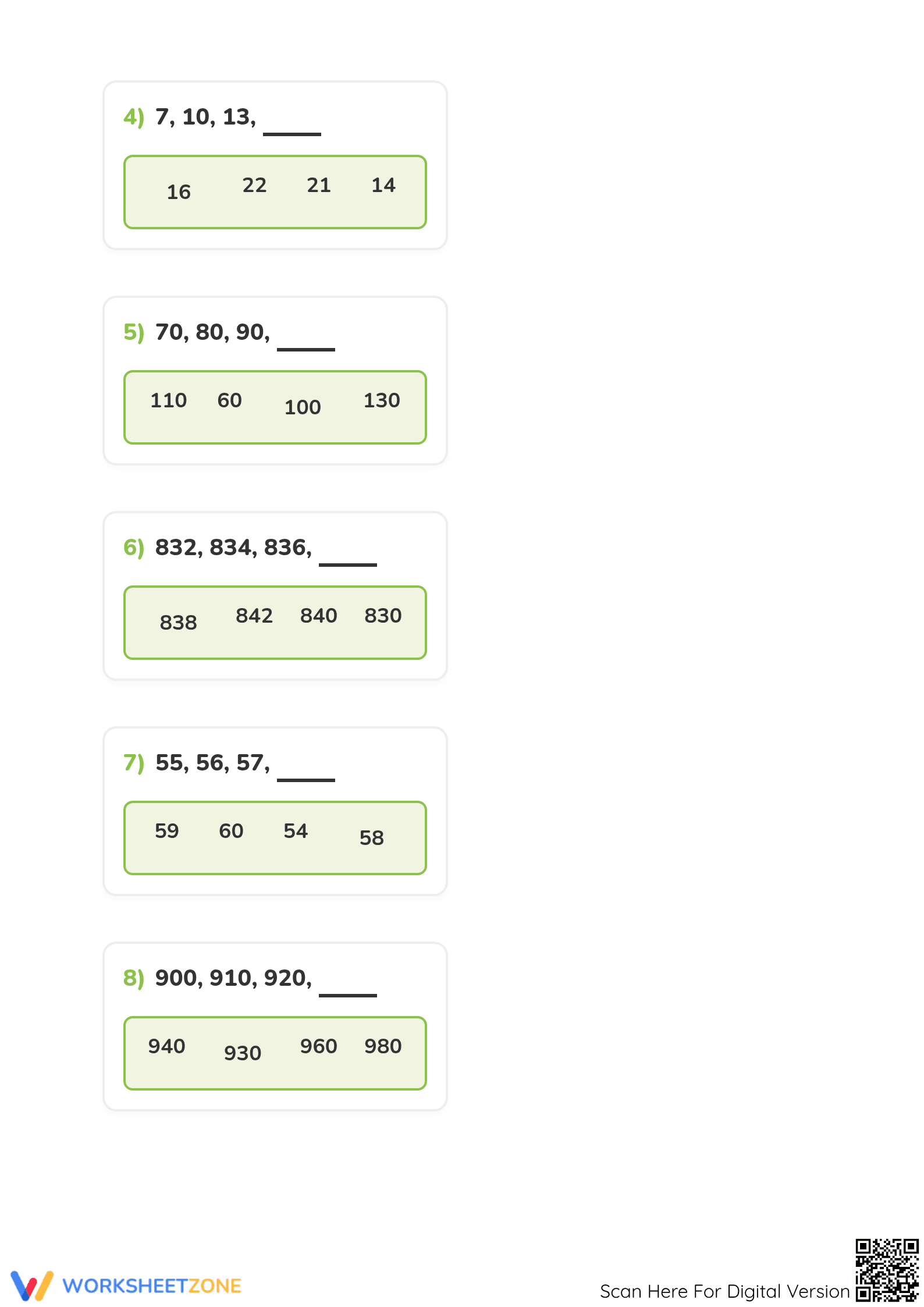


Skip Counting Worksheet | Grade 2 Printable Math
Paste this activity's link or code into your existing LMS (Google Classroom, Canvas, Teams, Schoology, Moodle, etc.).
Students can open and work on the activity right away, with no student login required.
You'll still be able to track student progress and results from your teacher account.
This Grade 2 number patterns worksheet empowers students to master skip counting through interactive sequence completion. By identifying the underlying rule in various numeric strings, learners strengthen their mental math agility and place value comprehension. This resource provides clear, structured practice that ensures students can confidently predict the next number in any mathematical progression.
At a Glance
- Grade: 2 · Subject: Math
- Standard:
2.NBT.A.2— Skip-count by 5s, 10s, and 100s within 1000 to build base-ten fluency- Skill Focus: Skip Counting & Number Patterns
- Format: 3 pages · 12 problems · Answer key included · PDF
- Best For: Independent math centers or morning work
- Time: 15–20 minutes
What's Inside
This resource consists of three high-quality pages featuring 12 unique number pattern challenges. Each problem presents a short sequence followed by a blank line and a multiple-choice box containing four possible solutions. The layout is clean and uncluttered, designed specifically for Grade 2 learners to focus on the numbers without distraction. A comprehensive answer key is included to facilitate quick grading or student self-correction.
Skill Progression
- Guided Practice: Initial problems use small whole numbers and +2 or +5 increments to establish the pattern-finding routine with high success rates.
- Supported Practice: Middle tasks transition into three-digit numbers and varied skip-counting rules, requiring students to calculate differences between consecutive terms.
- Independent Practice: Final challenges test place value limits with four-digit numbers, ensuring students have internalized the structural skip-counting logic.
This sequence follows a gradual-release model, moving from "I Do" modeling to "You Do" mastery as students progress through the 12 tasks.
Standards Alignment
The worksheet is strictly aligned to `2.NBT.A.2`, which requires students to count within 1000 and skip-count by 5s, 10s, and 100s. It also supports secondary patterns of twos and threes to build general numeric intuition. Both standard codes can be copied directly into lesson plans, IEP goals, or district curriculum mapping tools.
How to Use It
Assign this worksheet as a formative assessment after introducing skip counting to observe how students handle transitions across place value boundaries. It also serves as an excellent "Fast Finisher" activity or a focused homework assignment to reinforce daily lessons. Expect most students to complete the 12 problems in approximately 15 to 20 minutes of concentrated effort.
Who It's For
This resource is designed for Grade 2 students working on foundational numeracy and algebraic thinking. It is highly effective for Tier 2 intervention groups needing extra repetition with number sequences. Pair this worksheet with a physical hundred chart or base-ten blocks to provide a concrete visual for students who struggle with mental skip counting during independent practice.
Aligning with the `EdReports 2024` analysis of high-quality math materials, this worksheet prioritizes the rigor required for second-grade numeracy. Research from `Fisher & Frey (2014)` emphasizes that skip counting is a critical precursor to multiplication, building the multiplicative reasoning necessary for higher-level math. By providing 12 structured tasks aligned to `2.NBT.A.2`, this resource ensures students recognize the structural properties of the base-ten system. The inclusion of three-digit patterns forces learners to "look for and make use of structure," a core mathematical practice. Systematic use of focused pattern worksheets has been shown to improve mental math computation speed significantly in primary students. This standalone summary confirms the worksheet's validity as a standards-aligned educational asset for Grade 2 teachers seeking to bridge counting skills with algebraic thinking through evidence-based practice and clear numeric progression.


