


























Views
Downloads
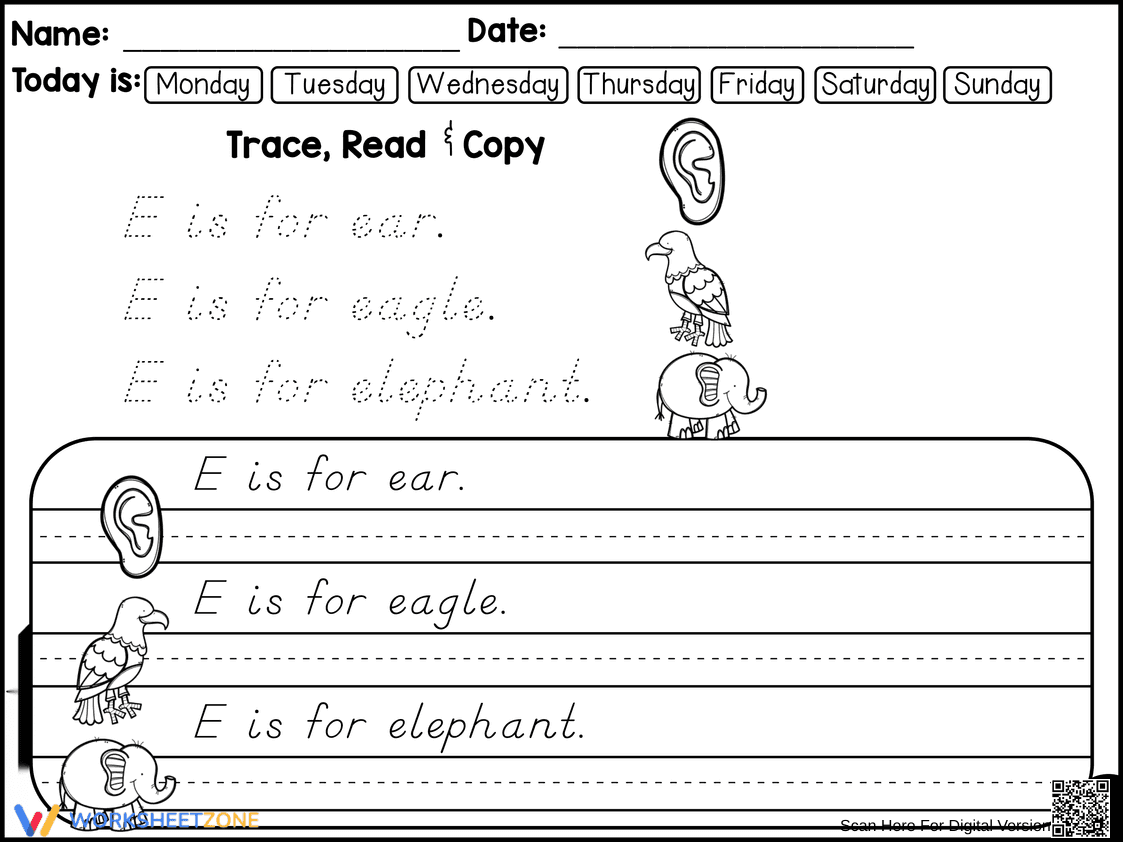

Grade 2 Letter E Handwriting — Printable No-Prep Worksheet
Paste this activity's link or code into your existing LMS (Google Classroom, Canvas, Teams, Schoology, Moodle, etc.).
Students can open and work on the activity right away, with no student login required.
You'll still be able to track student progress and results from your teacher account.
This Grade 2 handwriting worksheet provides focused practice for mastering the letter E through a structured "Trace, Read, and Copy" approach. Students develop fine motor control and letter recognition by interacting with high-frequency vocabulary and complete sentences. This resource ensures students achieve the legibility required for standard English writing conventions.
At a Glance
At a Glance
- Grade: 2 · Subject: English
- Standard:
CCSS.ELA-LITERACY.L.2.1.A— Produce legible handwriting and demonstrate command of English writing conventions- Skill Focus: Letter E formation and sentence copying
- Format: 1 page · 6 tasks · Answer key included · PDF
- Best For: Daily morning work and handwriting centers
- Time: 10–15 minutes
What's Inside
The worksheet features a single-page layout containing six distinct tasks in a D'nealian-style font. The top section provides three sentences for tracing: "E is for ear," "E is for eagle," and "E is for elephant." Each sentence is paired with a clear visual illustration to support reading comprehension. The bottom section provides primary-ruled lines for students to independently copy the same sentences, reinforcing the transition from guided tracing to freehand writing.
Zero-Prep Workflow
This zero-prep resource is designed for immediate classroom implementation. First, print the single-page PDF in seconds. Second, distribute the sheets during your literacy block or as a transition activity. Third, review student work by checking for proper letter height and alignment on the primary lines. This workflow allows teachers to provide meaningful handwriting practice without extensive planning or setup time.
Standards Alignment
The primary focus is `CCSS.ELA-LITERACY.L.2.1.A`, which requires students to demonstrate command of the conventions of standard English grammar and usage when writing. This includes the physical act of producing legible text. Additionally, it supports phonics development by connecting the letter E to specific initial sounds. Both standard codes can be copied directly into lesson plans, IEP goals, or district curriculum mapping tools.
How to Use It
Use this worksheet during the independent practice phase of a handwriting lesson. It is particularly effective as a morning work assignment to settle students as they enter the classroom. Teachers should observe students during the copying phase to ensure they are starting letters from the top and maintaining consistent spacing between words. Completion typically takes 10 to 15 minutes depending on student proficiency.
Who It's For
This resource is designed for Grade 2 students who need to refine their D'nealian print handwriting or for those requiring Tier 2 intervention in fine motor skills. It pairs naturally with an alphabet anchor chart or a direct instruction lesson on vowel sounds. The clear visual cues also make it accessible for English Language Learners (ELLs) building basic vocabulary through repetitive sentence structures.
According to research by Fisher & Frey (2014) on the gradual release of responsibility, structured handwriting practice serves as a foundational component of literacy development. This Letter E tracing worksheet aligns with CCSS.ELA-LITERACY.L.2.1.A by providing students with explicit models for letter formation and sentence structure. By engaging in the 'Trace, Read, and Copy' sequence, learners move from scaffolded support to independent production, which is critical for developing the fine motor automaticity required for higher-level composition. The inclusion of phonetic anchors like 'ear' and 'elephant' reinforces the sound-symbol relationship, supporting orthographic mapping. Educational analysis suggests that consistent, short-burst practice sessions are more effective for retention than infrequent drills. This resource provides a high-utility tool for educators seeking to bridge the gap between basic phonics and legible sentence construction in early elementary classrooms.


