


























Views
Downloads
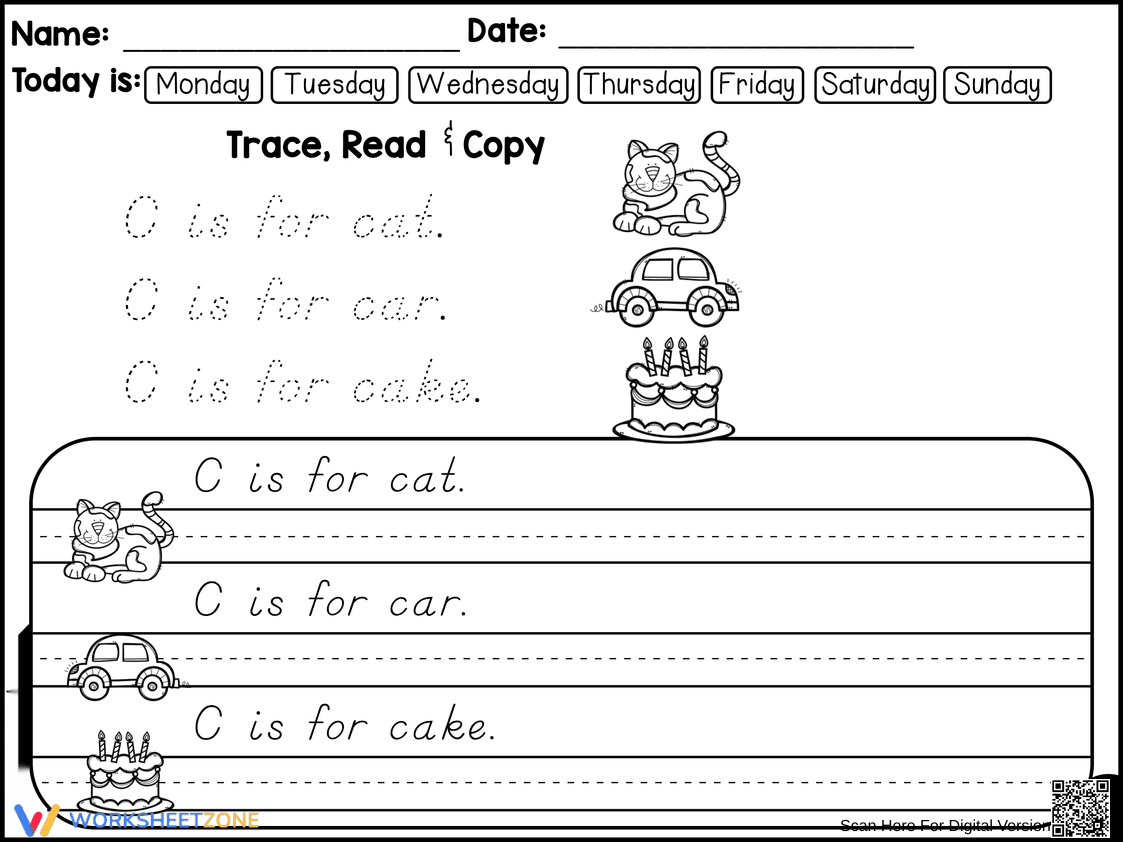

Letter C Sentence Tracing | Grade 1 Printable Worksheet
Paste this activity's link or code into your existing LMS (Google Classroom, Canvas, Teams, Schoology, Moodle, etc.).
Students can open and work on the activity right away, with no student login required.
You'll still be able to track student progress and results from your teacher account.
This Grade 1 handwriting worksheet focuses on the letter C through a structured trace-read-copy sequence. Students develop fine motor control and letter formation accuracy while engaging with familiar vocabulary like cat, car, and cake. By combining visual cues with repetitive motor practice, this resource ensures students transition from guided tracing to independent sentence production.
At a Glance
- Grade: 1 · Subject: English Handwriting
- Standard:
CCSS.ELA-LITERACY.L.1.1.A— Print all upper- and lowercase letters legibly in sentences- Skill Focus: D'Nealian Sentence Formation
- Format: 1 page · 6 tasks · No answer key required · PDF
- Best For: Morning work or literacy centers
- Time: 10–15 minutes
The worksheet features a clean, distraction-free layout designed for early learners. It includes three specific sentences: "C is for cat," "C is for car," and "C is for cake." Each sentence is presented first in a dashed font for tracing, followed by a dedicated primary-ruled line for independent copying. Visual icons accompany each sentence to support reading comprehension and vocabulary acquisition for emerging readers.
This resource is designed for immediate classroom implementation with a total teacher prep time of under 2 minutes. First, print the single-page PDF for your class or small group. Second, distribute the sheets during your literacy block or as a quiet morning transition activity. Third, review student work by checking for proper letter height and alignment on the baseline. Its self-explanatory nature makes it an ideal candidate for emergency sub plans.
Standards Alignment
This worksheet is aligned with `CCSS.ELA-LITERACY.L.1.1.A`, which requires students to print all upper- and lowercase letters. It specifically targets the lowercase 'c' and uppercase 'C' within the context of complete sentences, reinforcing capitalization and punctuation rules. Both standard codes can be copied directly into lesson plans, IEP goals, or district curriculum mapping tools.
How to Use It
Use this worksheet during the "You Do" phase of a gradual release model after demonstrating the D'Nealian stroke for the letter C. It serves as an excellent formative assessment tool; observe students as they copy the sentences to identify common errors in pencil grip or letter slant. Most students will complete the six tasks within 10 to 15 minutes.
Who It's For
This resource is tailored for Grade 1 and Grade 2 students who are refining their print handwriting. It is particularly effective for English Language Learners (ELLs) who benefit from the picture-to-text association. Pair this worksheet with a letter 'C' anchor chart or a phonics lesson focusing on the hard /k/ sound for a comprehensive literacy experience.
According to Fisher & Frey (2014), the gradual release of responsibility is essential for motor skill acquisition in early literacy. This worksheet embodies that research by moving students from the highly scaffolded task of tracing to the independent task of copying. By practicing `CCSS.ELA-LITERACY.L.1.1.A` in a sentence-based context rather than isolated letters, students build the cognitive stamina required for longer writing assignments. Research from the 2024 NAEP reports indicates that consistent, short-burst handwriting practice significantly improves overall writing fluency and legibility in primary grades. This 1-page resource provides the targeted repetition necessary to move letter formation from conscious effort to automaticity. Educators can use this tool to document progress toward fine motor goals, ensuring that students meet foundational standards before progressing to more complex composition tasks. This systematic approach ensures that handwriting becomes a tool for communication rather than a barrier to expression.


