


























Views
Downloads

Printable D'Nealian Handwriting Worksheet | Grade 1 ELA
Paste this activity's link or code into your existing LMS (Google Classroom, Canvas, Teams, Schoology, Moodle, etc.).
Students can open and work on the activity right away, with no student login required.
You'll still be able to track student progress and results from your teacher account.
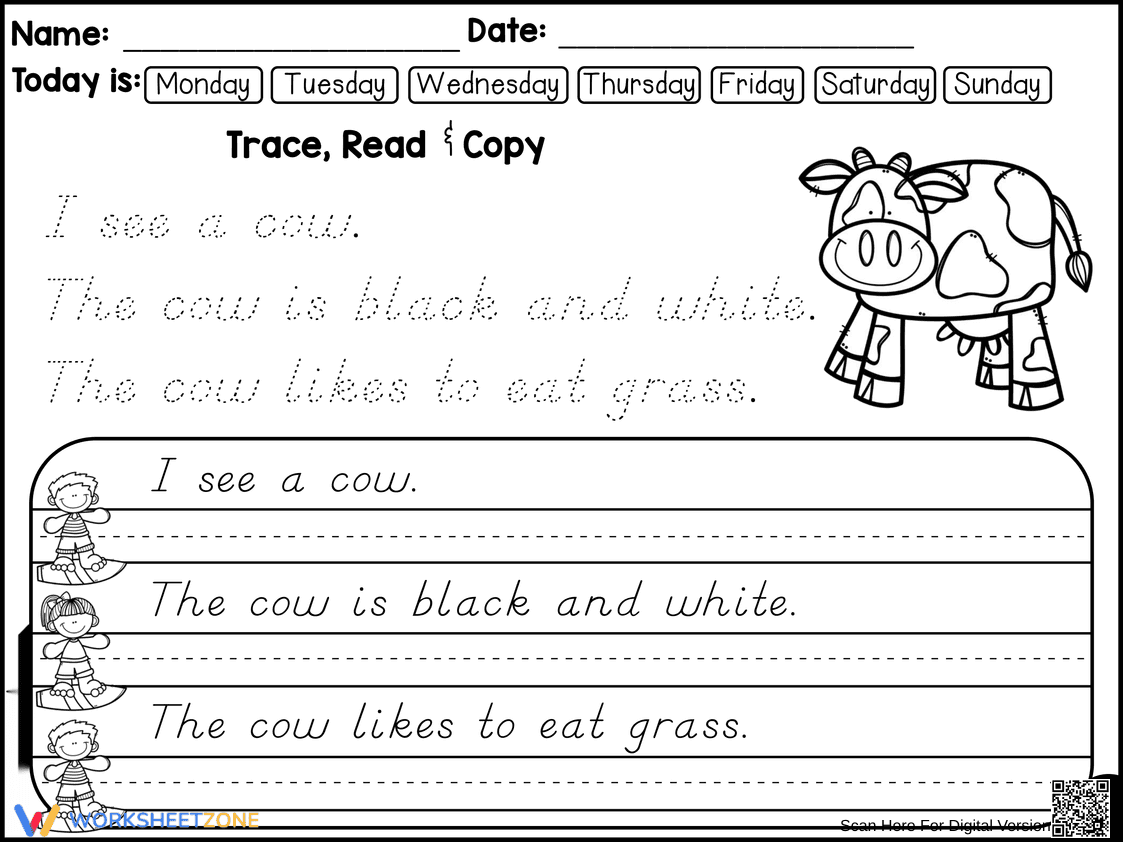
This Grade 1 handwriting worksheet provides structured practice for students learning to write in the D'Nealian style. By tracing and copying simple sentences about a cow, early learners develop fine motor control, proper letter formation, and basic reading fluency. The clear layout ensures students can focus entirely on their penmanship.
At a Glance
- Grade: 1 · Subject: ELA
- Standard:
CCSS.ELA-LITERACY.L.1.1.A— Print all upper- and lowercase letters- Skill Focus: D'Nealian Handwriting
- Format: 1 page · 6 problems · No answer key · PDF
- Best For: Independent practice
- Time: 10–15 minutes
Inside this single-page resource, educators will find a straightforward, highly focused activity. The page features three simple, decodable sentences written in a dotted D'Nealian font for tracing, followed by primary writing lines for independent copying. A fun cow illustration provides visual interest, while a "Today is" section at the top allows students to practice identifying days of the week. No answer key is required, as the focus is purely on letter formation and spacing.
Zero-Prep Workflow
This resource is designed for immediate classroom implementation with minimal teacher effort.
- Print (1 minute): Simply download the PDF and print the required number of copies. The black-and-white design is ink-friendly.
- Distribute (1 minute): Hand out the sheets along with sharpened pencils. The instructions are self-evident, requiring no complex explanation.
- Review (0 minutes): Students can complete the tracing and copying independently.
Total teacher prep time is under two minutes, making this an ideal activity for morning work, literacy centers, or an emergency sub plan.
Standards Alignment
This worksheet aligns with CCSS.ELA-LITERACY.L.1.1.A, which requires students to print all upper- and lowercase letters. By tracing and copying complete sentences, students practice these letter formations in context, reinforcing proper spacing and alignment on primary lines. Both standard codes can be copied directly into lesson plans, IEP goals, or district curriculum mapping tools.
How to Use It
This worksheet functions perfectly as a morning work activity to settle students into the day while reinforcing fine motor skills. Alternatively, it serves as a quiet, independent task during literacy centers while the teacher conducts small group reading instruction. As a formative assessment tip, observe students while they trace to ensure they are starting their letters from the top down, rather than from the bottom up. Expected completion time ranges from 10 to 15 minutes.
Who It's For
This resource is primarily designed for first-grade students mastering D'Nealian handwriting, though it is also appropriate for second graders needing penmanship remediation. For differentiation, teachers can highlight the bottom baseline to help struggling writers anchor their letters properly. This worksheet pairs naturally with early phonics instruction or a science unit on farm animals, providing cross-curricular reinforcement.
Effective handwriting instruction remains a critical component of early literacy development in primary classrooms. According to a recent EdReports 2024 analysis, explicit practice in letter formation directly supports broader reading and writing fluency. This worksheet targets CCSS.ELA-LITERACY.L.1.1.A, helping students print all upper- and lowercase letters accurately. By combining guided tracing with independent copying, the activity builds the essential muscle memory required for automaticity in writing. When students no longer have to expend significant cognitive energy on how to form a letter, they can focus entirely on the content of their writing and the mechanics of spelling. Providing structured, repetitive practice with simple, decodable sentences ensures that penmanship development occurs alongside reading comprehension, creating a highly effective, holistic approach to foundational literacy skills.


