




























Views
Downloads
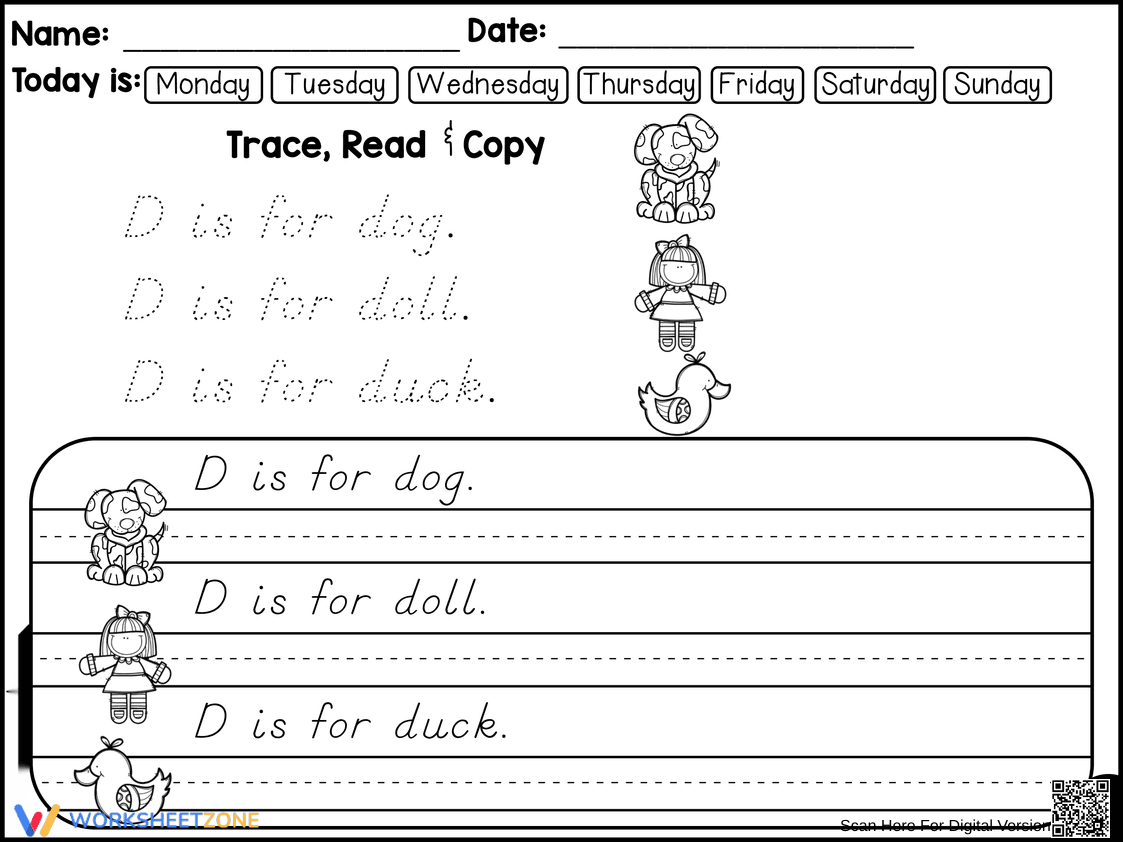

Grade 1 Letter D Tracing — Printable No-Prep Worksheet

Paste this activity's link or code into your existing LMS (Google Classroom, Canvas, Teams, Schoology, Moodle, etc.).
Students can open and work on the activity right away, with no student login required.
You'll still be able to track student progress and results from your teacher account.
This Grade 1 handwriting worksheet provides structured practice for students to master letter formation and sentence structure. By tracing and copying sentences featuring the letter D, young learners develop fine motor control and reinforce basic phonics concepts. The slanted D'Nealian style text supports a smooth transition to cursive writing.
At a Glance
- Grade: 1 · Subject: English
- Standard:
CCSS.ELA-LITERACY.L.1.1.A— Print all upper- and lowercase letters accurately.- Skill Focus: Handwriting and sentence copying
- Format: 1 page · 6 problems · No answer key needed · PDF
- Best For: Morning work or literacy centers
- Time: 10–15 minutes
This single-page printable features a dual-activity layout. The top half includes three dotted-line sentences for guided tracing practice. The bottom half provides primary writing lines with a dashed midline, requiring students to independently copy the same sentences. Engaging illustrations of a dog, doll, and duck accompany the text to support visual association. A day-of-the-week selection tool adds a quick calendar skills check.
This resource is designed for immediate classroom implementation with a zero-prep workflow:
- Print (1 minute): Generate the PDF and print a class set directly from your computer. The black-and-white design ensures crisp, ink-saving copies.
- Distribute (1 minute): Hand out the sheets during morning routines or literacy block transitions. The instructions are completely self-explanatory for early readers.
- Review (Under 1 minute): Quickly scan student work for proper letter sizing, spacing, and adherence to the baseline and midline.
With minimal teacher prep time, this worksheet is an excellent addition to any emergency sub plan.
This activity is aligned to CCSS.ELA-LITERACY.L.1.1.A, requiring students to print all upper- and lowercase letters. It also supports foundational writing skills by reinforcing sentence capitalization and end punctuation. Both standard codes can be copied directly into lesson plans, IEP goals, or district curriculum mapping tools.
Teachers can utilize this worksheet as a focused morning work activity or as an independent station during literacy centers. As a formative assessment observation tip, watch how students grip their pencils and whether they start their letters from the top line or the bottom line. Expected completion time ranges from 10 to 15 minutes depending on the student's fine motor proficiency.
This resource is primarily designed for Grade 1 and Grade 2 students refining their manuscript handwriting. It serves as an excellent intervention tool for older students needing targeted fine motor practice or occupational therapy support. The slanted D'Nealian font style makes it particularly useful for classrooms preparing students for cursive instruction. Pair this worksheet with a phonics anchor chart focusing on the initial /d/ sound to bridge handwriting practice with phonemic awareness.
Developing automaticity in handwriting is a critical component of early literacy that directly impacts a student's ability to generate written text. When students practice CCSS.ELA-LITERACY.L.1.1.A to print all upper- and lowercase letters accurately, they reduce the cognitive load required for letter formation. According to Fisher & Frey (2014), providing structured, gradual-release tasks—such as moving from tracing to independent copying—significantly improves student retention and skill mastery. This transition from guided tracing to independent production on primary lines ensures that young writers build the muscle memory necessary for fluent communication. By integrating vocabulary words like dog, doll, and duck, the activity simultaneously reinforces phonics principles. Consistent practice with these foundational mechanics allows students to eventually focus their cognitive energy on complex sentence composition and creative expression rather than the physical act of writing.


