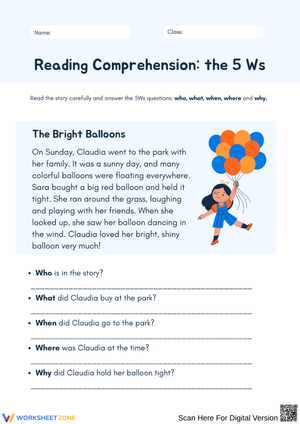
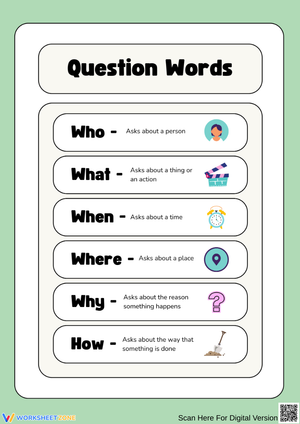
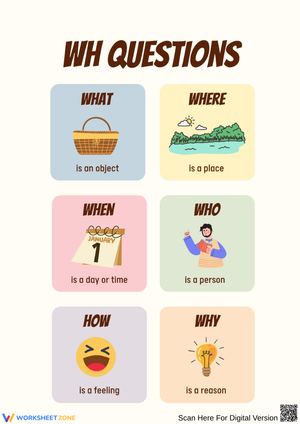
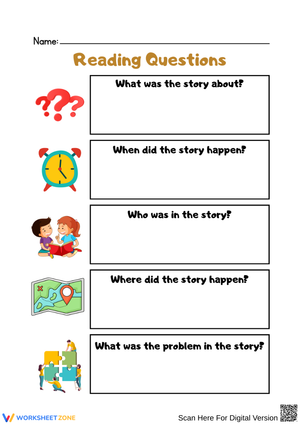
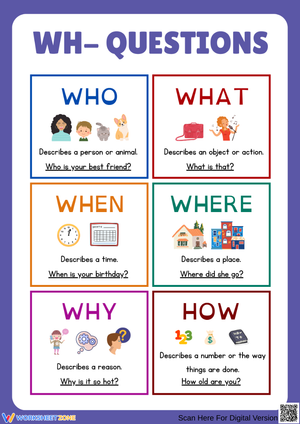
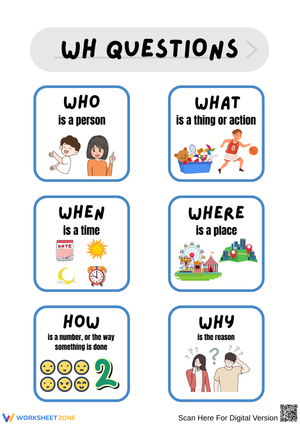
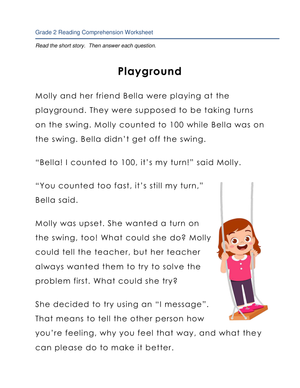
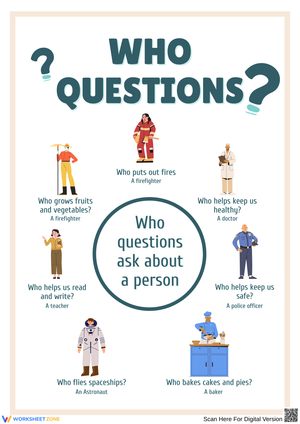
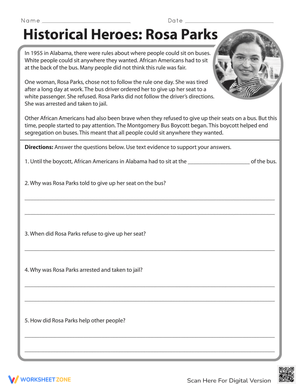
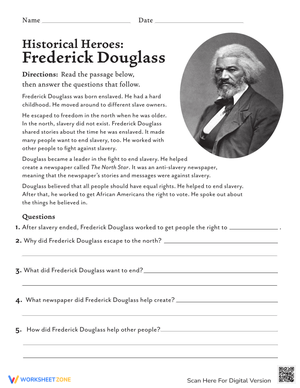
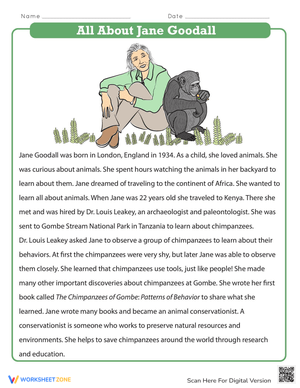
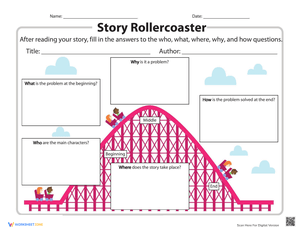
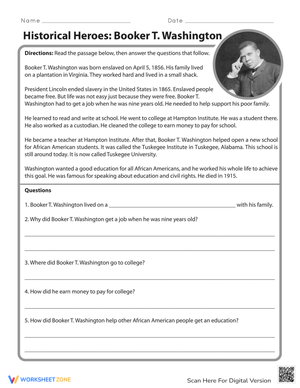
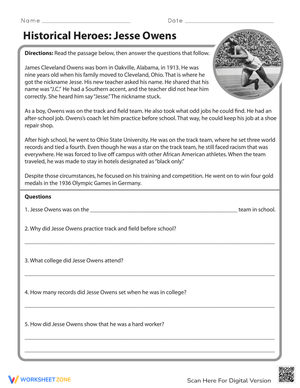
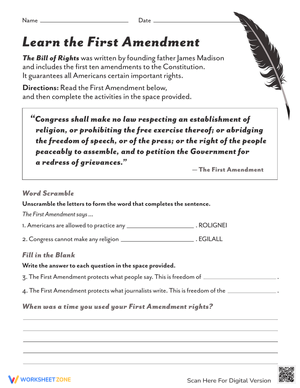
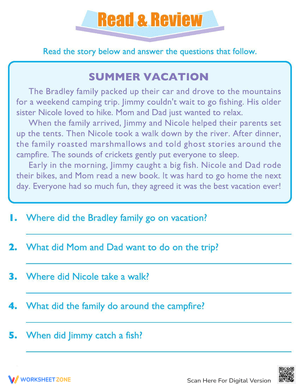
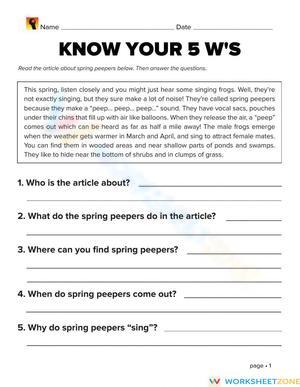
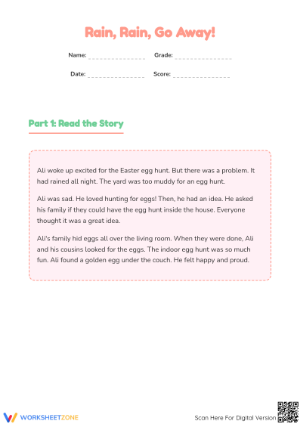
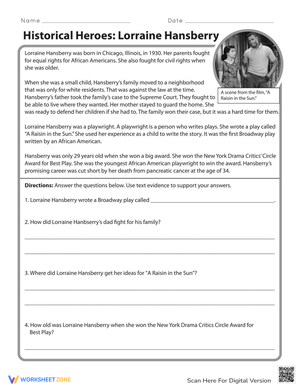
These who what when where why questions printable worksheets for 2nd grade give teachers a ready-to-use reading comprehension set built around the five questions that matter most when 7- and 8-year-olds are moving from decoding into meaning-making. Each worksheet pairs a short passage — fiction or informational — with a structured response frame, so students practice returning to the text for evidence rather than answering from memory. The set covers both literary and informational genres, because second graders encounter both in a single school day and need practice applying the same questioning habit across text types.
What Each Worksheet Asks Students to Do
The five questions divide into two skill levels, roughly speaking. Who, Where, and When are mostly retrieval tasks — students locate a character name, a place, or a time marker and transfer it to the response frame. That's meaningful practice, but it doesn't separate strong comprehenders from average ones. What and Why are where the real diagnostic information lives. Answering "What" at this grade level means identifying the central event, not just anything that happened — and students who haven't yet learned to weigh details will often write down the moment they found most interesting rather than the one that drives the text. "Why" requires connecting a character's action to an internal motivation or external cause, which is the first step into inferential thinking. In each worksheet, students mark specific lines in the passage to support their "Why" answers, building the text-evidence habit that the Common Core's key-detail standards explicitly require.
Student Errors Worth Catching Before They Become Habits
The most common "Who" error isn't blanking — it's listing every character in the story rather than identifying the character central to the specific event the worksheet addresses. Students who write three names when one is called for are telling you they haven't learned to prioritize yet. That vagueness is worth addressing directly during the first few uses of the format because it follows students into written assessments, where a partially right answer is still wrong.
"Why" produces the most instructive errors because they fall into two distinct types: the blank (student gives up entirely) and the invented reason (student writes a plausible motivation not supported by the text). The second type actually reflects stronger comprehension than the first — the student understood enough to construct a reasonable explanation — but it's exactly the habit to interrupt before third grade, when text-dependent reasoning becomes a formal expectation. The most effective fix is requiring students to mark the supporting sentence in the passage before they write the "Why" answer. That single step catches the invented-reason pattern almost every time.
Getting the Most Out of These Worksheets in Your Weekly Routine
Guided reading groups are where these worksheets earn their place most clearly. After a small group finishes a passage, distribute the worksheet before the discussion — not after. Students who answer questions following a group discussion are often working from what they heard classmates say, not from the text. Completing the worksheet first means you collect actual individual comprehension data, and the conversation that follows is richer because students have already organized their thinking on paper.
Literacy centers are the other reliable placement. A student reads a short passage independently, completes the worksheet, and leaves it in a folder. One practical note: when you introduce this rotation in the fall, model exactly what "going back to find the answer in the text" looks like before students try it independently. Second graders who are left to interpret that instruction without a demonstration will highlight everything or nothing. One modeled session — walking through the back-and-forth between passage and worksheet in front of the class — prevents most of the confusion that derails this center for weeks if it's skipped.
Standard Alignment
The primary alignments are CCSS.ELA-LITERACY.RL.2.1 for literary text and CCSS.ELA-LITERACY.RI.2.1 for informational text — both require students to ask and answer who, what, where, when, why, and how questions to demonstrate understanding of key details. These two standards carry weight beyond second grade: they are the prerequisite for RL.2.3 (how characters respond to challenges) and RI.2.3 (cause and effect relationships), which means a student who leaves second grade unable to answer text-dependent detail questions reliably enters third grade with a visible and consequential gap. The who what when where why questions printable worksheets for 2nd grade address both RL and RI standards in a single format, and because each worksheet specifies whether the accompanying passage is literary or informational, teachers can track student progress across both standard codes separately across the school year.
Adjusting the Set for a Range of Reader Levels
For students still building writing fluency — including many English language learners and students receiving reading intervention — blank response lines can create a barrier that has nothing to do with comprehension. Adding a sentence starter before distributing ("The main character is ___" or "This takes place in ___") shifts the task back to comprehension without changing what the student is asked to demonstrate. Some teachers keep a few pre-prepped copies of each worksheet with starters already written in, ready to swap in for specific students. It takes about two minutes per worksheet and keeps those students working on the actual skill rather than shutting down over syntax under pressure.
Advanced readers who move through the five questions accurately benefit from a sixth prompt: "How do you know?" applied specifically to their "Why" answer. That single follow-up forces a text citation rather than accepting a plausible-sounding response. Another reliable push is having these students generate their own "Why" question after answering the one on the sheet — question generation requires them to evaluate which information in the text actually matters, which is harder than answering a question someone else wrote. Teachers who use who what when where why questions printable worksheets for 2nd grade with a mixed-ability class typically find the same core format holds across the full range; the adjustments are small and targeted rather than requiring an entirely separate set of materials.
Frequently Asked Questions
Can these worksheets be used with informational text, or are they mostly built around stories?
Each worksheet works with both genres, and using the format with both throughout the year is worth doing deliberately. The five questions shift in meaning depending on text type: in a narrative, "Why" asks about character motivation; in an informational passage, it asks about cause or purpose. Students who only practice with fiction often freeze when the same question format appears on an informational text on an assessment. Rotating one narrative worksheet, then one informational, is the most practical way to build flexible comprehension before that flexibility is tested.
How do these worksheets function as formative assessment rather than just practice?
The who what when where why questions printable worksheets for 2nd grade give you a fast diagnostic snapshot after any small group lesson. Collect the completed worksheets and sort them into three categories: accurate answers with text support on all five questions, partial answers that break down specifically at "Why" or "When," and mostly incomplete or evidence-free responses. That sort takes four or five minutes and tells you more about where to focus your next guided reading session than a whole-class discussion does. The question-by-question structure makes it straightforward to identify a student who handles retrieval questions well but consistently struggles with the inferential ones.
Can students use these as planning tools for their own writing?
Yes, and it's a natural transfer. Before drafting a short narrative, students fill out a blank 5 Ws frame: who is in the story, what happens, when and where it takes place, and why the character acts. Students who plan this way tend to produce stories with clearer settings and more explicit motivations. The "Where" and "Why" sections of second graders' independent writing are typically the weakest, which mirrors exactly the two questions that cause the most difficulty in reading comprehension. Using the same frame for both reading and writing reinforces the connection between how authors build a story and how readers understand one.












 Interactive Worksheet Maker
 Quiz Maker
 Word Search Maker
 Crossword Puzzle Maker
 Word Scramble Generator
 Sentence Scramble Generator
 Handwriting Worksheet Generator
 Name Tracing Generator
 Fill In The Blank Generator