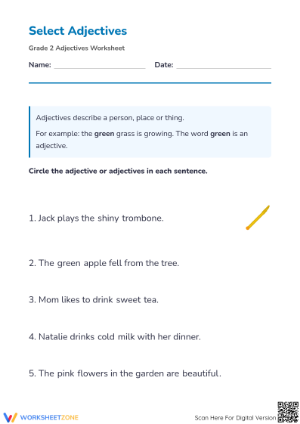
These 2nd grade adjectives pdf worksheets give second graders structured practice with descriptive language across five skill areas: identifying adjectives in context, sorting by category, expanding flat sentences with well-chosen words, and working through comparative and superlative forms. The set includes both recognition tasks and production tasks, because those two skills develop at different rates and need to be practiced separately.
What Each Worksheet Targets
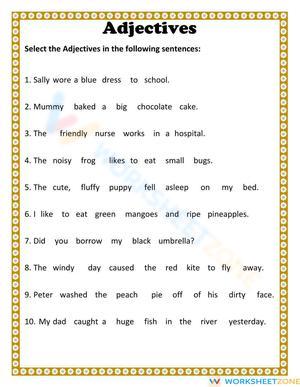
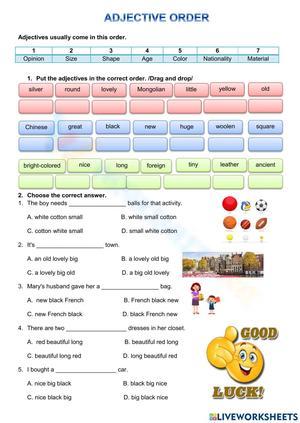
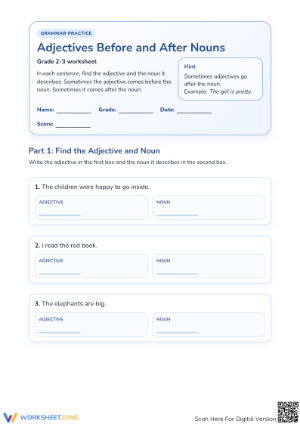
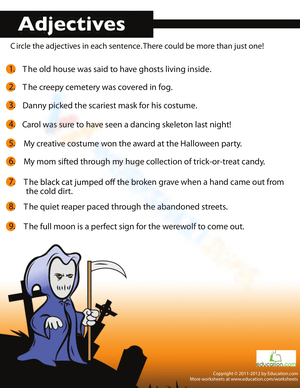
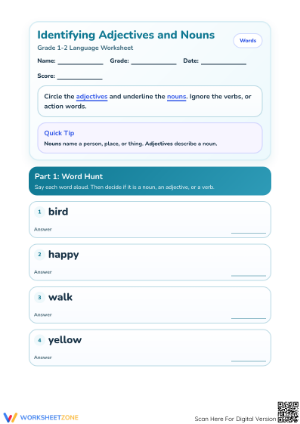
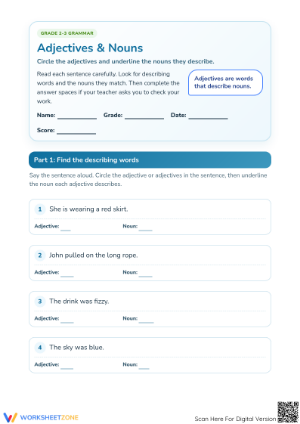
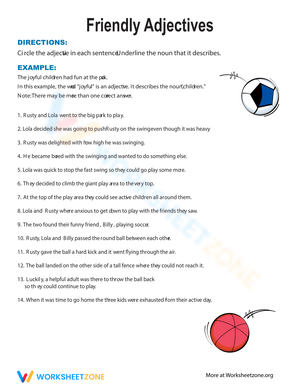
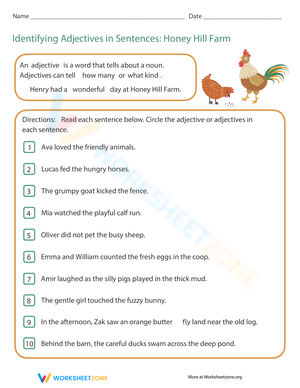
The earliest worksheets focus on identification. Students underline adjectives in short sentences and mark whether each one describes color, size, shape, or feeling. The category-labeling step matters more than it might seem: named categories give students a concrete retrieval cue during writing — stopping to ask "is there a size word I could add here?" is more productive than the vague reminder to "add details."
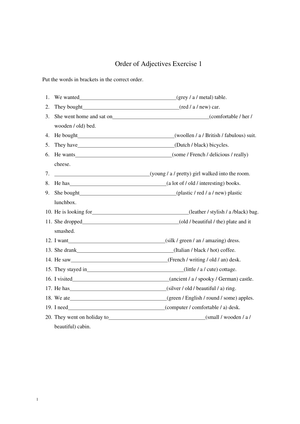
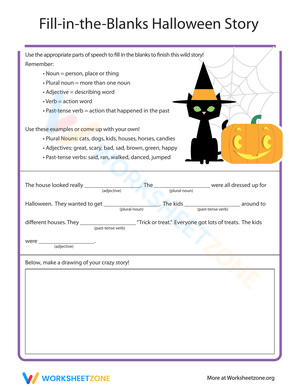
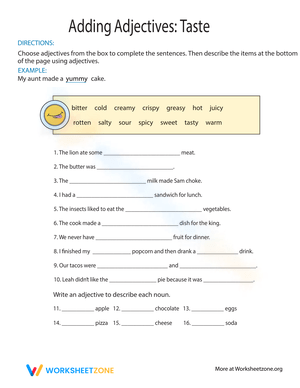
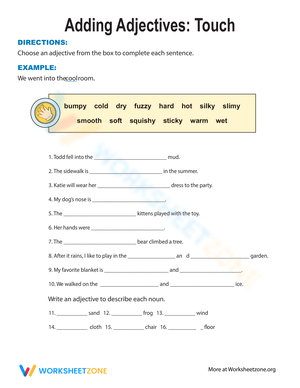
Middle worksheets shift to sentence expansion. Students receive a flat sentence — "The dog sat on the rug" — and rewrite it by inserting adjectives. Because students see the original and the revised version side by side, the grammatical work becomes visible. A student can point to exactly what changed and explain why the new sentence is more specific.
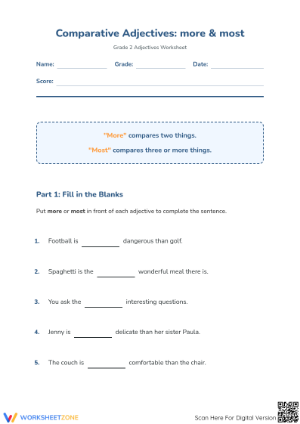
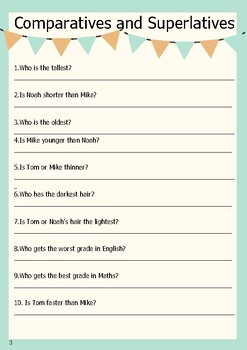
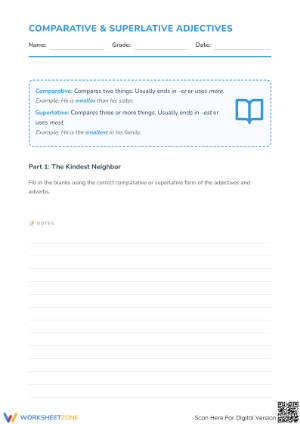
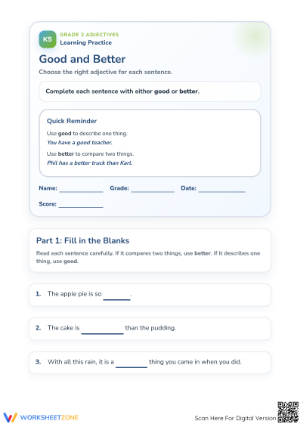
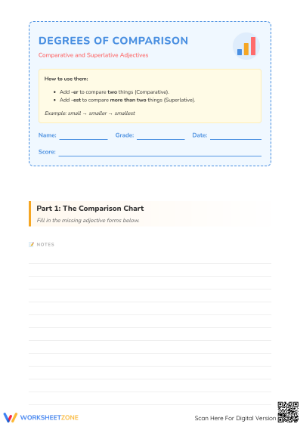
The comparative and superlative worksheets ask students to complete three-column charts: tall → taller → tallest. Spelling-change cases — doubling a final consonant, changing a final y to i — appear alongside a short reference box at the top of each worksheet so students can check their work as they go rather than guessing. The set closes with a performance task that asks students to describe a scene using at least one adjective from each studied category. That final worksheet functions more as a unit check than a drill — it's the one that tells you whether students can apply the skill without prompting.
Student Errors Worth Catching Before They Become Habits
The most reliable error in second-grade superlative work is the superlative-for-comparative swap. Students write "she is the tallest of the two" because superlatives feel more emphatic, and emphasis is what they're reaching for. One worksheet in the set addresses this by requiring students to count the nouns being compared before choosing a form — a small procedural step that forces the grammatical reasoning rather than bypassing it.
Irregular adjectives cause a separate problem. Students who have internalized the -er/-est pattern write "gooder" and "goodest" with complete confidence. Rule review alone doesn't fix this; repeated contextual exposure to "better" and "best" does. One worksheet uses a short paragraph dense with comparisons so students encounter irregular forms multiple times in a single reading, rather than as isolated vocabulary items they're supposed to memorize.
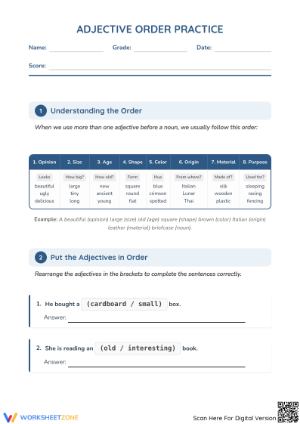
A third pattern worth watching: students generating their own adjective phrases often place the adjective after the noun — "a dog brown" instead of "a brown dog." This shows up most frequently in students who speak a post-nominal language at home, but it also appears in monolingual English students who haven't encountered enough print to absorb adjective order through exposure alone. The sentence-rewriting exercises reinforce pre-nominal placement by having students read correctly ordered models before generating their own.
Standard Alignment
The identification and sorting worksheets address CCSS.ELA-LITERACY.L.2.1.E, which requires students to use adjectives and adverbs and choose between them depending on what is being modified. In most second-grade classrooms, this standard lands mid-year — after students have working knowledge of nouns and verbs, and before complex sentence construction begins. The comparative and superlative worksheets connect to CCSS.ELA-LITERACY.L.2.1.F, which covers producing, expanding, and rearranging sentences, since adjective expansion is the most direct route to sentence elaboration at this level. These 2nd grade adjectives pdf worksheets fit that mid-year instructional window: use the identification and sorting worksheets early in the unit, then move to sentence expansion as students enter a descriptive writing block.
Fitting These Worksheets Into Your Lesson Planning
The identification worksheets work well as Monday warm-ups — five minutes at the start of the ELA block while students settle in. The sorting task gives everyone something concrete and low-stakes to do during transition, which focuses the room before direct instruction begins. It also means you can glance at student work during those five minutes and quickly see who is already identifying adjectives reliably and who needs another round of practice.
The sentence-expansion worksheets belong inside the writing unit, placed the day before students draft a descriptive paragraph. Completing one as a class — projecting it and filling it in together — gives students a model to reference when they sit down to write independently. The before-and-after format does the instructional work that a verbal explanation alone doesn't: students can point to exactly what changed and name what kind of adjective they added.
Save the comparative and superlative worksheets for small-group work. That skill has enough moving parts — counting nouns, applying spelling rules, checking for irregulars — that students still shaky on basic identification lose the thread quickly. Pulling a small group while the rest of the class works on earlier worksheets keeps the pace productive for everyone. The final performance-task worksheet makes a clean exit ticket for the last day of the adjective unit; reviewing a class set takes about eight minutes and tells you clearly who is ready to move on.
Adjusting the Set for Mixed-Ability Classrooms
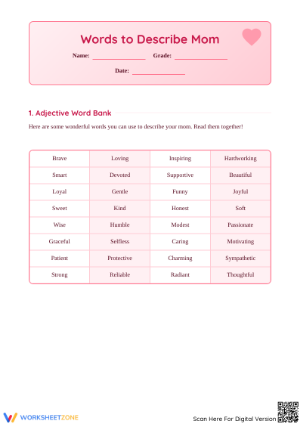
Students still working on basic identification need a word bank. Print the sorting worksheets with a box of adjectives in the corner and let students select and sort rather than generate from scratch. This keeps the cognitive demand on the grammatical concept — which word is the adjective? what category does it belong to? — rather than on vocabulary retrieval, which is a separate skill worth addressing on its own terms.
Students who move through identification quickly can work with modified versions of the sorting worksheets where the category labels are removed. They name their own categories. Students at this level often propose categories the class hasn't discussed — texture words, temperature words — and those conversations tend to be more generative than any scripted extension task. For the sentence-expansion worksheets, remove one noun from the original sentence and ask advanced students to supply both the noun and its adjective. That's a meaningfully harder task that stays within the same worksheet format, so no additional materials are needed.
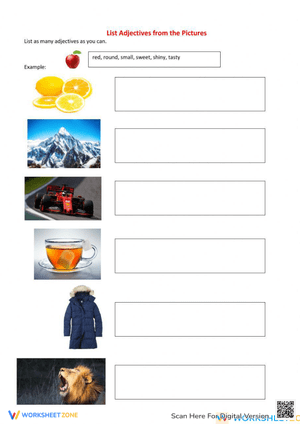
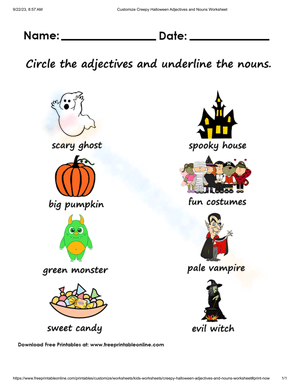
For English language learners still building reading fluency, pairing the 2nd grade adjectives pdf worksheets with labeled images or physical classroom objects keeps vocabulary retrieval from overwhelming the grammatical task. Students can focus on recognizing which word is the adjective and naming its category without also battling unfamiliar text.
Frequently Asked Questions
How long does each worksheet take a typical second grader to complete?
Identification and sorting worksheets run about eight to twelve minutes for most second graders working independently. Sentence-expansion worksheets take closer to fifteen minutes because students are generating language, not just recognizing it. The performance-task worksheet at the end of the set works best with a full twenty-minute writing block, since students are producing original descriptive text rather than completing structured exercises.
When in the school year should comparative and superlative forms be introduced?
Most second-grade pacing guides place comparative and superlative adjectives in the second half of the year, after students have solid command of basic adjective identification and use. Introducing comparatives before students can reliably identify adjectives in context tends to produce procedural confusion — students focus on the suffix rules without understanding what the suffix is doing grammatically. The earlier worksheets in the set build that foundation before the comparative and superlative worksheets appear.
Can these worksheets serve as formative assessment tools rather than just practice?
The 2nd grade adjectives pdf worksheets lend themselves well to formative use, especially the sentence-expansion and performance-task worksheets. Those formats require students to produce language rather than select from given options, which makes the reasoning visible in a way that fill-in-the-blank tasks don't. Reviewing a class set of sentence-expansion worksheets takes a few minutes and quickly surfaces which students are applying adjectives correctly and which are defaulting to the same two or three words regardless of context.












 Interactive Worksheet Maker
 Quiz Maker
 Word Search Maker
 Crossword Puzzle Maker
 Word Scramble Generator
 Sentence Scramble Generator
 Handwriting Worksheet Generator
 Name Tracing Generator
 Fill In The Blank Generator