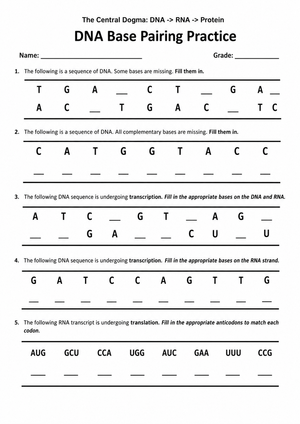
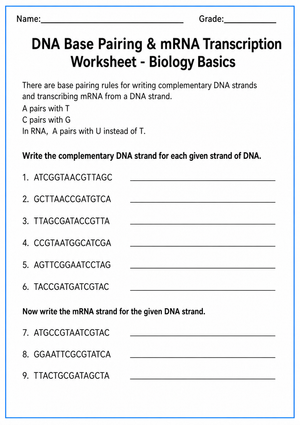
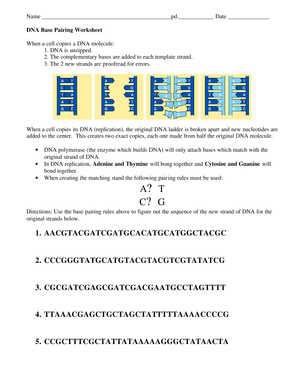
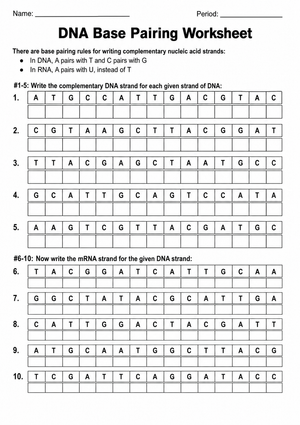
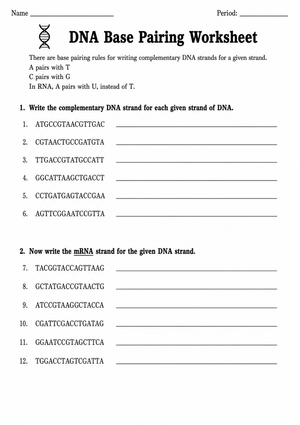
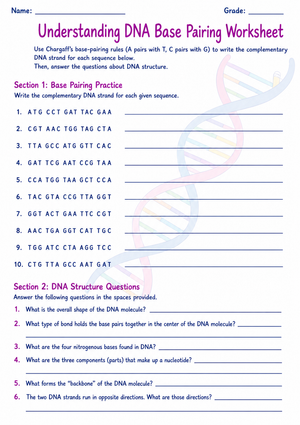
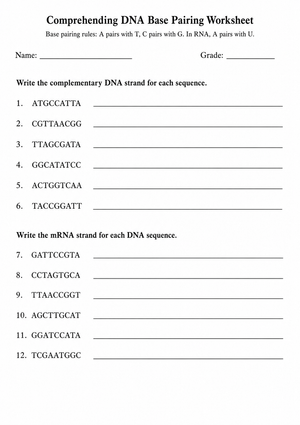
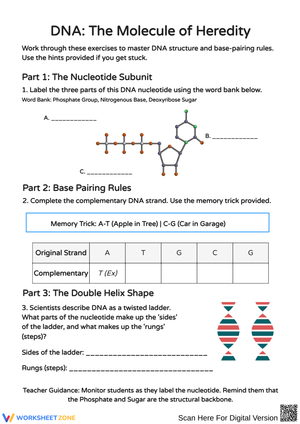
These DNA base pairing worksheets for 10th grade give biology teachers a focused set of practice materials for the part of the genetics unit where students first encounter the molecular logic of the double helix — before replication, before transcription, and well before the abstract machinery of protein synthesis enters the picture. Each worksheet targets a specific layer of the concept, from identifying complementary strands to working through Chargaff's rules numerically, so teachers can assign them in sequence or pull individual worksheets to fill a particular gap.
What Each Worksheet Asks Students to Do
The core skill in every worksheet is reading a partial DNA strand and writing the complementary sequence — but the set builds beyond that quickly. One worksheet gives students a double-stranded segment where several base pairs have been deliberately scrambled, and students must locate each mismatched pair, mark it, and write a one-sentence justification grounded in hydrogen bonding. Another asks students to apply Chargaff's rules quantitatively: given that a DNA sample is 22% Adenine, they calculate the remaining base percentages and explain the relationship between purine and pyrimidine totals. A third worksheet uses annotated diagrams to walk through antiparallel strand orientation — students label the 3' and 5' ends on both strands and trace the directionality, which becomes essential background for understanding how DNA polymerase moves during replication. One worksheet in the set contrasts DNA-DNA base pairing with DNA-RNA base pairing side by side, which addresses the Uracil/Thymine confusion head-on rather than waiting for students to collide with it later.
Standard Alignment
These worksheets support NGSS HS-LS3-1 (Heredity: Inheritance and Variation of Traits), which asks students to explain the role of DNA and chromosomes in encoding heritable information. Base pairing is the foundational mechanism that makes that encoding stable and copyable — without a working understanding of complementary strands, students cannot accurately model replication, describe how mutations arise from mispairing events, or explain why the sequence of nucleotides determines amino acid sequence downstream. In most 10th grade scope-and-sequence plans, this standard is addressed early in the genetics unit precisely because it establishes the molecular vocabulary that every subsequent standard in the heredity cluster depends on.
The Biochemical Reasoning Behind the Rules
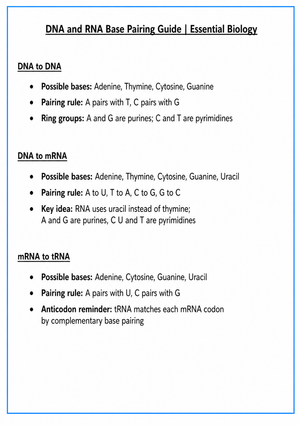
The pairing rules — Adenine with Thymine, Cytosine with Guanine — are not arbitrary. Adenine and Guanine are purines with double-ring structures; Cytosine and Thymine are single-ring pyrimidines. The geometry of the double helix demands one of each in every rung, which is why purine-purine and pyrimidine-pyrimidine pairings don't occur in intact DNA. The hydrogen bond counts matter too: two bonds hold A-T pairs, three hold C-G pairs. That difference in bond strength is why G-C rich regions resist strand separation — a fact that reappears when students study restriction enzymes and PCR primer design later in the year. When students work through complementary strand exercises without understanding this physical basis, they tend to treat base pairing as a memorization task. These worksheets keep the structural reasoning visible by pairing letter-based sequence problems with simplified molecular diagrams, so the rule stays connected to the chemistry that produces it.
Mistakes Students Make That These Worksheets Help You Catch
The most consistent error in 10th grade is substituting Uracil for Thymine on a DNA strand. Students who encounter RNA in the same unit sometimes carry Uracil into DNA problems without noticing, particularly on assessments where both molecule types appear. The contrast worksheet in this set addresses that directly, but even students who perform well on it may slip back during a timed test. Marking their errors with a specific symbol — some teachers use a circled "U?" — helps students see the pattern in their own mistakes across multiple worksheets rather than treating each error as isolated.
A subtler error involves purine-purine mismatches. Students who have memorized "A pairs with T, C pairs with G" sometimes write a correct letter but for the wrong reason — they're using rote recall rather than the size-complementarity logic. The error-identification worksheet exposes this because it presents G-A and C-T pairings alongside legitimate sequences, and students who rely purely on memorization without understanding the purine/pyrimidine distinction often miss the G-A mismatch entirely, since both G and A are letters they associate with correct pairings.
Smart Ways to Work These Worksheets Into Your Week
The complementary strand worksheet works well as a Monday opener during the genetics unit — three to four minutes at the start of class gives you immediate data on who internalized the rules from last Friday's lecture and who is still treating A-T and C-G as separate facts rather than a structural system. That quick formative read shapes how much you need to reteach before moving forward.
The Chargaff's rules calculation worksheet fits naturally as a bridge between direct instruction on base composition and a lab where students analyze actual genomic data. Students who complete the percentage calculations on paper first make fewer arithmetic errors when they encounter real base-count data from GenBank or similar sources. The error-identification worksheet is well suited to the last ten minutes before a quiz — it activates retrieval without introducing new information, and students tend to stay engaged because the task feels concrete rather than like passive review. For classes running a stations rotation through nucleotide structure, complementary strands, and DNA-RNA comparison, one worksheet per station keeps each rotation self-contained with a clear product students turn in.
Adjusting These Worksheets for a Range of Learners
Students who are still consolidating the basic rules benefit from a reference strip — a small card showing the four bases, their categories, and their pairing partners — kept at the corner of the desk while they work. The goal is to reduce cognitive load during the mechanical steps so attention stays on the structural reasoning rather than on retrieving letter assignments from memory. That scaffolding comes off as confidence builds, typically within a worksheet or two.
For students who have the rules down and need to move laterally, the quantitative Chargaff problems can be extended: ask them to design a primer sequence for a given template strand and explain why its G-C content matters for binding stability. That extension connects base pairing rules to actual molecular biology technique without requiring separate materials. For students who struggle with the abstract spatial language around antiparallel strands, sketching the sugar-phosphate backbone as a physical ladder — with explicit arrows for directionality on each rail — before labeling with letters reduces the confusion between strand orientation and strand sequence that shows up regularly in student work.
Frequently Asked Questions
Do these worksheets cover RNA base pairing or only DNA-DNA pairing?
One worksheet in the set directly compares DNA-DNA and DNA-RNA base pairing, including the Thymine/Uracil distinction and how Adenine pairs with Uracil during transcription. The remaining worksheets focus on DNA-DNA complementary strand work, which is the appropriate emphasis before students encounter mRNA and tRNA in the protein synthesis section of the unit.
At what point in a genetics unit do these worksheets fit best?
They belong early — after an introductory lesson on nucleotide structure and the double helix, but before any instruction on replication or transcription. Students who skip this practice and move straight to replication often mishandle the template strand logic because they're reconstructing base pairing rules on the fly while simultaneously processing new information about enzyme function. Treating base pairing as a prerequisite rather than a parallel topic saves reteaching time.
How are the worksheets sequenced relative to each other?
The set moves from recognition to application to analysis. The first worksheet asks students to complete complementary strands from a given template. Later worksheets introduce the error-identification format and the Chargaff's rules calculations. The DNA-RNA contrast worksheet is positioned last because it presupposes comfort with DNA base pairing and introduces the comparison as a conceptual extension rather than a first encounter.
Can these worksheets be used as a quiz or graded assignment?
Yes, though they work best as formative tools during instruction. The error-identification worksheet in particular gives you specific, actionable information about which students are working from structural understanding versus rote recall — information that is harder to extract from a traditional fill-in-the-blank quiz. If you use them as summative grades, the Chargaff's rules calculation worksheet is the most defensible choice because it requires students to show mathematical reasoning, not just recall letter pairings.












 Interactive Worksheet Maker
 Quiz Maker
 Word Search Maker
 Crossword Puzzle Maker
 Word Scramble Generator
 Sentence Scramble Generator
 Handwriting Worksheet Generator
 Name Tracing Generator
 Fill In The Blank Generator