DNA Structure Printable Worksheets for 10th Grade Biology
For teachers guiding students through the complexities of genetics, having reliable and accurate resources is absolutely essential. Using DNA structure printable worksheets for 10th grade helps students visualize the microscopic world inside every cell. These resources break down the double helix into understandable components, allowing learners to grasp how genetic information is stored and transmitted across generations. By focusing on the specific architecture of deoxyribonucleic acid, teachers can build a strong foundation for subsequent lessons on replication, transcription, and translation. When students can physically label diagrams, color-code base pairs, and write out complementary sequences on paper, the abstract concepts of molecular biology become concrete. This hands-on practice is vital for mastering the intricate details of the human body system and cellular function.
The Architecture of the Double Helix
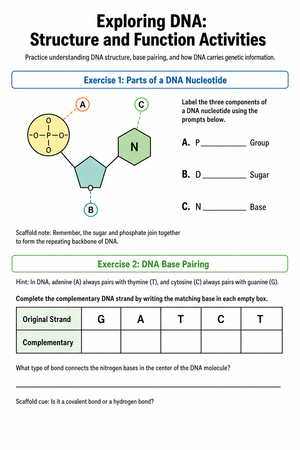
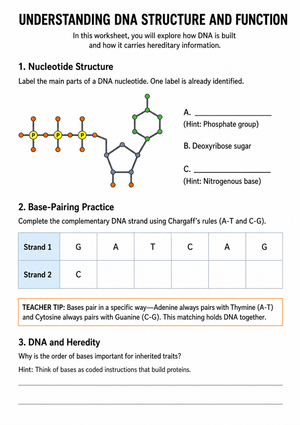
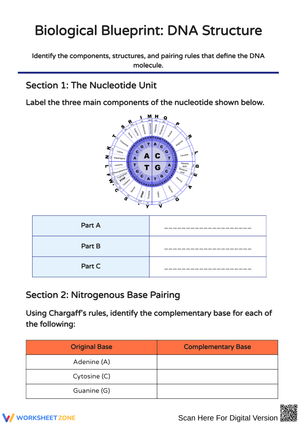
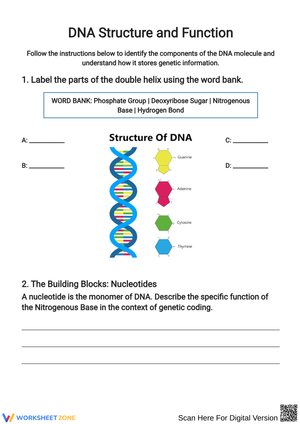
To effectively teach genetics, educators must ensure students understand the basic building blocks of the DNA molecule. According to the NHGRI DNA Fact Sheet, DNA is a double helix composed of two antiparallel strands of nucleotides. Each nucleotide is the fundamental unit of this molecule and consists of three distinct parts: a deoxyribose sugar, a phosphate group, and one of four nitrogenous bases. These bases include Adenine, Thymine, Cytosine, and Guanine. When students use printable materials to map out these structures, they can clearly see how the sugar and phosphate groups alternate to form the strong outer backbone of the molecule. This backbone is held together by strong covalent phosphodiester bonds, ensuring the genetic code remains stable and protected from environmental damage. Meanwhile, the nitrogenous bases point inward, meeting in the middle to form the rungs of the twisted ladder. Understanding this specific arrangement is necessary for students to comprehend how DNA functions as a reliable storage medium for genetic information.
Base Pairing and Chargaff's Rule
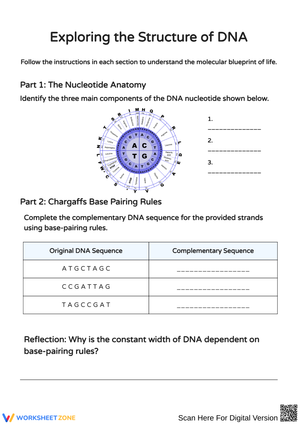
One of the most important concepts for students to master is the specific pairing of nitrogenous bases. Chargaff's Rule dictates that Adenine always pairs with Thymine, and Cytosine always pairs with Guanine. This predictable pairing is the key to DNA replication and cellular division. In the classroom, worksheets provide an excellent opportunity for students to practice applying this rule. By giving students a single strand of a DNA sequence, teachers can ask them to determine the complementary strand. This repetitive practice helps solidify the concept in their minds. Furthermore, it is important to highlight the chemical interactions that make this pairing possible. Adenine and Thymine are connected by two hydrogen bonds, while Cytosine and Guanine are connected by three hydrogen bonds. Although hydrogen bonds are relatively weak individually, their combined strength across the entire DNA molecule provides significant stability. At the same time, this relative weakness allows the two strands to separate easily when the cell needs to replicate its DNA or transcribe a gene.
Aligning with NGSS HS-LS1-1 Standards
For science educators, ensuring that lesson plans align with required benchmarks is a top priority. When utilizing DNA structure printable worksheets for 10th grade, teachers can directly support the NGSS HS-LS1-1 Standards. This specific benchmark emphasizes the role of DNA in providing the instructions necessary for forming proteins. Before students can understand how proteins are synthesized, they must first understand the structure of the molecule that holds the instructions. Worksheets that require students to analyze the sequence of bases help them see that the order of these bases is what determines the genetic code. By breaking down the structure of the double helix, educators are laying the groundwork for students to understand how a sequence of nucleotides translates into the complex proteins that carry out essential functions within the human body system. This alignment ensures that classroom activities are meaningful exercises that build toward a comprehensive understanding of biological processes.
Exploring Antiparallel Strands
Another complex concept that students often struggle with is the antiparallel nature of the DNA strands. As highlighted in resources like Khan Academy: DNA Structure and Replication, the two strands of the double helix run in opposite directions. One strand runs in a 5' to 3' direction, while the complementary strand runs in a 3' to 5' direction. This orientation is determined by the numbering of the carbon atoms in the deoxyribose sugar ring. Teaching this concept requires clear visual aids. Printable diagrams where students must label the 5' and 3' ends of each strand are highly effective. By mastering the antiparallel structure early on, students will have an easier time understanding the mechanics of leading and lagging strands in subsequent lessons on replication.
Classroom Implementation
Integrating these worksheets into your daily lesson plans can take many forms. To maximize student engagement and retention, consider using a variety of worksheet activities that target different learning styles. Here are several effective ways to use these printables in your 10th-grade biology classroom:
- Diagram Labeling: This is a classic and effective starting point. Provide students with a blank outline of a DNA molecule and have them identify the phosphate groups, deoxyribose sugars, and specific nitrogenous bases. This helps them visualize the spatial relationship between the different components.
- Color-Coding Activities: Assign a specific color to each of the four bases and have students color a double helix diagram accordingly. This visual representation makes it immediately obvious if a student has misunderstood the base-pairing rules, as the colors will not match up correctly.
- Sequence Practice: Give students a long string of letters representing a 5' to 3' sequence and challenge them to write the complementary 3' to 5' sequence below it. This builds speed and accuracy in applying Chargaff's Rule.
- Structural Analysis: Push students to think more deeply about the molecule. Ask them to compare the rungs of the DNA ladder to the rails of the backbone, noting the different types of bonds and molecules involved in each part.
When introducing the concept of hydrogen bonding between base pairs, have students draw the bonds using dashed lines rather than solid lines on their worksheets. This simple visual distinction helps reinforce the chemical difference between the weak hydrogen bonds connecting the bases and the strong covalent bonds holding the sugar-phosphate backbone together, making the mechanics of DNA unzipping much easier to grasp.
Assessing Student Understanding
After students have completed their worksheets, it is important to assess their comprehension. Reviewing the completed diagrams and sequences as a class allows teachers to address any common misconceptions immediately. For example, if many students are pairing Adenine with Cytosine, the teacher can pause and review the specific chemical reasons why that pairing does not work. Additionally, these printable resources can serve as excellent study guides for upcoming quizzes and exams. By keeping their labeled diagrams and sequence practice sheets in their biology binders, students have a reliable reference to look back on when preparing for unit assessments. Teachers can also collect specific worksheets to use as formative assessments, grading them for accuracy to gauge the overall understanding of the class before moving on to more advanced topics like transcription and translation.
Frequently Asked Questions
1. What are the three parts of a DNA nucleotide?
A single DNA nucleotide is composed of three distinct components: a five-carbon sugar called deoxyribose, a phosphate group, and a nitrogenous base. The nitrogenous base can be Adenine, Thymine, Cytosine, or Guanine. These three parts bond together to form the basic building block of the entire DNA double helix. The sugar and phosphate form the backbone, while the base extends into the center of the molecule.
2. How do hydrogen bonds facilitate the unzipping of DNA?
Hydrogen bonds connect the nitrogenous bases across the center of the DNA molecule. Because hydrogen bonds are relatively weak compared to the covalent phosphodiester bonds in the sugar-phosphate backbone, they can be easily broken by specific cellular enzymes. This allows the two strands to separate, or unzip, without damaging the individual strands, which is necessary for both replication and transcription processes.
3. What is the difference between purines and pyrimidines?
Purines and pyrimidines are the two categories of nitrogenous bases found in DNA. Purines, which include Adenine and Guanine, have a double-ring chemical structure. Pyrimidines, which include Thymine and Cytosine, have a single-ring structure. A purine always pairs with a pyrimidine to maintain a consistent and uniform width across the entire DNA double helix.
4. Why is the DNA structure described as antiparallel?
The term antiparallel refers to the fact that the two strands of the DNA double helix run in opposite directions alongside each other. One strand is oriented in the 5' to 3' direction, while the complementary strand is oriented in the 3' to 5' direction. This specific arrangement is essential for the proper functioning of enzymes during DNA replication, as these enzymes can only build new DNA strands in one specific direction.
Clear All