Grade 1 Sentence Scramble Worksheets
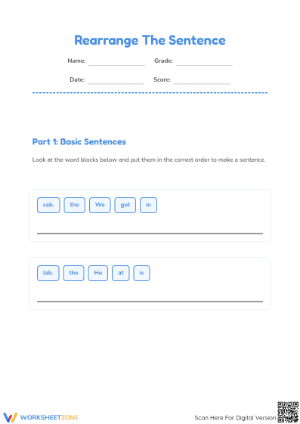
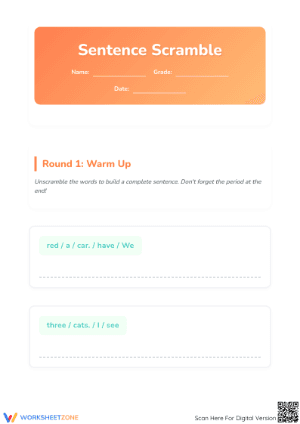
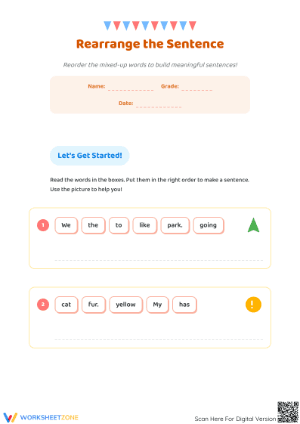
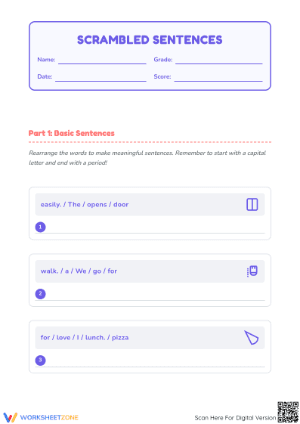
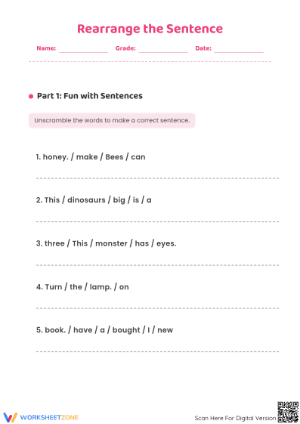
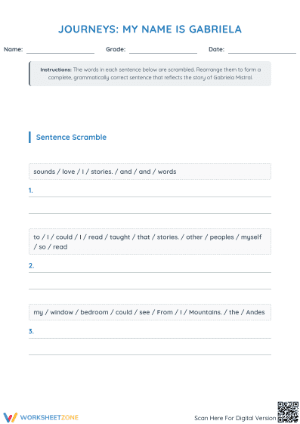
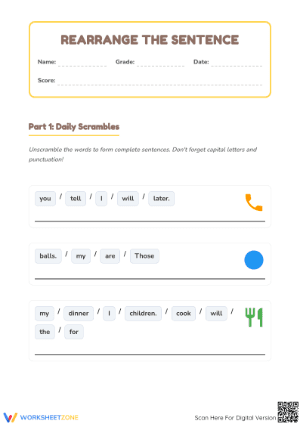
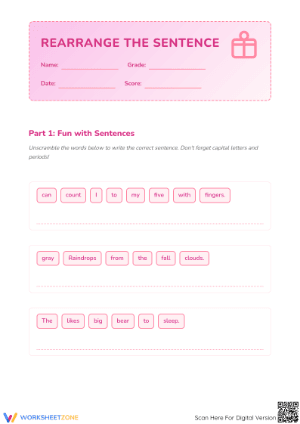
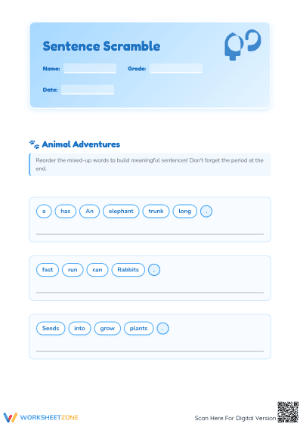
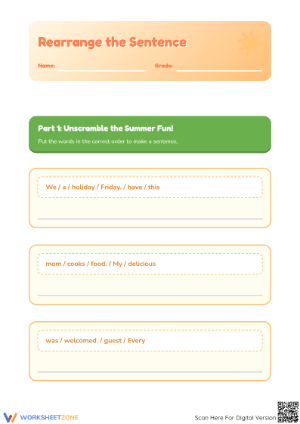
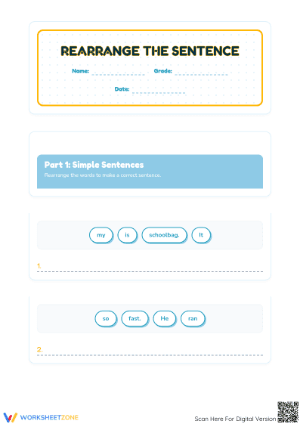
In a sentence scramble, first graders get the words of a sentence in mixed-up order and put them back together. Each sentence uses familiar first-grade sight words such as the, can, see, my, we, is and like. That way, students spend their effort on word order, not on decoding.
Every scramble practices three grade-1 skills:
- Reading sight words in context. Students read I, the and see inside a real sentence, not on a flash card.
- Capital letter at the start. The first word is the only one with a capital letter (besides I and names), so students learn to look for it. Example: dog / The / big / is → The dog is big.
- A period or question mark at the end. The word with the end mark goes last, and the finished sentence shows the punctuation they copy.
Most sheets ask students to cut, order and glue the words, then write the sentence on primary lines. That adds handwriting and spacing practice. Start with three- or four-word sentences, then move to five or six as students grow more confident.
These activities support CCSS L.1.1.J (produce complete simple sentences), L.1.2.B (end punctuation) and RF.1.3.G (irregularly spelled words).
The Standard Behind the Practice: CCSS.ELA-LITERACY.L.1.1
Sentence scramble tasks target CCSS.ELA-LITERACY.L.1.1, the grade 1 standard covering command of standard English grammar and sentence conventions. Unscrambling a sentence requires a student to notice the terminal punctuation first, since a period, question mark, or exclamation point signals what kind of sentence they are rebuilding before they even move a single word. That small decoding step, done automatically, is exactly the kind of sentence-convention awareness the standard describes.
Teachers who use sentence scrambles as a daily five-minute warm-up often notice that students begin self-correcting capitalization and punctuation in their independent writing within a few weeks, because the scramble format forces them to check those two features every single time before a sentence counts as done.
Classroom Implementation
Sentence scramble worksheets fit naturally into several parts of the school day. As morning work, a single scramble gives students an immediate, low-prep task the moment they walk in, and it doubles as a quick formative check on who still needs support with capitalization or punctuation. As a literacy center station, a folder of scrambles lets students work at their own pace while you pull small groups for guided reading or intervention.
In small group instruction, sentence scrambles work well as a warm-up before a phonics or sight word lesson, since students are rereading and manipulating words they already know, which reinforces the connection between decoding and sentence-level reading. For independent practice, pair a scramble worksheet with a quick self-check: have students read their finished sentence aloud to a partner or to themselves before turning it in, catching errors before you do.
Choose the format based on your goal for the day. Cut-and-paste versions are ideal for students who need a concrete, kinesthetic way to test different word orders before committing to one. Write-in versions move faster and are a better fit once students are comfortable with the skill and you want a quicker check of independent mastery.
Frequently Asked Questions
1. How should teachers use sentence scramble worksheets in a 1st grade classroom?
Use them as short, five-minute morning work, a literacy center station, or a warm-up before small group instruction. Their brief, self-contained format makes them easy to fit into transitions without disrupting the rest of the literacy block.
2. What skills do sentence scramble worksheets build besides word order?
They reinforce capitalization, end punctuation, sight-word recognition, and reading fluency, since students must reread their finished sentence to confirm it makes sense before they are done.
3. How do sentence scrambles align with CCSS grammar standards for grade 1?
They target CCSS.ELA-LITERACY.L.1.1, which covers demonstrating command of standard English grammar and sentence conventions, by requiring students to rebuild grammatically correct sentences from a scrambled word set.
4. Are sentence scramble worksheets good for struggling or early readers?
Yes. Because the vocabulary is already provided, the task isolates word-order practice from word-retrieval demands, making it accessible for students who are not yet ready to generate sentences independently.
5. How often should first graders practice sentence scrambles for the best results?
A short daily or several-times-weekly routine, even just one scramble per session, gives students repeated, low-stakes practice that builds capitalization and punctuation habits over time without requiring a large block of instructional time.












 Interactive Worksheet Maker
 Quiz Maker
 Word Search Maker
 Crossword Puzzle Maker
 Word Scramble Generator
 Sentence Scramble Generator
 Handwriting Worksheet Generator
 Name Tracing Generator
 Fill In The Blank Generator