


























Views
Downloads

Unscramble Sentences Worksheet | Printable Grade 1 ELA
Paste this activity's link or code into your existing LMS (Google Classroom, Canvas, Teams, Schoology, Moodle, etc.).
Students can open and work on the activity right away, with no student login required.
You'll still be able to track student progress and results from your teacher account.
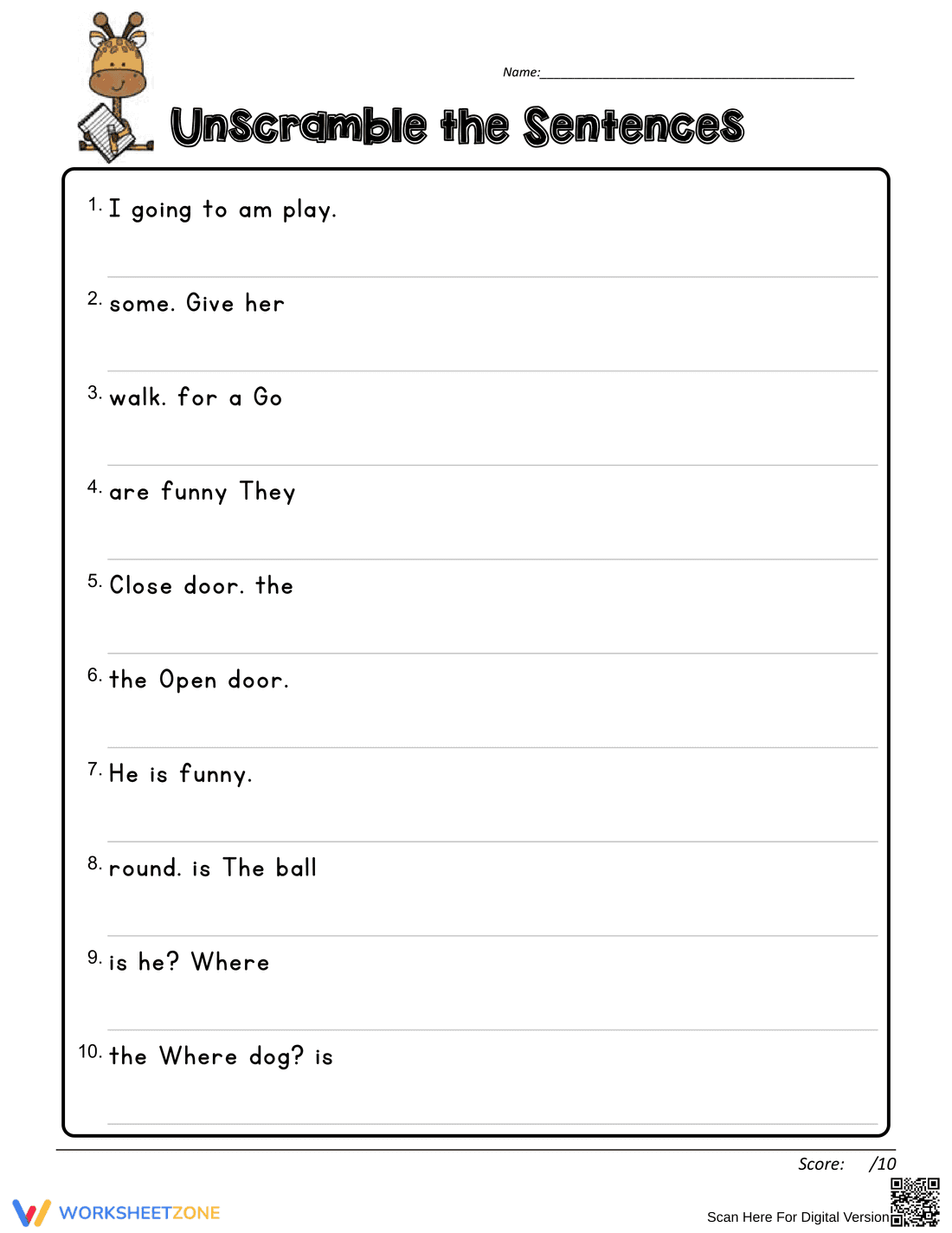
This printable ELA worksheet helps Grade 1 students master sentence structure by unscrambling words to form complete thoughts. Students analyze word order, apply capitalization rules, and add correct punctuation to build foundational writing skills. This resource ensures young learners transition from recognizing isolated words to constructing coherent, grammatically correct sentences independently.
At a Glance
- Grade: Grade 1 · Subject: English Language Arts
- Standard:
CCSS.ELA-LITERACY.L.1.1— Produce and expand complete simple sentences.- Skill Focus: Sentence structure and word order
- Format: 1 page · 10 problems · Answer key included · PDF
- Best For: Morning work or independent grammar practice
- Time: 15–20 minutes
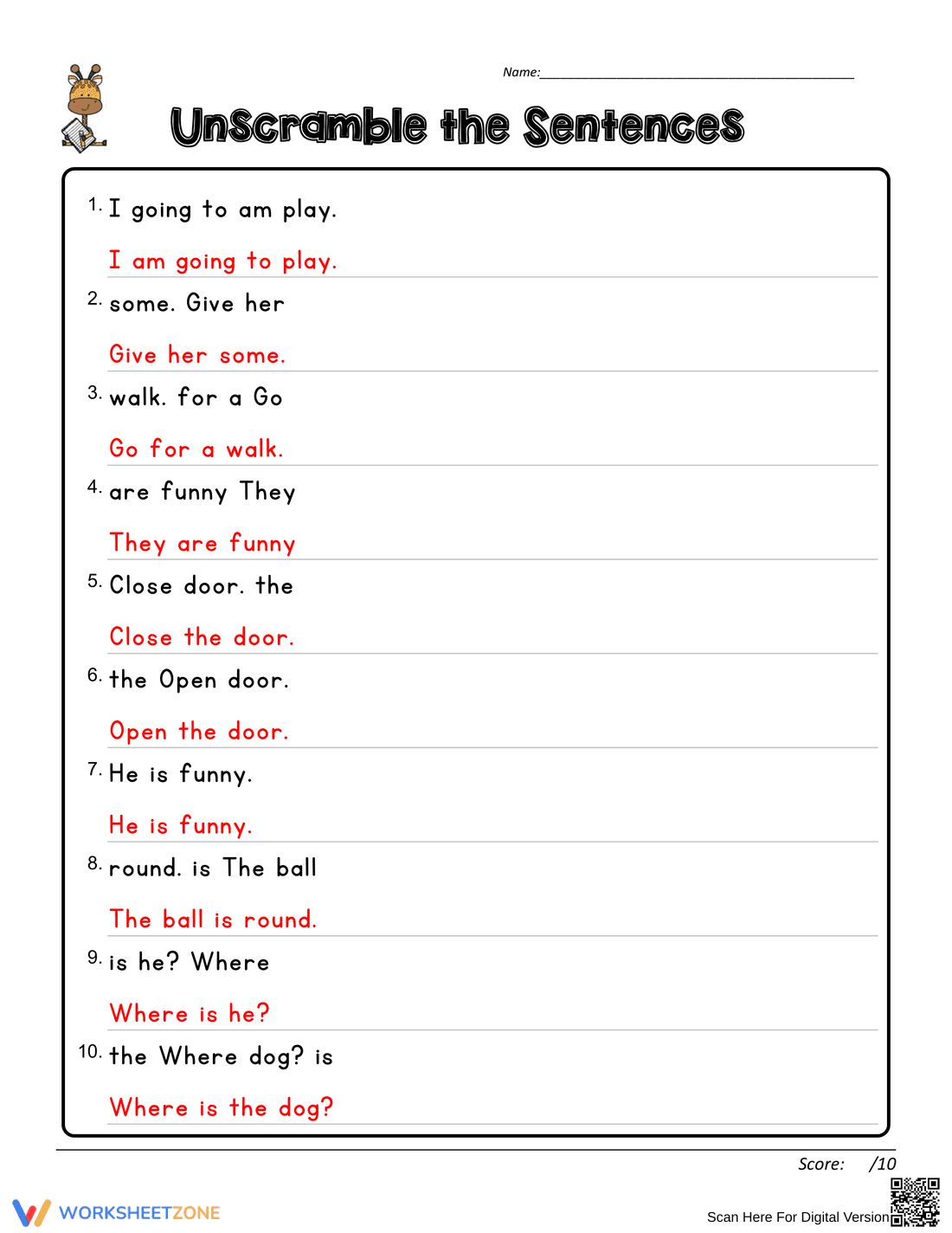
This single-page PDF worksheet contains 10 carefully structured scrambled sentence tasks. Each problem presents a jumbled set of words that students must rearrange into a logical, complete sentence. The layout provides clear, wide writing lines beneath each prompt to support early writers with letter formation and spacing. A complete, color-coded answer key is included to facilitate rapid grading or student self-assessment.
This resource features a zero-prep workflow designed to save valuable classroom time. First, print the single-page PDF in less than 2 minutes. Second, distribute the sheets to students for a quick 15-minute independent activity. Third, review the answers using the provided key in under 2 minutes. With a total teacher prep time of under 2 minutes, this worksheet is ideal for emergency sub plans, transition periods, or last-minute homework assignments.
This activity aligns directly with the Common Core State Standard `CCSS.ELA-LITERACY.L.1.1`, which requires students to demonstrate command of the conventions of standard English grammar and usage when writing or speaking. Additionally, it supports `CCSS.ELA-LITERACY.L.1.1.j` by prompting students to produce complete simple sentences. Both standard codes can be copied directly into lesson plans, IEP goals, or district curriculum mapping tools.
Use this worksheet as a formative assessment immediately after direct instruction on sentence parts. As students work, observe if they correctly place capitalized words at the beginning and punctuation marks at the end of their sentences. Alternatively, assign this as a warm-up activity at the start of a writing block. Students typically complete the 10 tasks within 15 to 20 minutes.
This worksheet is designed for Grade 1 students, but also serves as an excellent review for struggling second graders or an enrichment activity for advanced kindergarteners. For students requiring extra support, pair this worksheet with physical word cards or a sentence-building anchor chart. It integrates well alongside shared reading texts to reinforce how authors organize words to convey meaning.
According to a ScienceDirect TpT Analysis, structured sentence-unscrambling activities significantly accelerate syntactic development in early childhood education. By manipulating word order to form complete thoughts, students build a concrete understanding of syntax and grammar conventions. This worksheet aligns with `CCSS.ELA-LITERACY.L.1.1` to help learners master the plain-English skill of organizing scrambled words into coherent, grammatically correct sentences. Research by Fisher & Frey (2014) on the gradual release of responsibility supports using structured tasks like these to bridge the gap between guided grammar instruction and independent writing. Providing immediate feedback via the included answer key reinforces correct sentence boundaries and prevents the fossilization of grammatical errors. Educators can confidently integrate this resource into daily writing routines to support systematic literacy development, track student progress toward foundational ELA benchmarks, and build student confidence during independent practice.


