




























Views
Downloads

Grade 1 Sentence Building — Printable No-Prep Worksheet

Paste this activity's link or code into your existing LMS (Google Classroom, Canvas, Teams, Schoology, Moodle, etc.).
Students can open and work on the activity right away, with no student login required.
You'll still be able to track student progress and results from your teacher account.
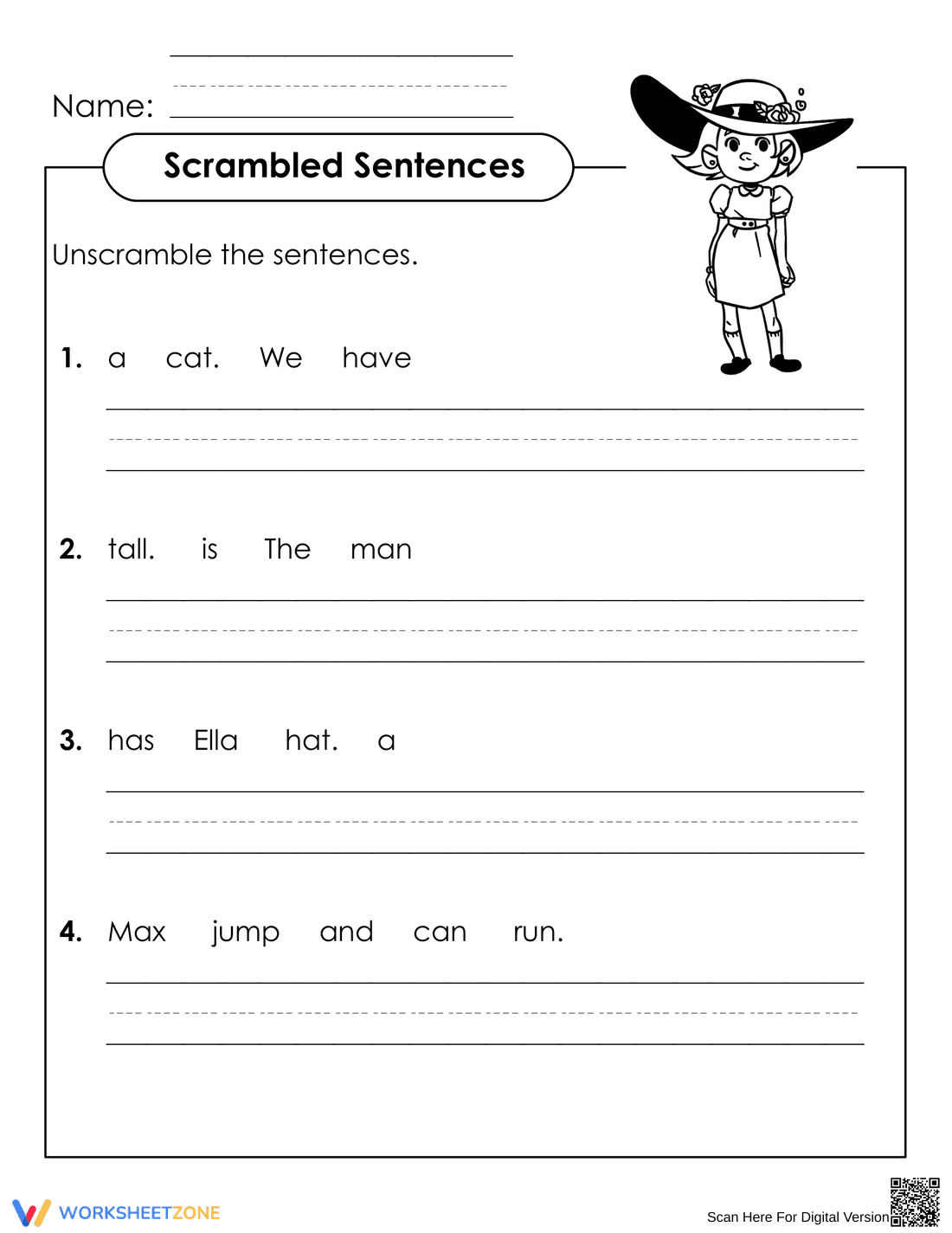
This printable worksheet helps early elementary students master basic sentence structure by unscrambling words to form complete thoughts. Students practice capitalization, punctuation, and word order to build foundational writing skills. By arranging mixed-up words into coherent sentences, learners develop a strong grasp of syntax and conventions.
At a Glance
- Grade: Grade 1 · Subject: English Language Arts
- Standard:
CCSS.ELA-LITERACY.L.1.1.J— Produce complete simple sentences in response to prompts- Skill Focus: Sentence structure and word order
- Format: 1 page · 4 problems · Answer key included · PDF
- Best For: Morning work or independent writing practice
- Time: 10–15 minutes
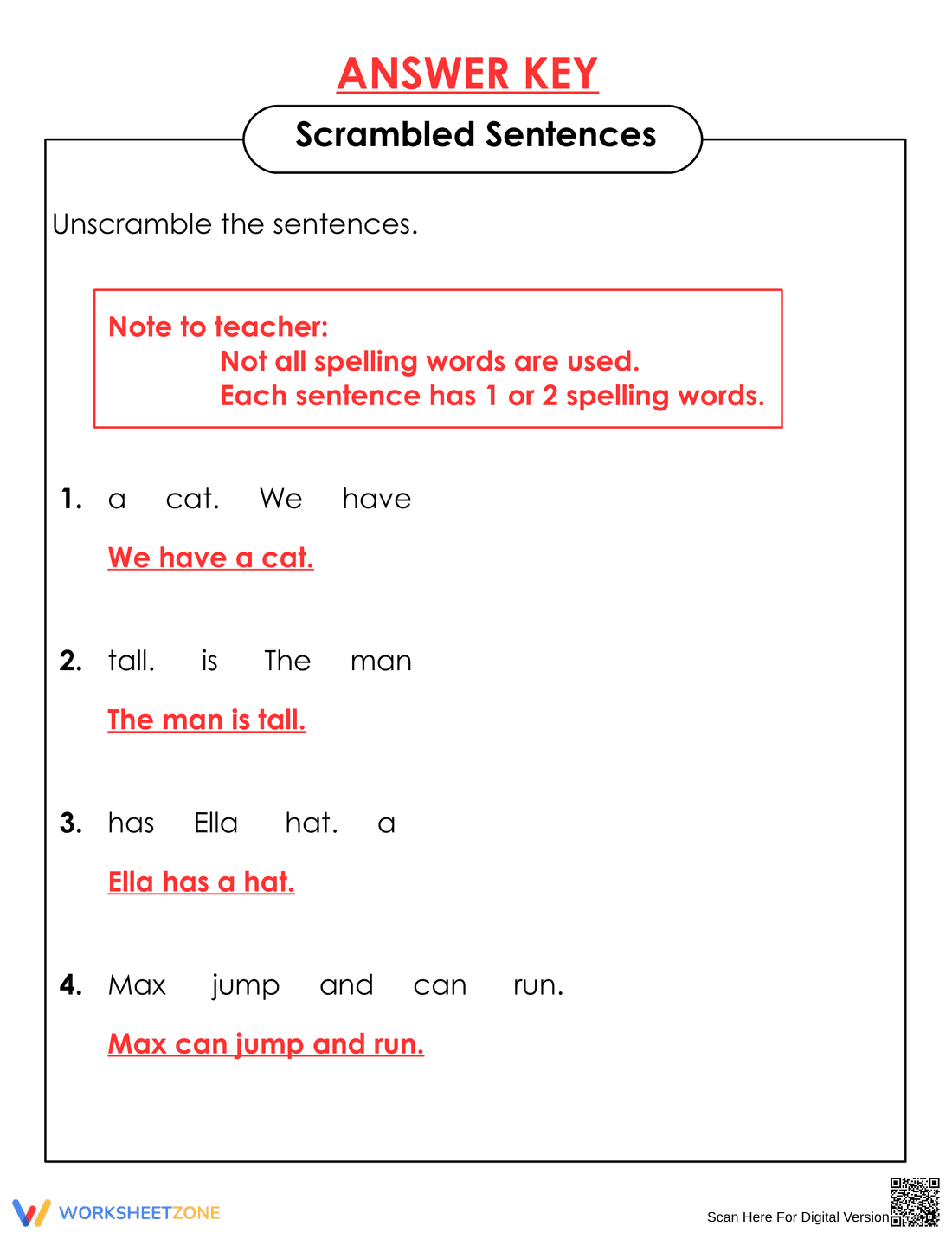
This resource contains a single-page activity featuring 4 scrambled sentence exercises designed for young learners. Each task presents a jumbled set of words that students must reorder and write correctly on primary handwriting lines. The layout includes clear spacing, a cute illustration to engage students, and a complete answer key for quick grading.
This resource is designed for immediate classroom deployment with a simple three-step workflow. First, print the single-page worksheet for your class, taking less than 1 minute. Second, distribute the sheets to students for a quick 10-minute independent activity or warm-up. Third, review the answers using the provided key in under 2 minutes. The total teacher preparation time is under 2 minutes, making this an ideal option for emergency sub plans, morning work, or transition periods.
This activity aligns directly with the Common Core State Standard CCSS.ELA-LITERACY.L.1.1.J, which requires students to produce complete simple sentences. By organizing words into the correct sequence, students demonstrate their understanding of subject-verb agreement and basic syntax. Additionally, it supports capitalization and punctuation standards by requiring proper sentence endings and starting capital letters. Both standard codes can be copied directly into lesson plans, IEP goals, or district curriculum mapping tools.
Use this worksheet during the independent practice portion of a writing lesson to reinforce word order. Alternatively, assign it as a formative assessment exit ticket to check student understanding of sentence structure. Teachers can observe whether students correctly capitalize the first word and place the period at the end. The activity takes approximately 12 minutes to complete.
This resource is ideal for first-grade students learning basic sentence mechanics, but it also serves as a helpful intervention for second graders or an extension for kindergarteners. It pairs naturally with a shared reading passage or an anchor chart showing sentence parts.
According to the Fisher & Frey (2014) framework for gradual release of responsibility, structured syntax practice helps novice writers transition from word-level comprehension to sentence-level production. This worksheet targets CCSS.ELA-LITERACY.L.1.1.J by providing scaffolded word banks that students must organize into logical, grammatically correct sentences. Research indicates that explicit instruction in sentence combining and unscrambling significantly improves reading comprehension and writing quality in early childhood education. By focusing on 4 targeted sentence-building tasks, this resource reinforces the mechanics of capitalization, spacing, and punctuation. Teachers can utilize this structured layout to assess student mastery of syntax conventions and identify specific areas needing intervention. The clear format ensures that students focus entirely on the cognitive task of sentence construction without unnecessary distractions, aligning with best practices for early literacy development.


