


























Views
Downloads



Rearrange the Sentence Worksheet | Grade 1-3 Essential
Paste this activity's link or code into your existing LMS (Google Classroom, Canvas, Teams, Schoology, Moodle, etc.).
Students can open and work on the activity right away, with no student login required.
You'll still be able to track student progress and results from your teacher account.
This Grade 1-3 sentence scramble worksheet helps students master syntax by reordering mixed-up words into coherent, grammatically correct sentences. By focusing on word order and punctuation cues, learners develop a stronger grasp of sentence structure and logical flow. It is an effective tool for building foundational writing confidence.
At a Glance
At a Glance
- Grade: 1-3 · Subject: ELA
- Standard:
CCSS.ELA-LITERACY.L.1.1.J— Produce and expand complete simple and compound sentences in response to prompts- Skill Focus: Sentence Scramble & Syntax
- Format: 1 page · 5 problems · Answer key included · PDF
- Best For: Independent practice or morning work
- Time: 10–15 minutes
What's Inside
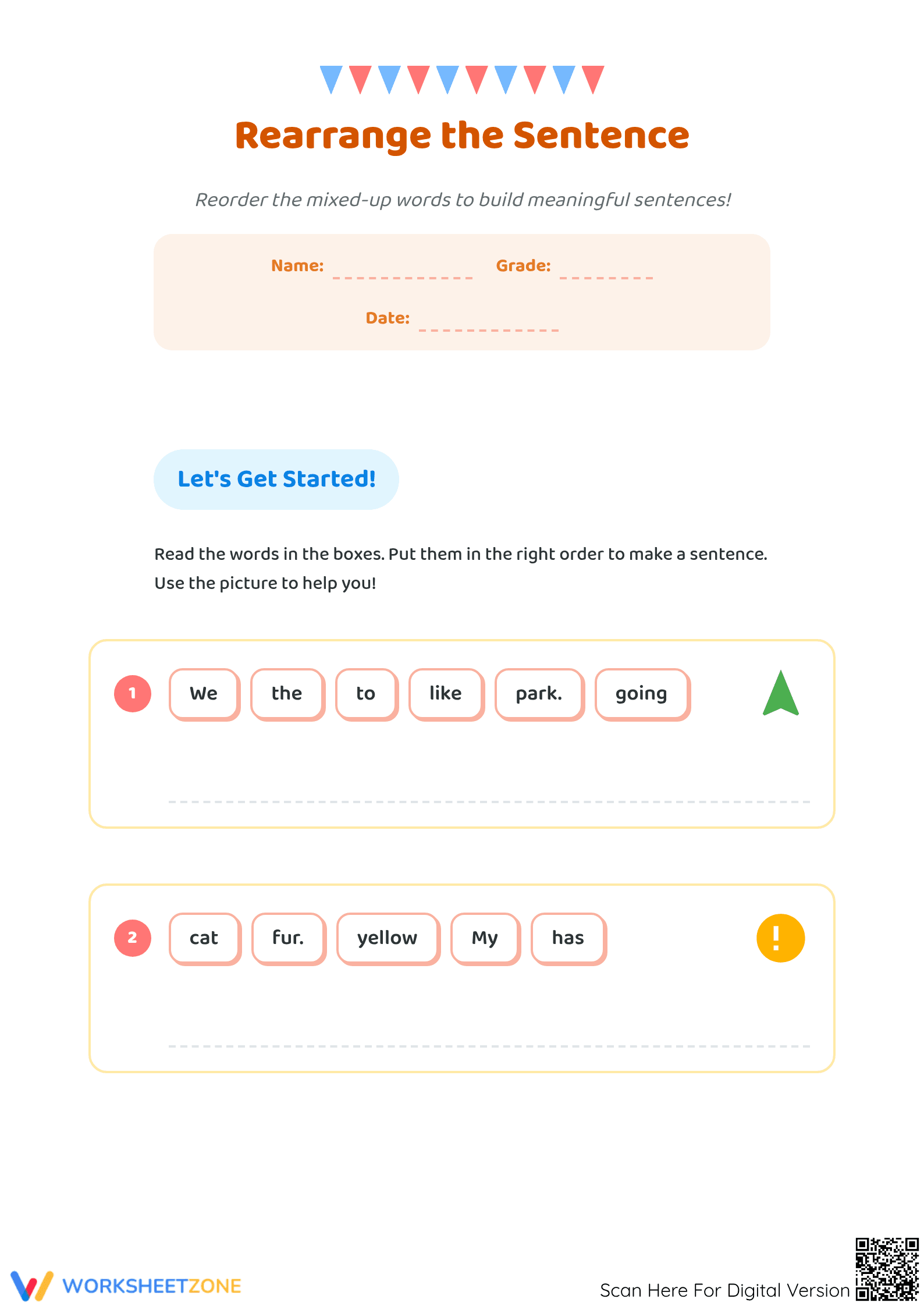
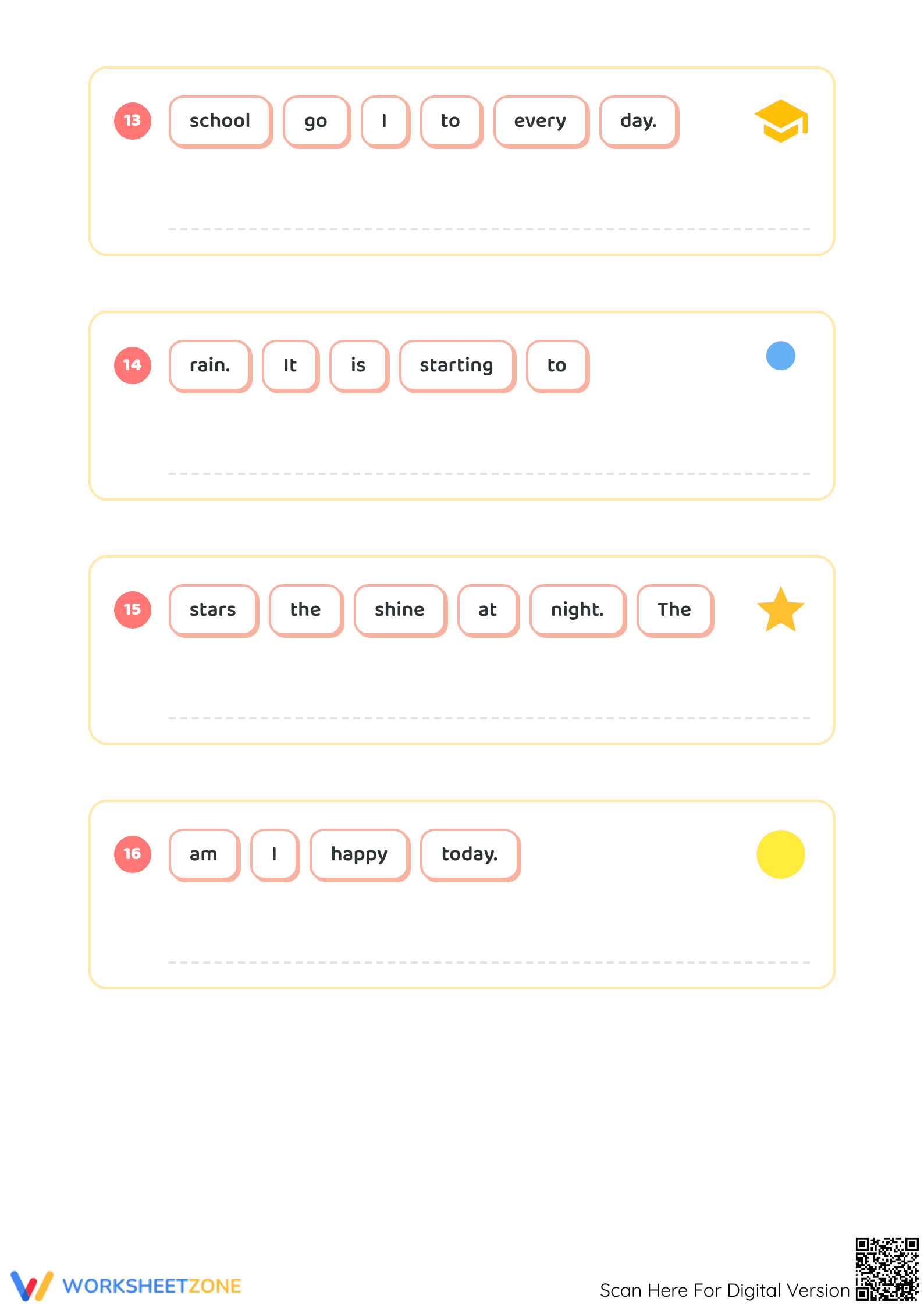
This single-page PDF features 5 distinct sentence-building tasks. Each task provides a set of boxed words—including capitalized starters and punctuated endings—to guide the student. Visual icons like a bicycle or a cat provide context clues to assist with decoding. Clear dashed lines are provided for neat handwriting practice as students transcribe their final sentences.
Zero-Prep Workflow
This resource is designed for immediate classroom implementation with a total teacher prep time of under 2 minutes. The workflow is straightforward:
- Print: Select the single-page PDF and print enough copies for your class (30 seconds).
- Distribute: Hand out the worksheets as a transition activity or morning work (1 minute).
- Review: Use the included answer key to quickly check student work or review as a group (5 minutes).
Because the instructions are self-explanatory and visual cues are provided, this worksheet is also an ideal candidate for emergency sub plans.
Standards Alignment
The primary focus is `CCSS.ELA-LITERACY.L.1.1.J`, which requires students to produce and expand complete simple and compound sentences. By physically rearranging words, students internalize the "Subject-Verb-Object" pattern common in English syntax. This standard code can be copied directly into lesson plans, IEP goals, or district curriculum mapping tools.
How to Use It
Use this worksheet as a formative assessment after a lesson on sentence parts. Observe if students recognize that the capitalized word begins the sentence and the word with the period ends it. It also functions well as a quiet "bell-ringer" activity. Expect students to complete the 5 tasks within a 10 to 15-minute window.
Who It's For
This resource is ideal for first through third-grade students, particularly those struggling with word order or English Language Learners (ELL) who need visual support for vocabulary. It pairs naturally with a grammar anchor chart or a direct instruction lesson on parts of speech.
Research by Fisher & Frey (2014) emphasizes the importance of scaffolded writing where students manipulate existing language structures before generating original text. This worksheet applies that principle by providing the necessary vocabulary while requiring the cognitive work of syntactic arrangement. By focusing on `CCSS.ELA-LITERACY.L.1.1.J`, the activity ensures that students are not just identifying words but are understanding the functional relationships between them. According to the RAND AIRS 2024 report, structured syntax practice in early elementary grades is a significant predictor of later reading comprehension success. This 5-task exercise provides the repeated exposure needed for students to recognize sentence boundaries and logical sequencing. It serves as a bridge between simple word recognition and the complex task of independent composition, making it a staple for any evidence-based literacy curriculum. The inclusion of visual aids further supports the NAEP findings that multi-modal cues improve retention in early learners.


