


























Views
Downloads
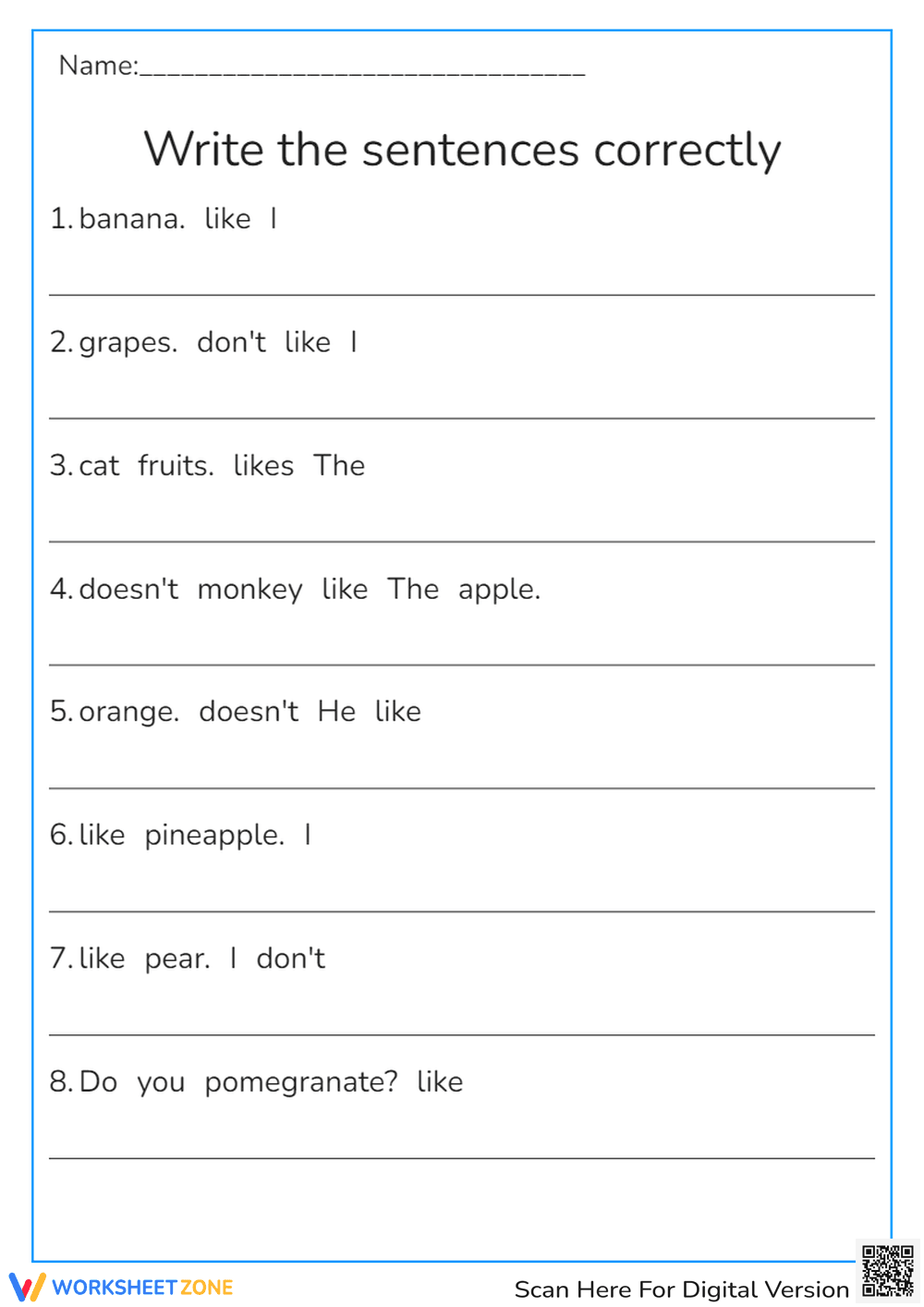

Printable Sentence Scramble Worksheet | Grade 1 ELA
Paste this activity's link or code into your existing LMS (Google Classroom, Canvas, Teams, Schoology, Moodle, etc.).
Students can open and work on the activity right away, with no student login required.
You'll still be able to track student progress and results from your teacher account.
This Grade 1 sentence scramble worksheet helps young learners master basic syntax and sentence structure. By rearranging mixed-up words into logical statements, students practice capitalization, punctuation, and subject-verb agreement. This focused activity builds foundational writing skills, ensuring early readers can construct complete, meaningful sentences with confidence.
At a Glance
- Grade: 1 · Subject: ELA
- Standard:
CCSS.ELA-LITERACY.L.1.1.J— Produce complete simple sentences- Skill Focus: Sentence Structure and Syntax
- Format: 1 page · 8 problems · Answer key included · PDF
- Best For: Independent practice or morning work
- Time: 10–15 minutes
This single-page resource features eight sentence scramble tasks centered around familiar vocabulary like fruits and animals. Each problem presents jumbled words alongside a blank line, prompting students to rewrite them correctly. The straightforward layout minimizes visual clutter for early elementary students. A complete answer key facilitates quick grading.
This resource is designed for a zero-prep classroom experience:
- Print (1 min): Download the PDF and print. The black-and-white design is ink-friendly.
- Distribute (1 min): Hand out during morning work or literacy centers. No extra materials needed.
- Review (3 mins): Use the answer key to check work or project correct sentences for class review.
With prep time under two minutes, it is perfect for any sub plan.
This worksheet is strictly aligned to CCSS.ELA-LITERACY.L.1.1.J, requiring students to produce and expand complete simple and compound declarative, interrogative, imperative, and exclamatory sentences in response to prompts. It also supports foundational capitalization and punctuation conventions. Both standard codes can be copied directly into lesson plans, IEP goals, or district curriculum mapping tools.
Teachers can deploy this worksheet during literacy centers as an independent practice station after direct instruction on sentence building. Alternatively, it serves as an effective formative assessment tool during morning work. While students complete the eight problems, teachers can circulate the room to observe if learners are naturally capitalizing the first word and placing periods at the end of their statements. The activity typically takes 10 to 15 minutes to complete, making it a highly efficient check for understanding.
This resource is primarily designed for first-grade students developing their early writing and grammar skills. It is also highly beneficial for English Language Learners (ELLs) who need structured practice with English syntax and word order. For differentiation, teachers can pair this worksheet with a visual anchor chart detailing subject-verb-object patterns, or provide sentence frames for students requiring additional scaffolding.
Mastering early syntax through activities like unscrambling words is a critical step in literacy development. This worksheet aligns with CCSS.ELA-LITERACY.L.1.1.J, focusing on the ability to produce complete simple sentences. According to Fisher & Frey (2014), providing students with structured, targeted practice in sentence construction significantly improves both their reading comprehension and expressive writing capabilities. When young learners actively manipulate word order, they internalize grammatical rules rather than just memorizing them. This hands-on cognitive task reinforces the relationship between subjects and predicates while solidifying essential conventions like capitalization and end punctuation. By integrating this targeted syntax practice into daily routines, educators can ensure students build the robust linguistic foundation necessary for more complex reading and writing tasks in subsequent grade levels, ultimately fostering long-term academic success.


