


























Views
Downloads


Printable Number of the Day Worksheet | Grade K-1 Math
Paste this activity's link or code into your existing LMS (Google Classroom, Canvas, Teams, Schoology, Moodle, etc.).
Students can open and work on the activity right away, with no student login required.
You'll still be able to track student progress and results from your teacher account.
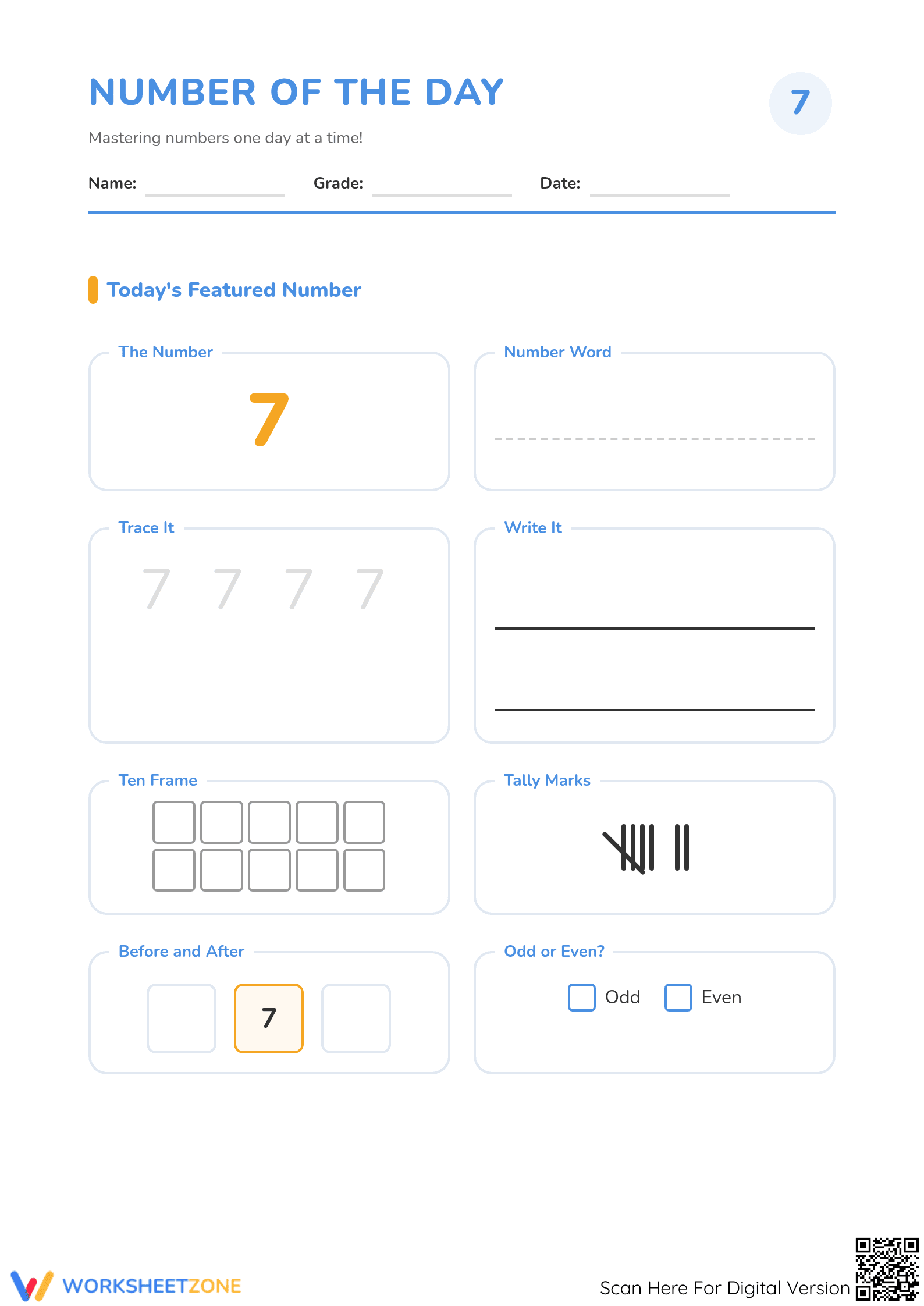
This comprehensive Number of the Day worksheet provides a structured daily routine for kindergarten and first-grade students to build foundational math skills. By engaging with a single number through multiple representations, learners develop a deep understanding of quantity, cardinality, and numerical relationships. This activity transforms abstract symbols into concrete concepts through visual and tactile exercises.
At a Glance
- Grade: Kindergarten · Subject: Math
- Standard:
CCSS.MATH.CONTENT.K.CC.B.4— Understand the relationship between numbers and quantities; connect counting to cardinality.- Skill Focus: Number representation and sense
- Format: 2 pages · 16 tasks · Answer key included · PDF
- Best For: Daily morning math warm-up routines
- Time: 10–15 minutes
What's Inside
Inside this 2-page PDF, you will find a primary sheet focused on a featured number and a secondary challenge sheet for higher numerical values. Each page contains modules for tracing, numeral writing, ten-frame visualization, tally mark recording, sequencing boxes for "before and after" logic, and an odd/even parity check. A dedicated "Draw Items" box at the bottom encourages creative representation of the specific quantity.
Zero-Prep Workflow
This zero-prep resource is designed for immediate classroom integration. The workflow is streamlined for maximum efficiency:
- Print: Send the 2-page PDF to your printer in seconds.
- Distribute: Hand out the sheets as students enter the room for a quiet, focused start.
- Review: Spend three minutes checking the work together on an interactive whiteboard.
Standards Alignment
The worksheet is strictly aligned to the primary standard `CCSS.MATH.CONTENT.K.CC.B.4`, which requires students to connect counting to cardinality. It also supports `CCSS.MATH.CONTENT.1.NBT.A.1` by requiring students to read and write numerals and represent a number of objects with a written numeral. Both standard codes can be copied directly into lesson plans, IEP goals, or district curriculum mapping tools.
How to Use It
Use this worksheet as a consistent morning "Bell Ringer" to ground students in math logic before starting a new lesson. During the activity, walk around the room to observe how students handle the tally marks; this provides a quick formative assessment of their ability to group items by five. It also works well as a post-instruction check to verify that students can translate a digit into a visual ten-frame representation.
Who It's For
This resource is tailored for Kindergarten and Grade 1 students who are mastering numbers within 20. It is particularly effective for English Language Learners (ELL) who benefit from the word-to-numeral association. Pair this worksheet with a physical 100-chart or a set of unifix cubes to provide a hands-on extension for students who need more concrete support before moving to the paper-and-pencil tasks.
Research from the RAND AIRS 2024 report suggests that structured routines in early childhood math significantly improve long-term retention of number sense. This Number of the Day worksheet applies these findings by requiring students to engage with the standard code `CCSS.MATH.CONTENT.K.CC.B.4` through diverse modalities. By translating a single number into tallies, ten-frames, and written words, learners bridge the gap between abstract symbols and physical quantity. The inclusion of a challenge section for higher numbers ensures that the cognitive demand remains appropriate as students progress. This multi-modal approach aligns with evidence-based practices for developing subitizing skills and numerical fluency. Educators can confidently use this tool as a reliable data point for progress monitoring in early numeracy. The 16 included tasks provide sufficient practice to ensure mastery of the plain-English skill of identifying, representing, and comparing whole numbers in a classroom setting.


