


























Views
Downloads

Kindergarten Number 4 Worksheet | Printable Daily Math
Paste this activity's link or code into your existing LMS (Google Classroom, Canvas, Teams, Schoology, Moodle, etc.).
Students can open and work on the activity right away, with no student login required.
You'll still be able to track student progress and results from your teacher account.
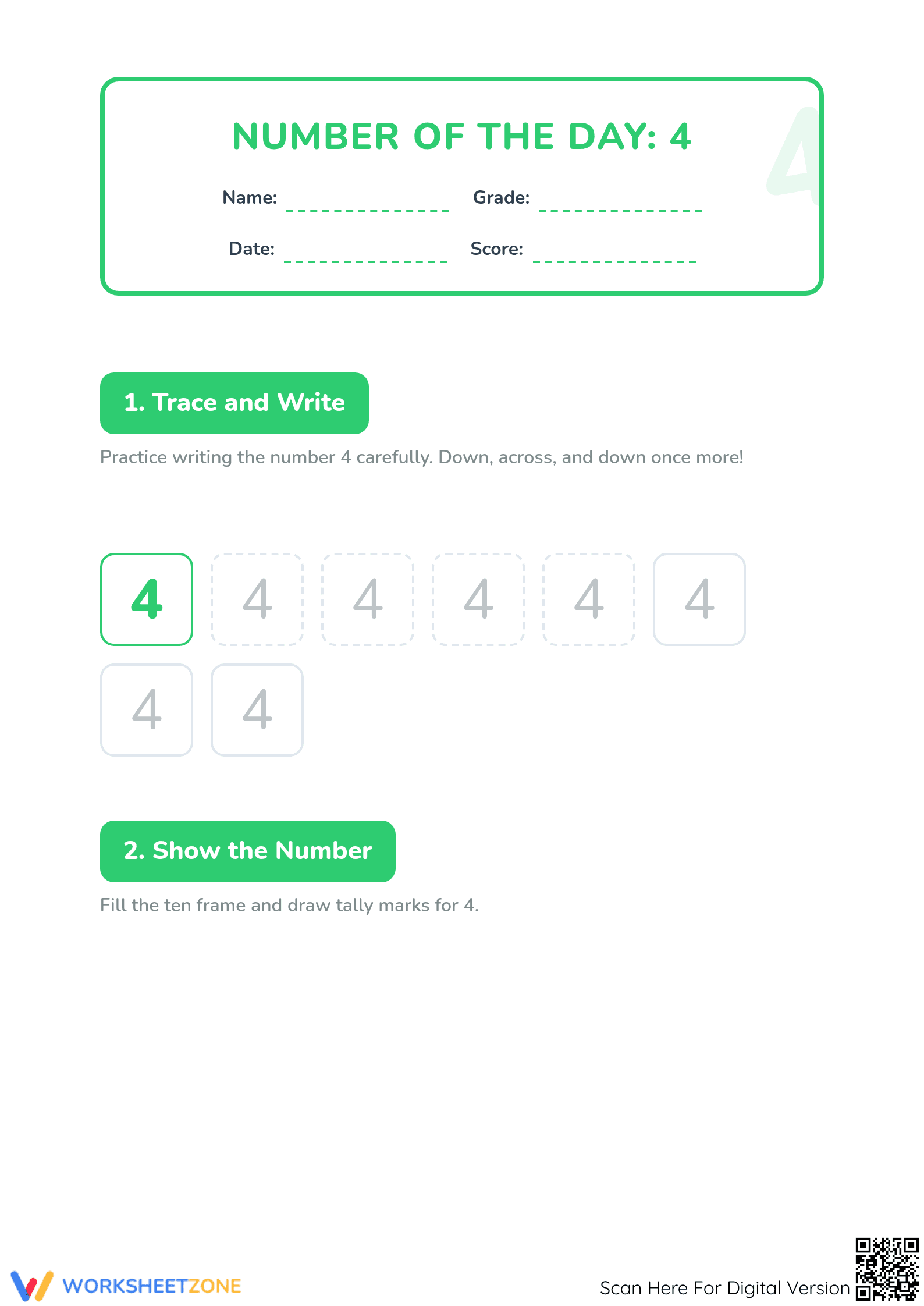
This comprehensive four-page worksheet helps early learners master the number 4 through multisensory representation and basic arithmetic. Students practice tracing, drawing, and counting to build a solid foundation in number sense and early operations. By engaging with different visual models, children develop the cardinality skills necessary for kindergarten math success.
At a Glance
- Grade: K–1 · Subject: Math
- Standard:
K.CC.A.3— Write numbers and represent a number of objects with a numeral- Skill Focus: Number 4 representation and operations
- Format: 4 pages · 24 tasks · Answer key included · PDF
- Best For: Morning work and daily math routines
- Time: 15–20 minutes
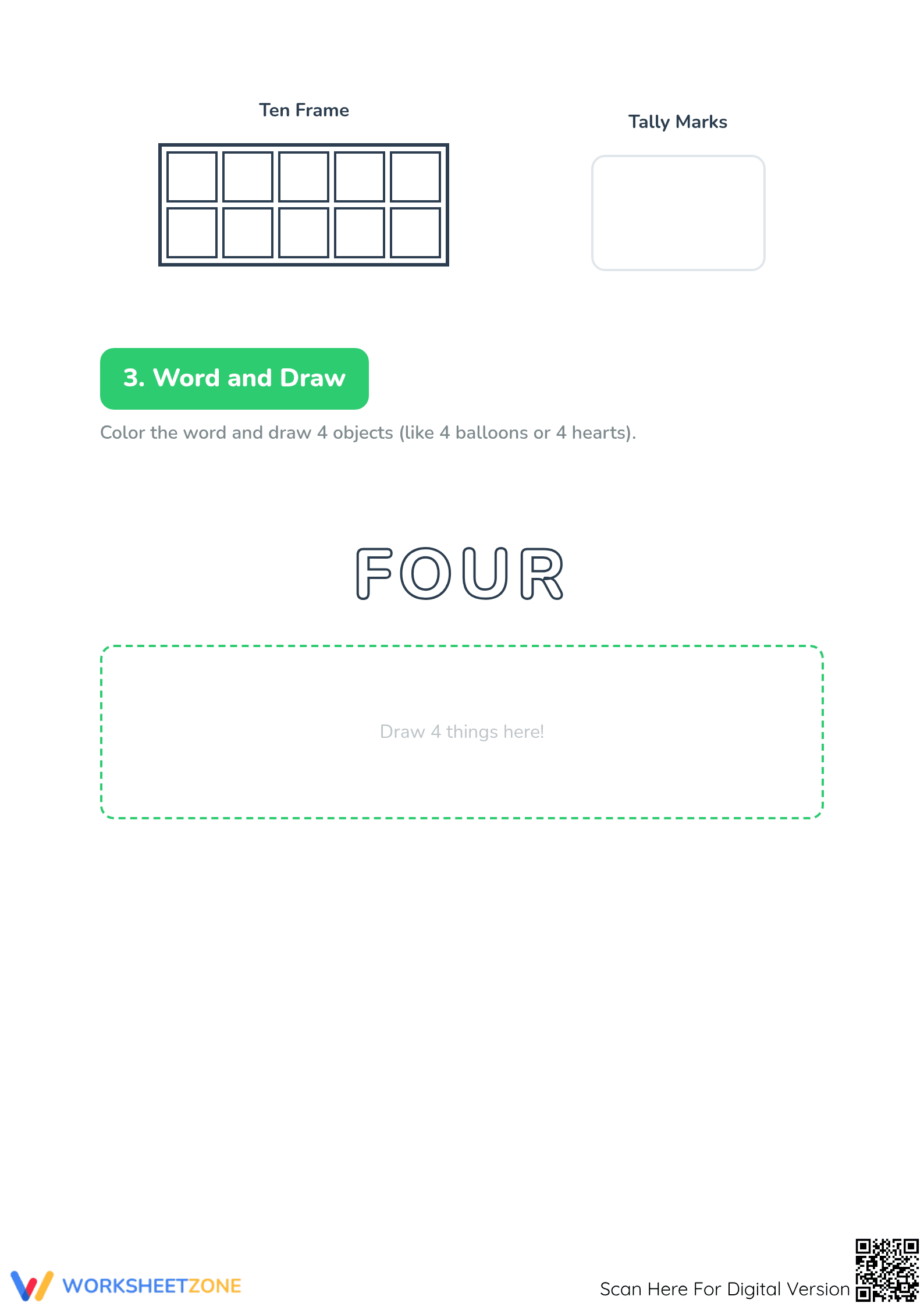
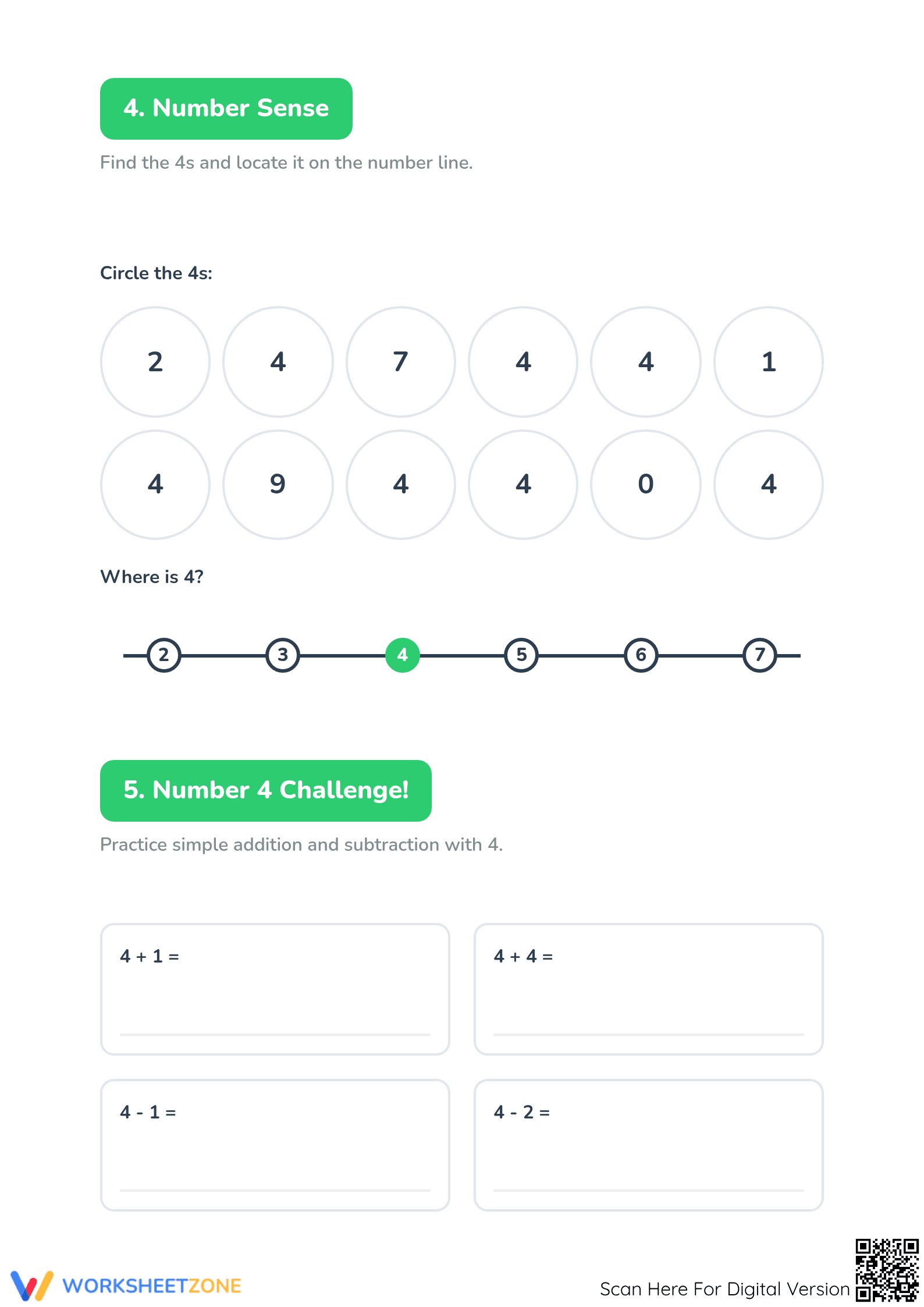
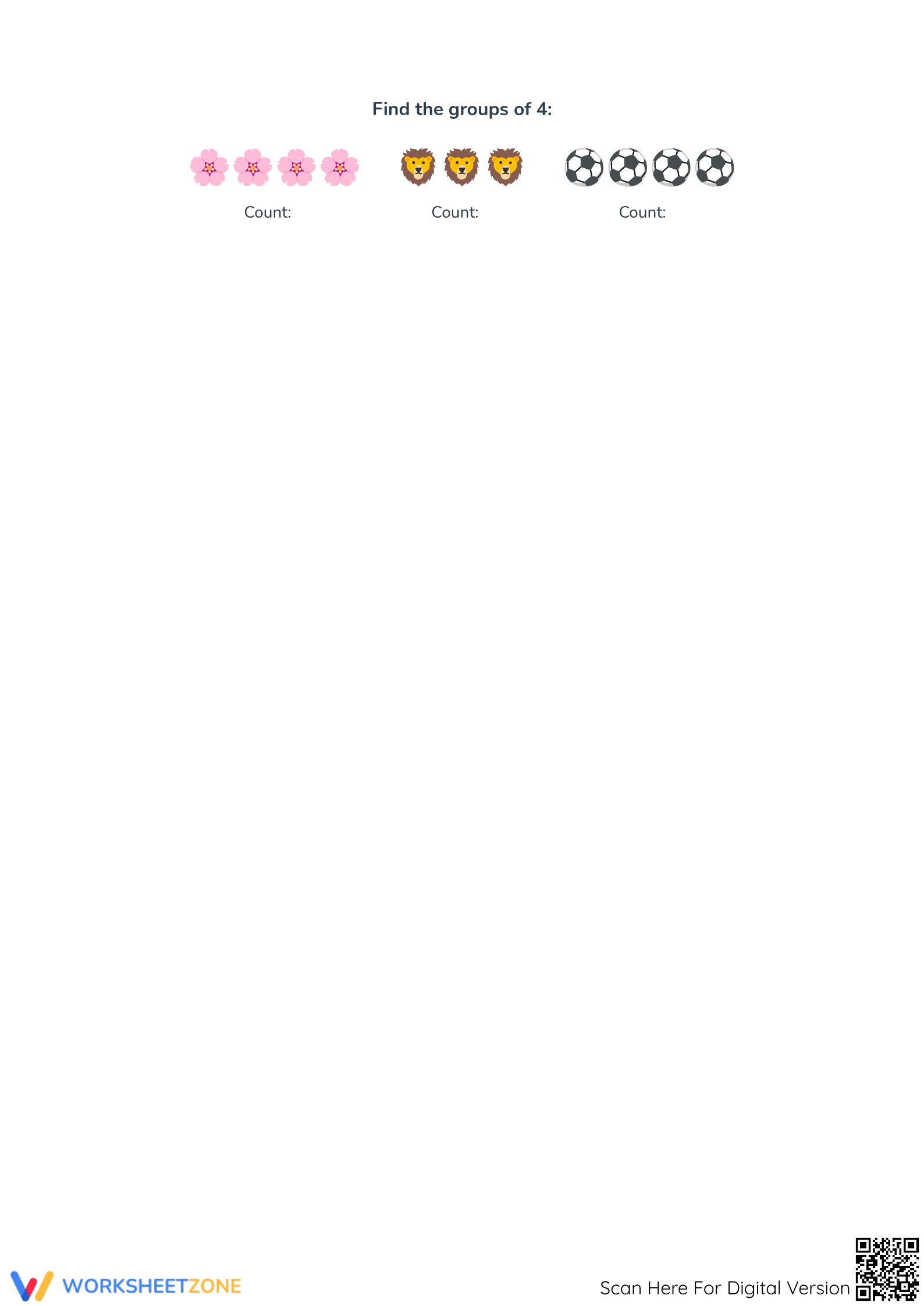
This resource includes four detailed pages featuring tracing guides, ten-frame grids, tally mark boxes, and a number line for spatial awareness. The packet also provides simple addition and subtraction problems involving 4, a "circle the 4s" visual discrimination game, and a final page of group counting exercises. Every task is structured to ensure students can work independently with minimal teacher guidance.
Zero-Prep Workflow
This resource is designed for an immediate classroom workflow that prioritizes teacher efficiency. First, print the four-page packet for the whole class, which takes roughly thirty seconds. Second, distribute the sheets for independent morning work, math centers, or as a focused sub plan. Finally, review the work using the included answer key for quick self-correction or small-group discussion. Total teacher prep time is under two minutes.
Standards Alignment
The worksheet is aligned to K.CC.A.3, which requires students to write numbers from 0-20 and represent a number of objects with a written numeral. It also supports K.OA.A.1 through introductory addition and subtraction expressions that use 4 as a base. Both standard codes can be copied directly into lesson plans, IEP goals, or district curriculum mapping tools for easy documentation.
How to Use It
Use this as a "Number of the Day" anchor activity during your morning meeting to establish counting routines and numerical fluency. It also works as an effective formative assessment tool—observe how students transition from concrete counting of objects to the abstract representation of the number line. The expected completion time for the entire four-page set is approximately 20 minutes for most kindergarteners.
Who It's For
This packet is specifically crafted for Kindergarten and Grade 1 students developing foundational numeracy. It is particularly effective for students requiring extra visual supports, such as ten frames and tally marks, to grasp number value. The material pairs perfectly with a number line anchor chart or a counting-bears manipulatives lesson to reinforce the concept of "fourness" in various contexts.
Standards-aligned practice with the number 4 is critical for developing the early cardinality skills required for later algebraic thinking. According to EdReports 2024, high-quality math instructional materials that integrate multiple representations—such as the ten frames and tally marks seen here—significantly improve long-term retention of number sense in primary grades. This worksheet specifically addresses the transition from counting to written numeral representation (K.CC.A.3), a key milestone in the Kindergarten curriculum. By combining visual discrimination tasks with basic arithmetic, the resource ensures students move beyond rote memorization into functional math literacy. Educators can confidently use these structured tasks to bridge the gap between concrete manipulatives and abstract symbol recognition in standard-aligned classrooms. This pedagogical approach supports the development of mental math strategies and prepares students for more complex operations in Grade 1 and beyond.


