


























Views
Downloads


Essential Number of the Day Worksheet | Grade 2 Math
Paste this activity's link or code into your existing LMS (Google Classroom, Canvas, Teams, Schoology, Moodle, etc.).
Students can open and work on the activity right away, with no student login required.
You'll still be able to track student progress and results from your teacher account.
This Grade 2 Number of the Day worksheet provides a comprehensive daily routine for building essential number sense and place value fluency. By engaging with a single number through multiple representations—including base-ten blocks, expanded form, and word names—students develop the deep conceptual understanding required for advanced mental math and multi-digit operations.
At a Glance
- Grade: 2 · Subject: Math
- Standard:
CCSS.MATH.CONTENT.2.NBT.A.3— Read and write numbers to 1000 using base-ten numerals, number names, and expanded form- Skill Focus: Number Sense & Place Value
- Format: 2 pages · 16 problems · Answer key included · PDF
- Best For: Daily morning work and math warm-ups
- Time: 10–15 minutes
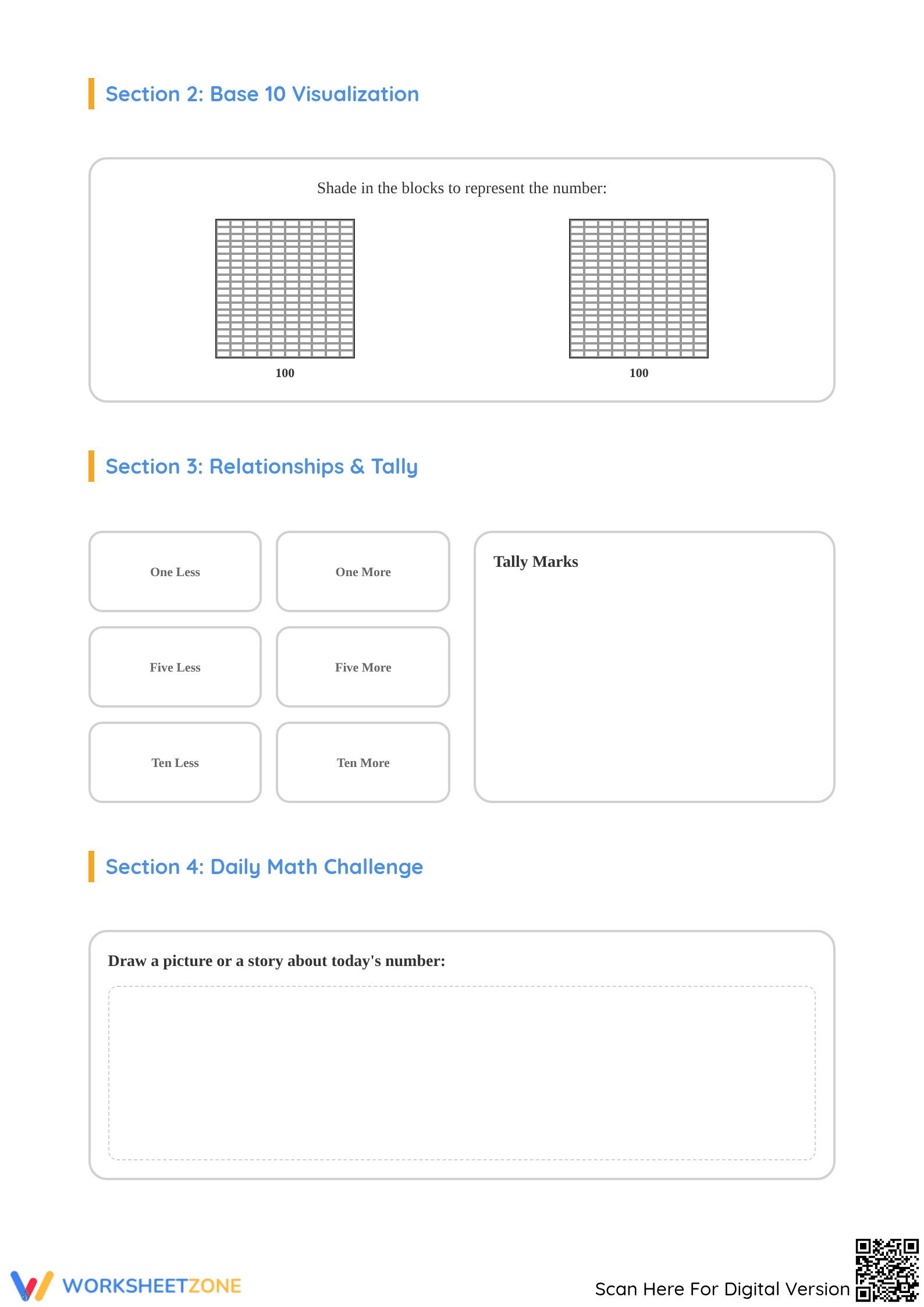
This two-page resource features four distinct sections designed to anchor student understanding. It includes a place value chart for hundreds, tens, and ones, an expanded form equation builder, two 100-block grids for base-ten visualization, a relationship matrix for identifying values more or less than the target, and a creative math challenge space for drawing or storytelling.
The worksheet follows a structured pedagogical flow. First, Guided Practice anchors the number's identity through word names and place value positioning. Next, Supported Practice transitions to visual and algebraic models using base-ten shading and expanded form equations. Finally, Independent Practice challenges students to determine relative values (one, five, and ten more or less) and apply their knowledge through an open-ended drawing task.
This activity is primarily aligned to `CCSS.MATH.CONTENT.2.NBT.A.3`, which requires students to read and write numbers to 1000 using diverse mathematical notations. It also supports `CCSS.MATH.CONTENT.2.NBT.B.8` by asking students to mentally add or subtract 10 or 100 from a given number. Both standard codes can be copied directly into lesson plans, IEP goals, or district curriculum mapping tools.
Use this as a consistent morning routine to start the math block with high-success repetition. It also serves as an effective formative-assessment tool; teachers can observe whether students struggle with the transition from the base-ten visual to the abstract expanded form equation. The worksheet typically takes 10 to 15 minutes to complete during independent seatwork or small-group instruction.
Designed for Grade 2 students, this resource is easily adapted for Grade 1 learners focused on two-digit numbers or as a review for Grade 3. It pairs naturally with physical base-ten manipulatives and classroom hundreds charts to provide a multisensory bridge between concrete and abstract mathematical reasoning and representation.
The Number of the Day instructional strategy is a proven method for reinforcing mathematical literacy through spaced repetition and multiple representations. According to a ScienceDirect TpT Analysis, daily number routines significantly decrease the cognitive load associated with place value tasks by familiarizing students with the underlying structure of the base-ten system. This worksheet targets the CCSS.MATH.CONTENT.2.NBT.A.3 standard, ensuring students can fluently navigate between numerals, word forms, and expanded notation. By requiring students to visualize numbers using blocks and relate them to more or less values, the resource builds the mental agility necessary for complex arithmetic. Educators can use these tasks to identify specific misconceptions in digit value versus face value. This research-backed approach supports long-term retention of number sense skills, making it an essential component of an effective elementary math curriculum. The structured layout ensures that students of all ability levels can access the core content while providing extension opportunities through creative story problems.


