


























Views
Downloads

Missing Addends Worksheet | Grade 2 Math Printable
Paste this activity's link or code into your existing LMS (Google Classroom, Canvas, Teams, Schoology, Moodle, etc.).
Students can open and work on the activity right away, with no student login required.
You'll still be able to track student progress and results from your teacher account.
This missing addends worksheet helps early elementary students build foundational algebraic thinking by solving for unknown numbers in addition equations. By practicing these targeted math problems, learners develop strong number sense and improve their overall addition fluency, setting the stage for more advanced mathematical concepts.
At a Glance
- Grade: 1–2 · Subject: Math
- Standard:
CCSS.MATH.CONTENT.1.OA.D.8— Determine the unknown whole number in an addition equation- Skill Focus: Missing Addends
- Format: 3 pages · 20 problems · Answer key included · PDF
- Best For: Independent practice and review
- Time: 15–20 minutes
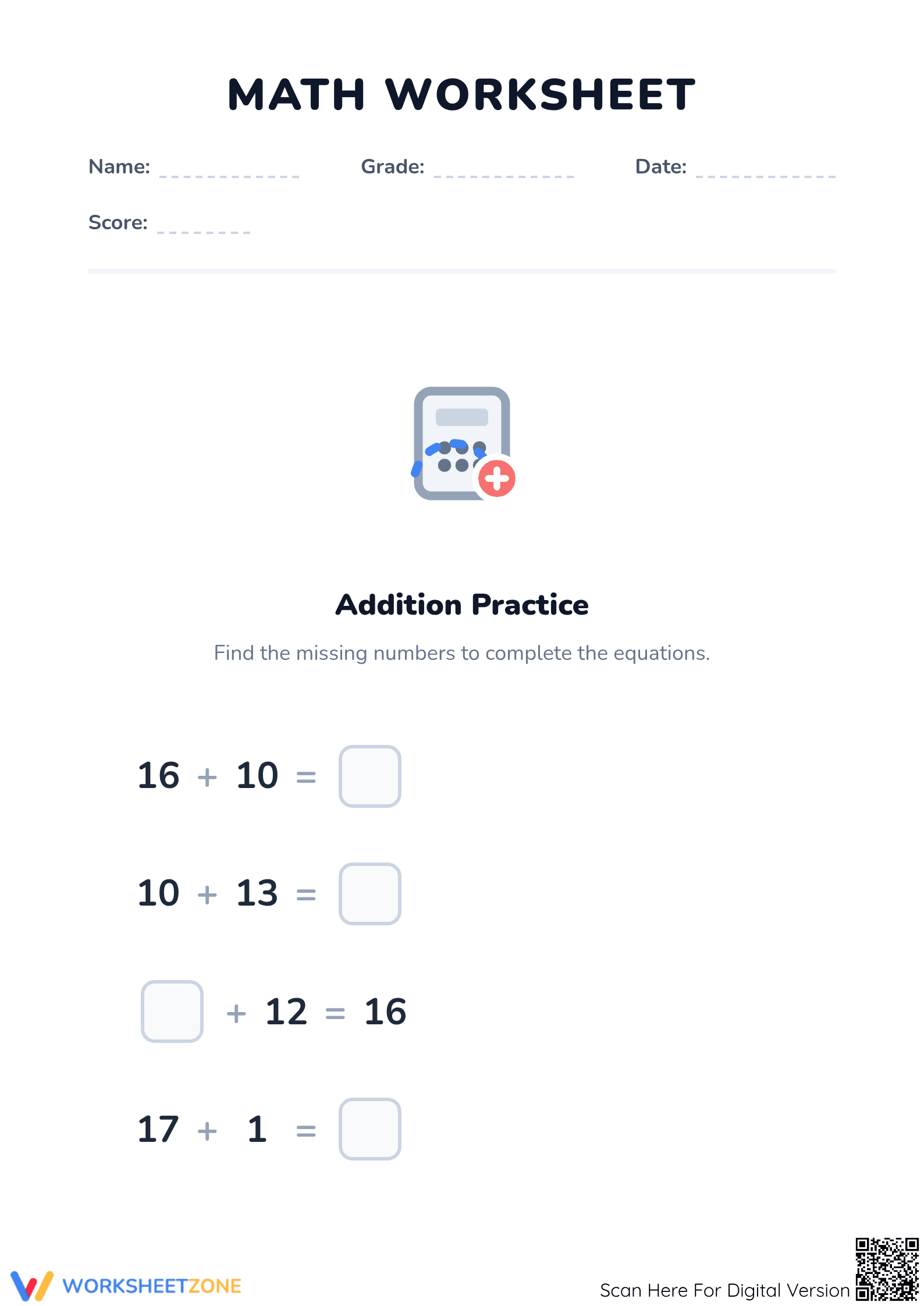
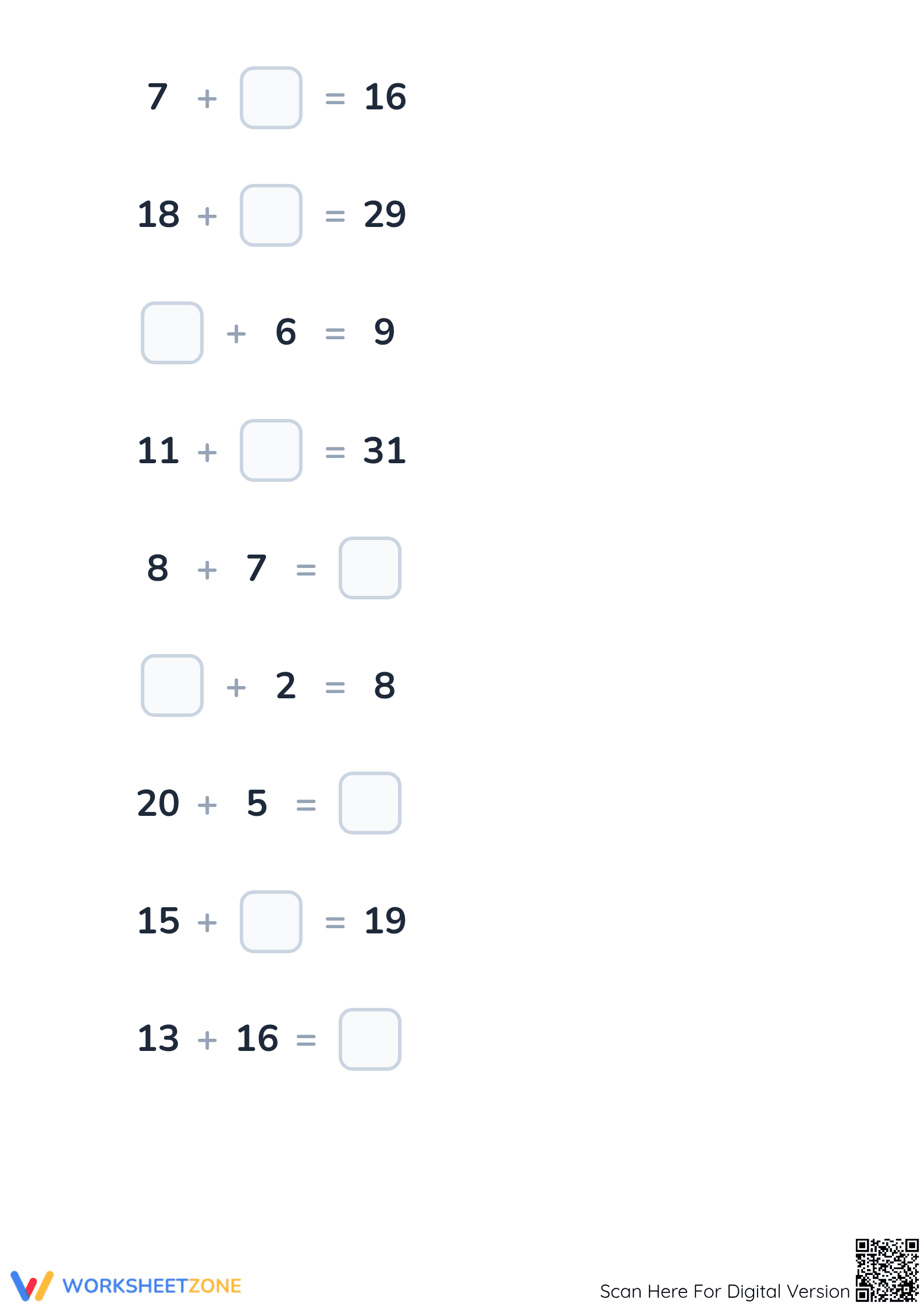
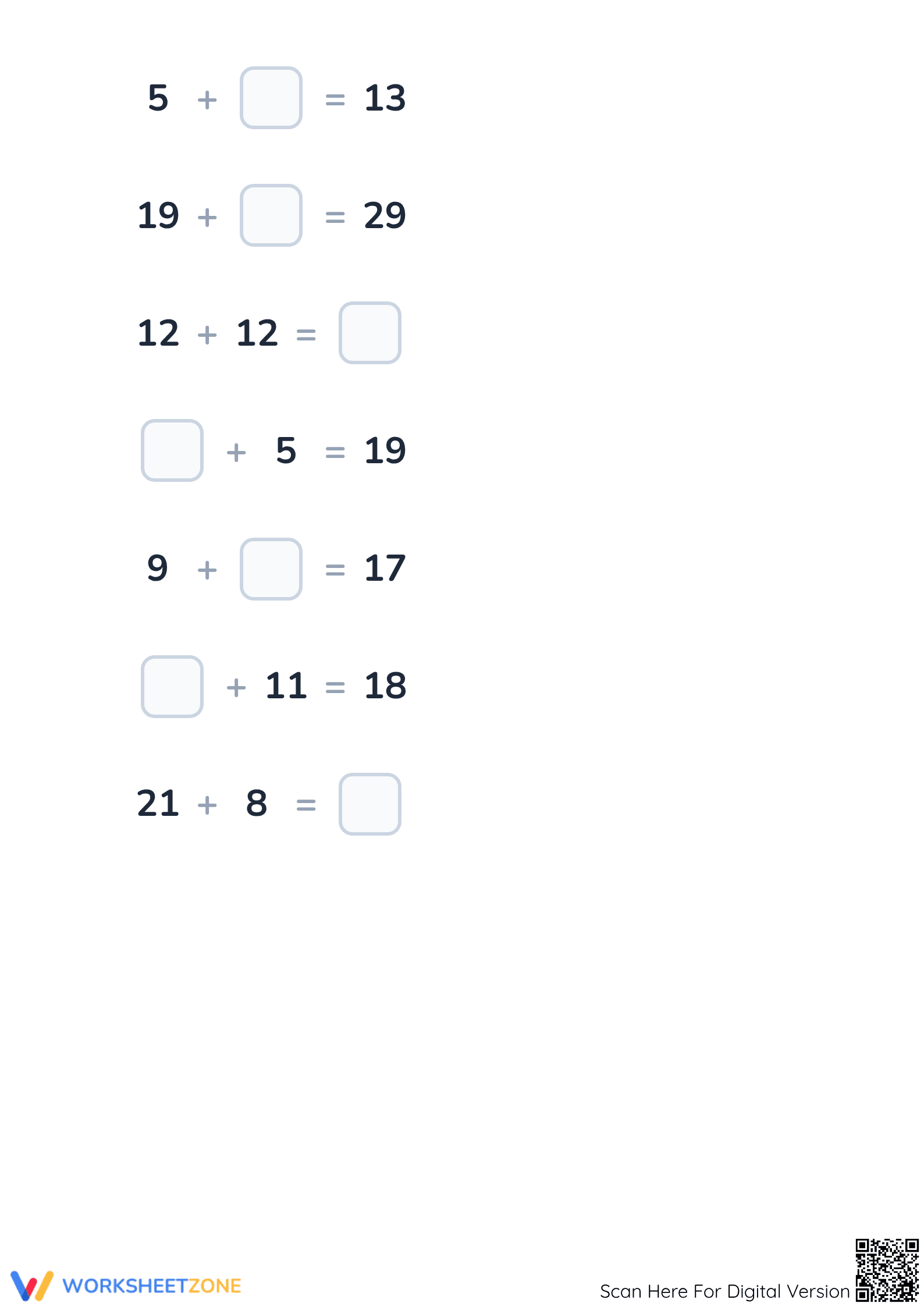
This comprehensive resource includes three pages of focused math practice featuring a total of 20 addition equations. Each problem presents a standard addition sentence with one missing addend, represented by a clear, easy-to-fill box. The equations feature a mix of single-digit and double-digit numbers, with sums ranging up to 31. A complete, separate answer key is provided for all three pages, allowing for quick grading or self-checking by students.
- Guided practice: The first page introduces the concept with four straightforward problems, allowing teachers to model the process of finding the missing part of the equation.
- Supported practice: The second page expands the challenge with nine equations, encouraging students to apply counting on or subtraction strategies with minimal assistance.
- Independent practice: The final page features seven additional problems to solidify mastery and build confidence.
This structured layout perfectly supports a gradual-release, I Do, We Do, You Do instructional model.
This resource is directly aligned to CCSS.MATH.CONTENT.1.OA.D.8: Determine the unknown whole number in an addition or subtraction equation relating three whole numbers. It also supports second-grade fluency standards for addition within 100. Both standard codes can be copied directly into lesson plans, IEP goals, or district curriculum mapping tools.
Deploy this worksheet during independent math centers after your primary direct instruction on addition strategies. It serves as an excellent quiet activity while the teacher pulls small groups for targeted support. Alternatively, assign these pages as morning work to activate mathematical thinking at the start of the day. As students work through the 15 to 20-minute activity, observe whether they use counting-on strategies with their fingers or if they recognize the inverse relationship between addition and subtraction. This formative assessment observation helps identify which learners need additional concrete manipulatives.
This printable is designed for first and second-grade students mastering basic addition and early algebraic concepts. It provides excellent differentiation for advanced first graders needing a challenge or second graders requiring fundamental review. Pair this activity with physical manipulatives like base-ten blocks or a classroom number line anchor chart to support visual and kinesthetic learners.
Mastering the skill to determine the unknown whole number in an addition equation, as outlined in CCSS.MATH.CONTENT.1.OA.D.8, is a critical milestone in early mathematics. Developing proficiency with missing addends transitions students from simple counting to true algebraic thinking. According to a recent ScienceDirect TpT Analysis, structured practice with unknown variables in early elementary grades significantly improves long-term mathematical reasoning and problem-solving capabilities. When students consistently engage with equations that place the unknown in various positions, they build a more flexible understanding of the equals sign as a symbol of equivalence rather than just a prompt to calculate an answer. This foundational number sense is essential for future success in multi-digit operations and advanced algebra. Providing targeted, repetitive practice with these specific equation structures ensures learners internalize these core mathematical relationships effectively.


