


























Views
Downloads


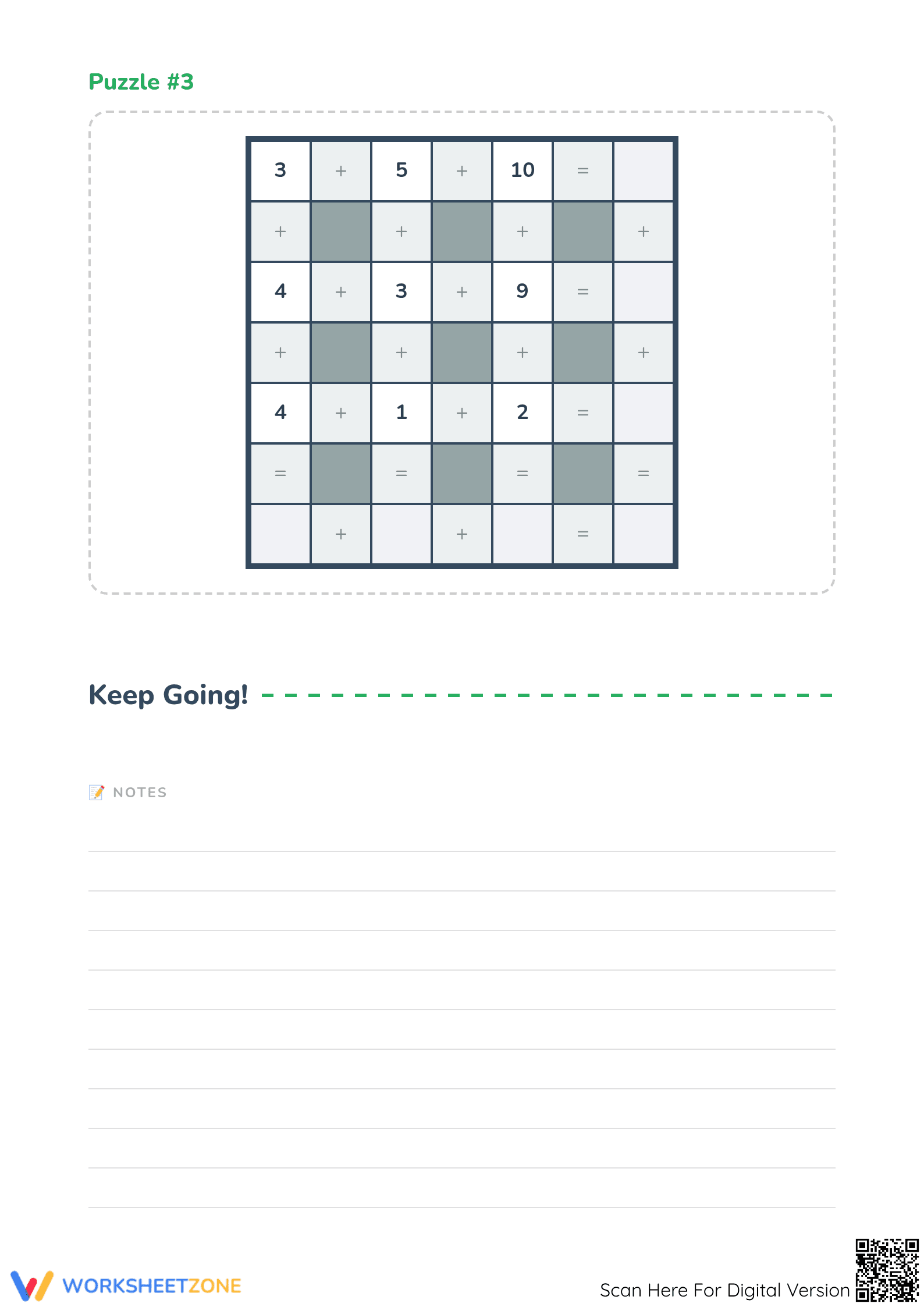


Printable Addition Grid Puzzles | Grade 2 Math
Paste this activity's link or code into your existing LMS (Google Classroom, Canvas, Teams, Schoology, Moodle, etc.).
Students can open and work on the activity right away, with no student login required.
You'll still be able to track student progress and results from your teacher account.
These Addition Grid Puzzles offer a dynamic and engaging way for students to sharpen their mental math skills while developing critical logical reasoning. By filling in missing addends to satisfy both row and column totals, learners move beyond rote memorization into active problem-solving. This collection provides a structured yet playful approach to achieving arithmetic fluency.
At a Glance
- Grade: 2 · Subject: Math
- Standard:
CCSS.MATH.CONTENT.2.OA.B.2— Fluently add and subtract within 20 using mental strategies.- Skill Focus: Addition within 20 and missing addends
- Format: 5 pages · 5 puzzles · Answer key included · PDF
- Best For: Early finisher activities and brain breaks
- Time: 10–15 minutes
Each of the five pages features a single, large-format 3x3 addition grid puzzle designed for clarity and ease of use. The grids contain a mix of given numbers and empty cells, requiring students to calculate totals and find missing values. A complete answer key is provided for every puzzle, allowing for quick self-correction or rapid teacher review.
Zero-Prep Workflow
The zero-prep design ensures this resource is classroom-ready in seconds. These steps help you integrate the puzzles immediately:
- Print (30 seconds): Select the desired number of puzzles and print directly from the PDF.
- Distribute (30 seconds): Hand out the sheets as independent work or center activities.
- Review (1 minute): Use the included answer key for immediate feedback or group discussion.
Total teacher preparation time is less than two minutes, making these puzzles an ideal solution for unexpected sub plans or transition periods.
Standards Alignment
The primary alignment is CCSS.MATH.CONTENT.2.OA.B.2: "Fluently add and subtract within 20 using mental strategies." These puzzles specifically target the relationship between addition and logical deduction. Standard codes can be copied directly into lesson plans, IEP goals, or district curriculum mapping tools.
How to Use It
These puzzles are best utilized during the independent practice phase of a lesson or as a formative assessment tool. Teachers should observe students as they navigate the grid; notice if they start with the rows containing two known numbers, which indicates a strategic understanding of missing addends. Completion typically takes 10 to 15 minutes per puzzle.
Who It's For
While designed for Grade 2 students, these puzzles are highly effective for Grade 1 enrichment or as a logic-based review for Grade 3 learners. They are particularly useful for students who benefit from visual-spatial math tasks. Pair this resource with a number line or addition chart to support learners who are still developing their mental fluency.
According to the RAND AIRS 2024 report on mathematical literacy, integrating puzzles into the primary curriculum significantly increases student engagement and math talk within the classroom. These addition grid puzzles encourage students to apply the Commutative and Associative Properties of addition in a non-threatening, game-like environment. Research by Fisher & Frey (2014) emphasizes that the gradual release of responsibility is most effective when students are given opportunities to apply foundational skills to novel problems. By requiring students to verify sums across two axes, the worksheet reinforces the concept of mathematical consistency and accuracy. This specific puzzle format aligns with the NAEP framework for Grade 4 mathematics assessment, which prioritizes the ability to solve problems involving numerical relationships and patterns. Using such tasks regularly helps bridge the gap between simple calculation and the algebraic thinking required in later grades.


