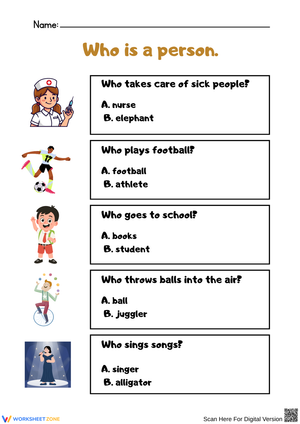
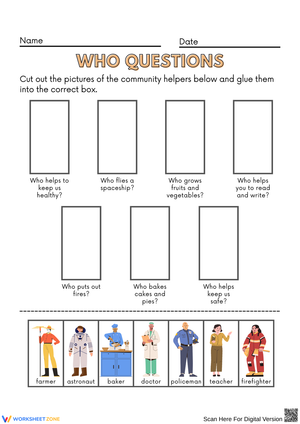
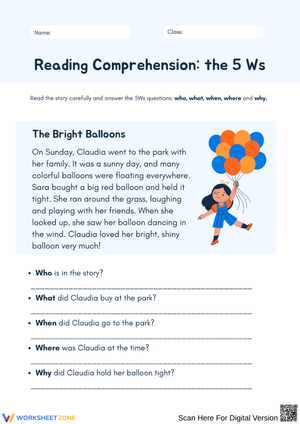
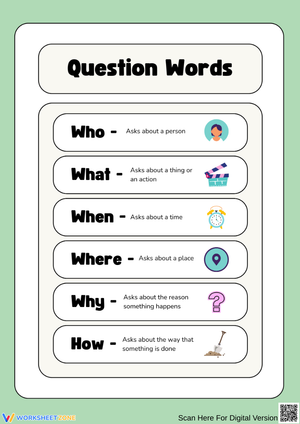
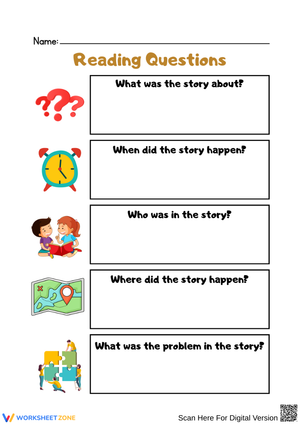
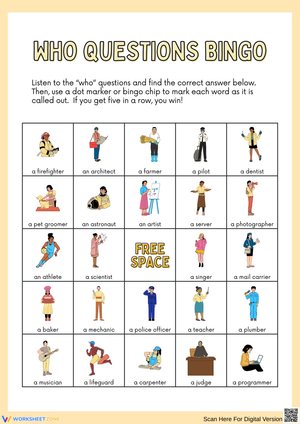
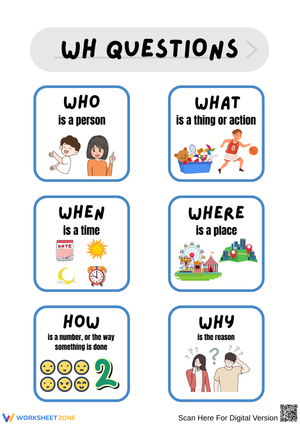
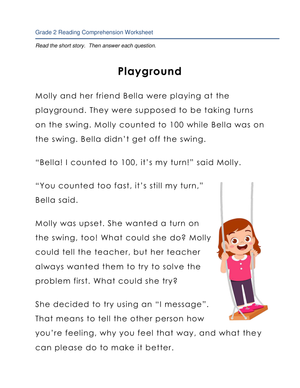
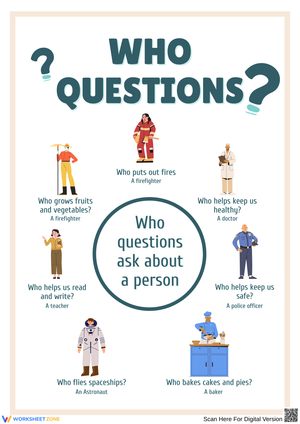
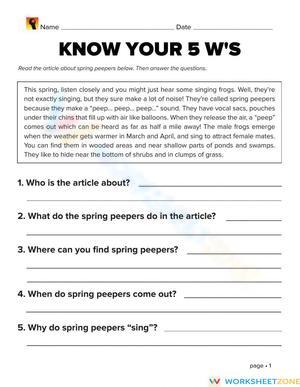
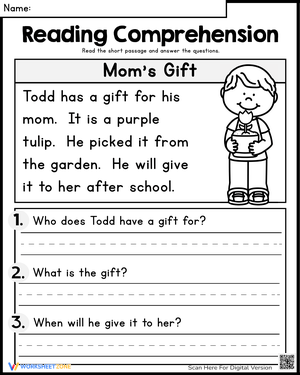
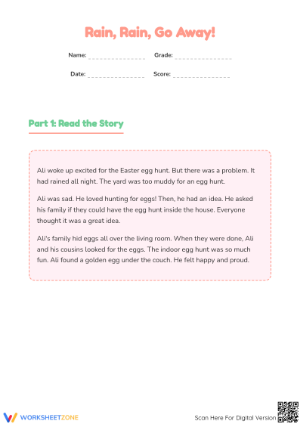
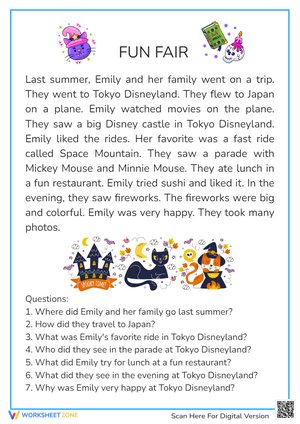
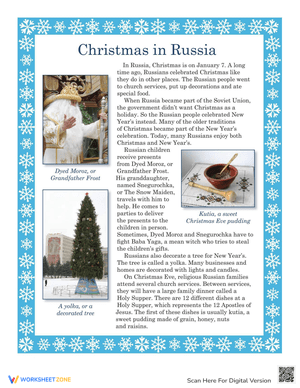
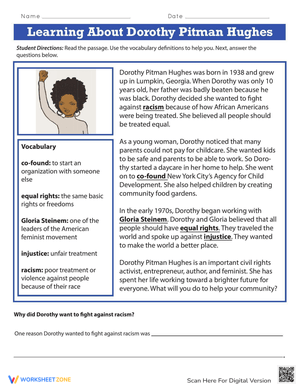
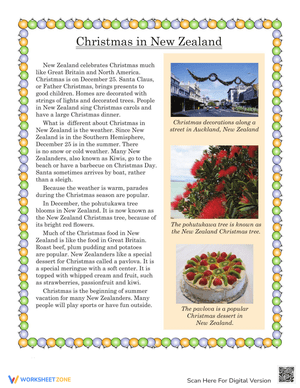
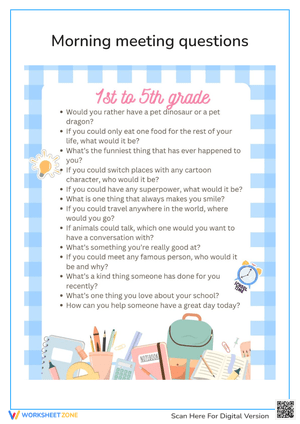
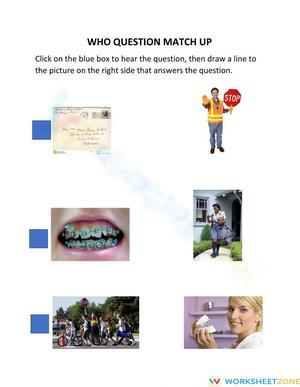
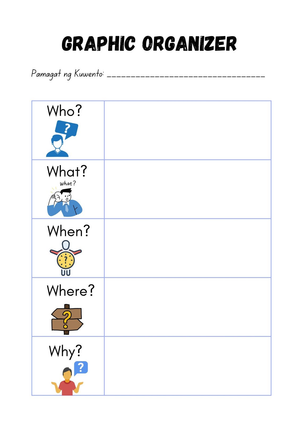
These who what when where why questions worksheets for 1st grade give teachers a ready-made entry point into text comprehension — one that holds up with decodable readers, picture books, and short informational passages alike. Each worksheet pairs a brief text with five targeted prompts, pushing students past word-level decoding into the habit of asking what a text actually means. Both literature and nonfiction are represented, so the questioning framework transfers across the full reading block.
Concepts Targeted in Each Worksheet
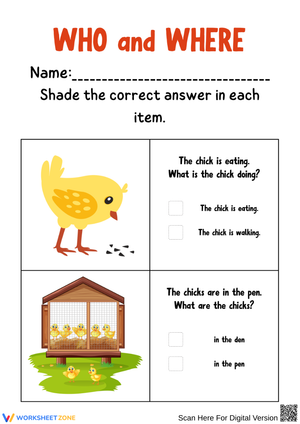
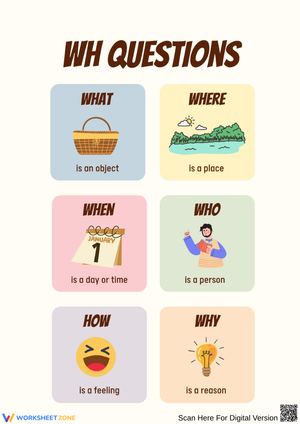
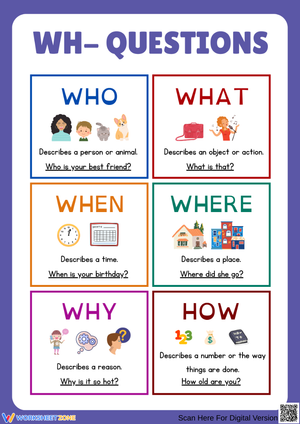
The five questions are not equal in difficulty, and the worksheets reflect that. Who and Where prompts anchor students to the most concrete, findable information — named characters and described locations. What moves into event identification, asking students to isolate the central action or main topic rather than whatever incidental detail caught their eye first. When trains readers to notice temporal language — phrases like "in the morning" or "after the storm" that first graders habitually skim. Why sits at the far end of the difficulty range, requiring students to connect a cause to its effect across sentence boundaries — a cognitive move that most 6-year-olds are just beginning to manage reliably.
Several worksheets include a drawing prompt alongside the written response for the Where question specifically. That drawing box is not decoration. It asks students to construct a mental image of the setting, which reinforces visualization as a comprehension strategy at a moment when most first graders cannot yet express complex ideas in writing.
Frequent Errors That Surface During Practice
The most common problem is students treating Who and What as interchangeable. Asked "Who went to the pond?" a student will often write "the frog went to the pond" — restating the full sentence rather than isolating the subject. That answer is not wrong, exactly, but it signals the student has not yet internalized what "Who" is specifically asking for. A brief follow-up — "Just tell me who did it, not the whole sentence" — usually resolves the error in the moment, but it resurfaces across several practice sessions before it disappears.
The Why question produces a distinct and more persistent error: circular answers. Asked "Why was Maria happy?" students write "because she was happy." They have located the emotion in the text but have not traced it back to its cause. This is developmentally expected at age 6 — inferential thinking is still forming — but it tells the teacher exactly which students need direct instruction on "what made her feel that way?" before they can answer Why questions independently on future worksheets.
Building These Worksheets Into Your Reading Block
The format works best when students have already heard or read the passage at least once before they pick up the worksheet. In guided reading groups, a first read-aloud followed immediately by individual worksheet completion keeps students oriented to the text while it is still fresh. The worksheet then becomes a structured note-catching activity rather than a memory test — a small but meaningful distinction for students who struggle to hold details over time.
For independent centers, these work well once students are comfortable with the format from group sessions. A whole-class introduction using a 5 Ws chart on the board, followed by individual completion, gives students the security of shared modeling before solo practice. Some teachers have also used individual worksheets as a Monday warm-up after a Friday read-aloud — re-exposure to the same text across two days deepens retention without requiring new instructional time. Using who what when where why questions worksheets for 1st grade as a formative tool reveals something specific: students who answer Where correctly but consistently leave Why blank are not struggling globally — they are sitting at the inference threshold, which is precisely where direct instruction should target next.
Standard Alignment
These worksheets address RL.1.1 and RI.1.1 directly. RL.1.1 requires 1st grade students to ask and answer questions about key details in literary texts; RI.1.1 carries the identical expectation into informational reading. Both standards appear in the first cluster of the Grade 1 Reading strand for a deliberate reason: they establish comprehension as an active process from the outset. A student who finishes a passage without forming a single question has decoded but has not read in the full sense. The 5 Ws give students a repeatable set of questions that applies to any text, which is exactly the transfer behavior both standards are trying to build. Who what when where why questions worksheets for 1st grade anchor that habit in daily practice and give teachers a direct line between classroom instruction and standard.
Adjusting the Worksheets for Different Reader Levels
For students still in the early stages of decoding, reading the passage aloud while they follow along removes the word-recognition barrier and lets comprehension work happen at the content level. Providing sentence starters — "Who: The _____ in the story is..." — reduces the writing demand without eliminating the thinking demand. Students at this level often understand the answer but cannot yet produce an independent written sentence; the sentence frame makes their thinking visible without giving the answer away.
The full set of who what when where why questions worksheets for 1st grade works well in mixed-ability classrooms precisely because the questions sit at different cognitive levels. Teachers can hold the same passage constant while adjusting response expectations: students reading above grade level can be asked to cite the specific sentence that supports each answer, and for the Why question, they can extend the response to explain what happened as a result of the cause — moving from cause identification into cause-and-consequence reasoning.
Frequently Asked Questions
How do I introduce the 5 Ws to students who have never worked with them before?
Start with a familiar story — something the class already knows from read-aloud. Ask the five questions orally and record answers on a chart before anyone touches a worksheet. The goal is for students to recognize the concept in conversation first. Once the language of "Who, What, When, Where, Why" feels familiar, the written format becomes a record of a process they have already practiced out loud.
Can these worksheets be used with nonfiction passages?
Yes, and nonfiction often produces cleaner answers for several questions. Who becomes the subject of the article, What becomes the main topic or event, When anchors historical or seasonal information, Where identifies a location or habitat, and Why explains the cause of an event or process. Students sometimes find Why easier in nonfiction because the text states causes more explicitly than stories do — a useful observation when deciding which text type to introduce to the class first.
What should I do if most of my class is consistently leaving the Why question blank?
That pattern signals the class has not yet internalized cause and effect as a concept separate from reading. Spend five minutes before the next worksheet session with a non-text example — "The glass fell off the table. Why did the glass fall?" — and model tracing back from the result to what triggered it. Students often need to see cause-and-effect reasoning applied to everyday events before they can transfer it to a reading passage.












 Interactive Worksheet Maker
 Quiz Maker
 Word Search Maker
 Crossword Puzzle Maker
 Word Scramble Generator
 Sentence Scramble Generator
 Handwriting Worksheet Generator
 Name Tracing Generator
 Fill In The Blank Generator