


























Views
Downloads
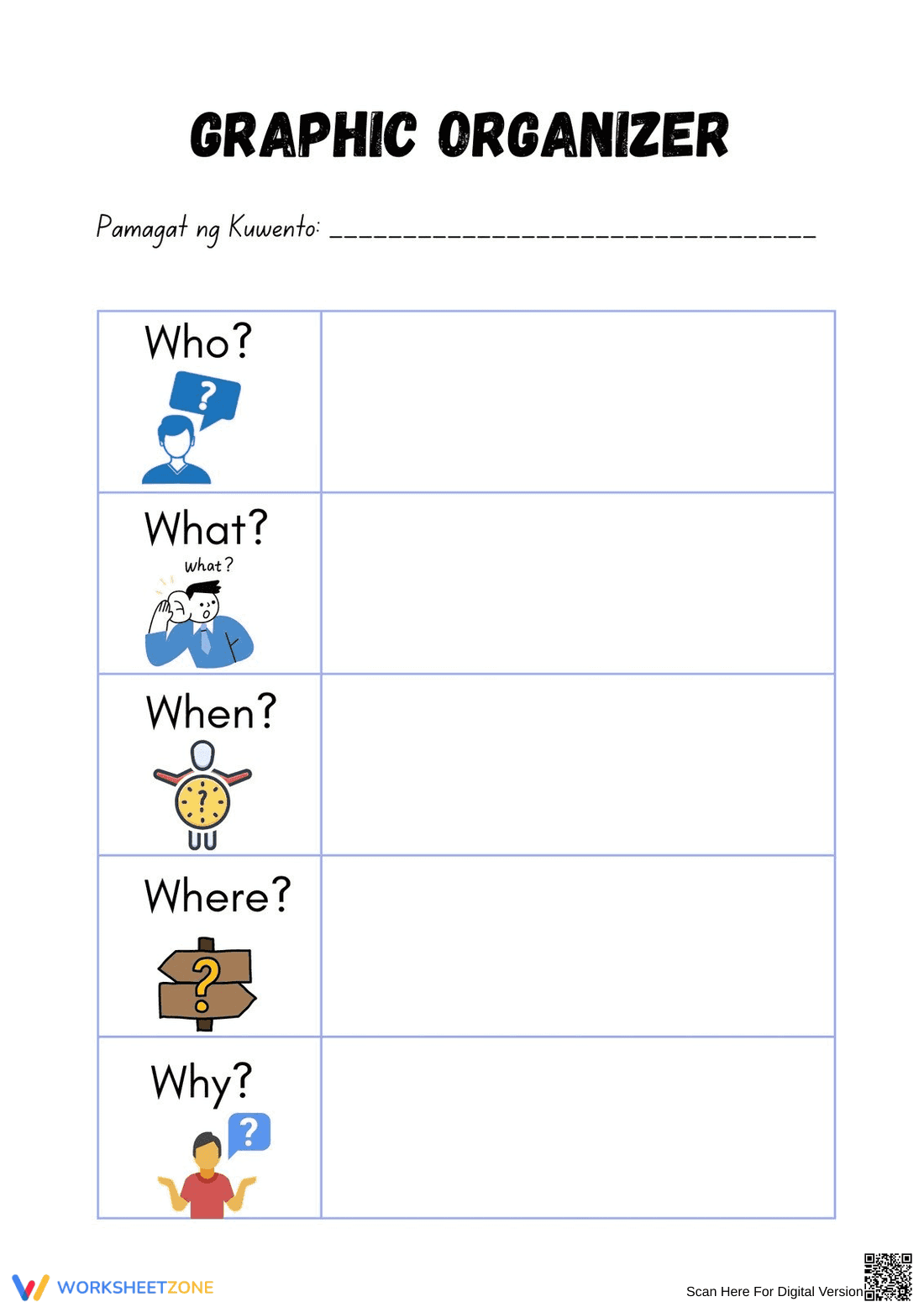

Grade 2 Story Elements — Printable No-Prep Worksheet
Paste this activity's link or code into your existing LMS (Google Classroom, Canvas, Teams, Schoology, Moodle, etc.).
Students can open and work on the activity right away, with no student login required.
You'll still be able to track student progress and results from your teacher account.
This story graphic organizer worksheet helps students identify key details in a text by answering the five Ws: who, what, when, where, and why. By breaking down narratives into these core components, young readers build foundational reading comprehension skills and learn to structure their understanding of any story.
At a Glance
- Grade: 2 · Subject: ELA
- Standard:
CCSS.ELA-LITERACY.RL.2.1— Ask and answer who, what, where, when, and why questions.- Skill Focus: Story Elements (5 Ws)
- Format: 1 page · 5 tasks · No answer key needed · PDF
- Best For: Independent reading response
- Time: 15–20 minutes
Inside this single-page resource, teachers will find a visual graphic organizer divided into five sections. Each features a clear icon and a question prompt—Who, What, When, Where, and Why—alongside blank space for student responses. The layout includes a line for the story title, making it easy to pair with any fiction text. As an open-ended response tool, no answer key is required.
This resource is designed for a zero-prep workflow.
- Print (1 minute): Download the PDF and print a class set.
- Distribute (1 minute): Hand out alongside a read-aloud or independent book.
- Review (2 minutes): Model how to fill in one section, then let students work.
With under two minutes of prep time, this worksheet is perfect for sub plans or literacy centers.
This worksheet is strictly aligned to CCSS.ELA-LITERACY.RL.2.1, which requires students to ask and answer such questions as who, what, where, when, why, and how to demonstrate understanding of key details in a text. It also supports foundational writing skills as students construct sentences to convey their thoughts. Both standard codes can be copied directly into lesson plans, IEP goals, or district curriculum mapping tools.
Teachers can utilize this graphic organizer during independent reading or as a post-read-aloud activity. For a whole-class lesson, read a picture book and have students complete the worksheet to check understanding. Alternatively, place it in a literacy center. As a formative assessment tip, observe whether students can accurately distinguish between the "where" and "when", as these are often confused. Expected completion time is 15 to 20 minutes.
This resource is primarily designed for second-grade students, though it serves as an excellent review tool for third graders or a scaffolded activity for advanced first graders. The visual cues (icons for each W question) provide built-in differentiation for English Language Learners and visual learners who benefit from non-verbal prompts. It pairs perfectly with any narrative text, short story passage, or classroom anchor chart detailing story elements.
Developing strong reading comprehension relies heavily on a student's ability to extract and organize key details from a text. By focusing on the CCSS.ELA-LITERACY.RL.2.1 standard, educators ensure that learners can confidently ask and answer who, what, where, when, and why questions. According to Fisher & Frey (2014), utilizing structured graphic organizers significantly improves students' capacity to retain narrative structures and recall specific textual evidence during independent reading tasks. This visual mapping strategy reduces cognitive load, allowing young readers to focus on meaning-making rather than struggling with blank-page anxiety. When students consistently practice identifying these five core elements, they build a robust framework for more advanced literary analysis in later grades. This targeted approach not only reinforces immediate comprehension but also fosters long-term academic resilience in literacy.


