These 1st grade proper nouns printable worksheets give teachers a focused set of practice materials for one of early grammar's more conceptually specific jumps: the idea that a capital letter signals not just sentence position but the specialness of a name. The set covers people's names, days of the week, months of the year, and pet names — the four categories CCSS L.1.2.a explicitly targets at this grade level. Each worksheet isolates one skill type so teachers can assign based on where students actually are, not just what the unit calendar says is next.
The Developmental Logic Behind This Unit
First graders arrive already holding one reliable capitalization fact: their own name starts with a big letter. Proper noun instruction takes that single anchor and extends its logic outward — to classmates' names, then to days and months, then to pet names. By the end of first grade, the instructional target is automaticity, not conscious rule-recall. Students should write "Tuesday" with a capital without pausing to decide; that habit develops through short, repeated practice across the year, not through a single intensive unit. Two or three brief worksheet sessions a week do more for retention than a full-period lesson once a month.
What Each Worksheet Targets
The set includes five distinct task types, each placing a different cognitive demand on the concept:
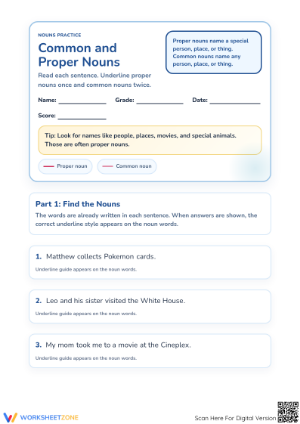
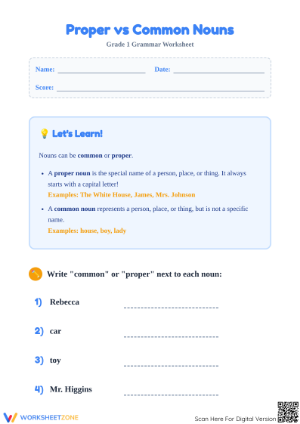
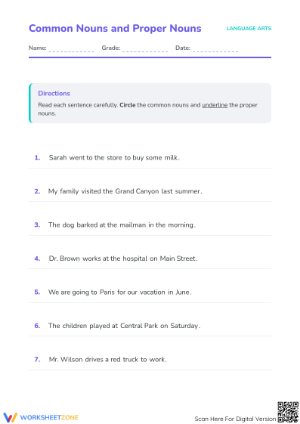
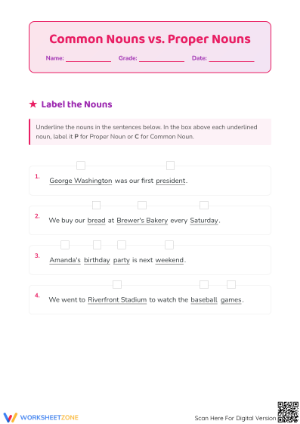
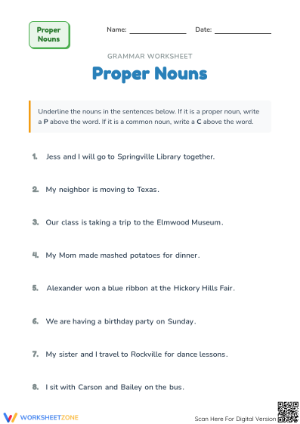
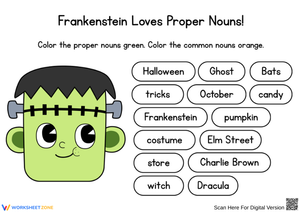
- Identification: Students underline or circle proper nouns within short sentences, learning to distinguish words capitalized because they are names from words capitalized simply because they open the sentence.
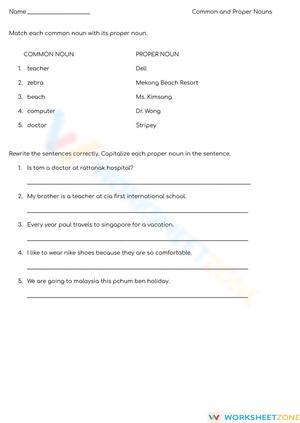
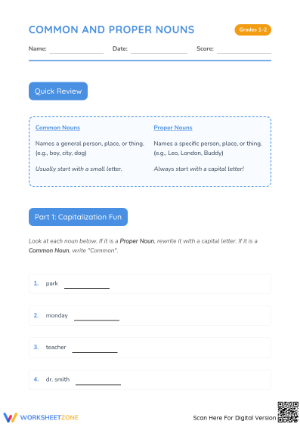
- Rewrite with correction: Students receive sentences where proper nouns appear in lowercase — "my cat is named whiskers" — and rewrite them with accurate capitalization. This makes the rule active rather than passive.
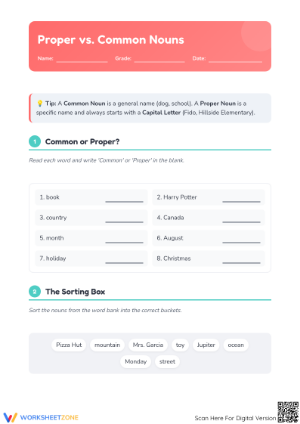
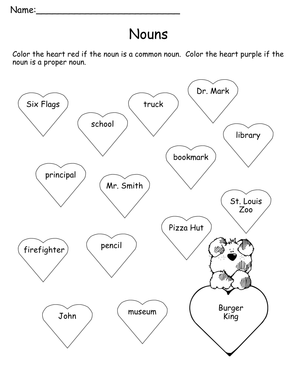
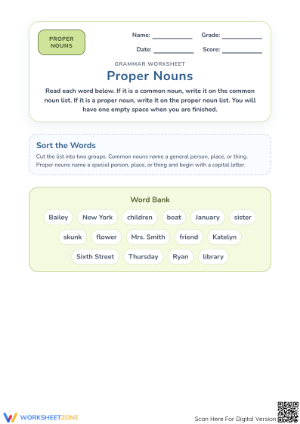
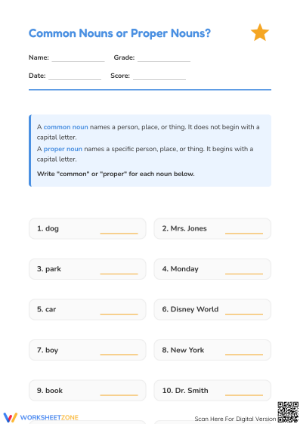
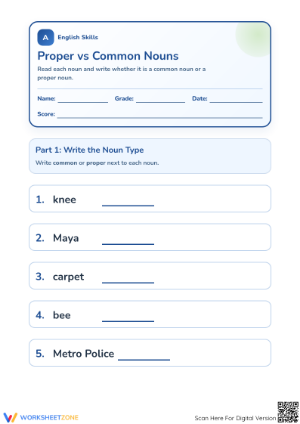
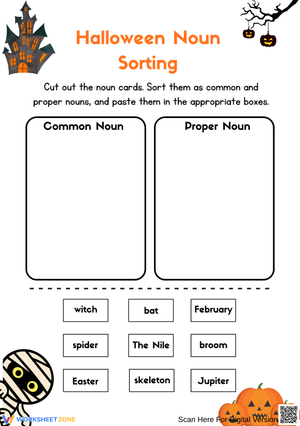
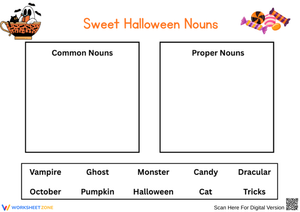
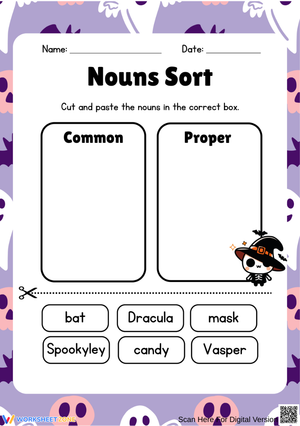
- Sorting: Students categorize a word list into two columns — common noun or proper noun — using picture cues as support. A picture of a generic dog beside the word dog sits next to a picture of a named dog beside the word Buster; the visual contrast makes the distinction concrete.
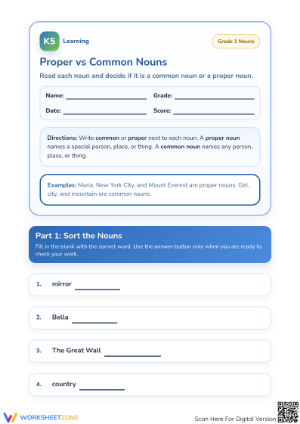
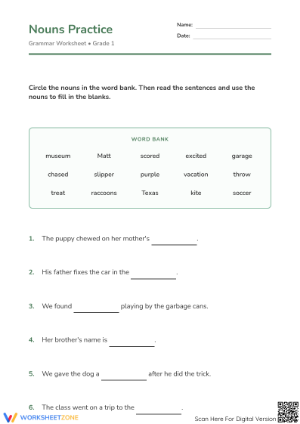
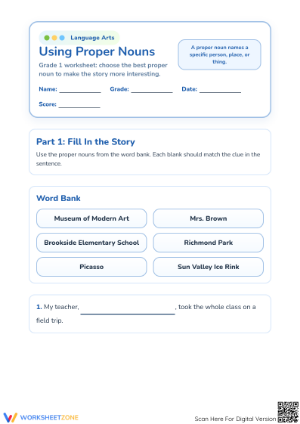
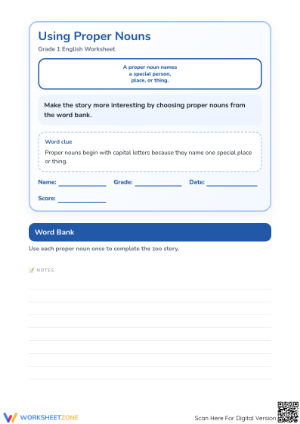
- Fill-in-the-blank: A word bank of days, months, and names provides the correct form; the task is placing it accurately inside a sentence, which reinforces both the grammar rule and sentence syntax at the same time.
- Sentence-writing prompts: Open-ended frames — "My favorite day is ___" or "My teacher's name is ___" — ask students to supply their own proper nouns, connecting the practiced rule to actual names in their own lives.
Mistakes Students Make That These Worksheets Help You Catch
Overgeneralization is the most consistent problem. Once students learn that "Monday" takes a capital, a meaningful number of them will start capitalizing "yesterday," "morning," and "weekend" as well — time-related words that feel grammatically similar to day names but follow different rules. This error surfaces most visibly in journal entries in the days immediately after a days-of-the-week worksheet. Catching it early prevents the habit from hardening.
A second pattern is rule slippage mid-sentence. A student writes "My dog is named Max" correctly on the worksheet, then writes "my dog is named max" in a journal entry two days later. The capital letter felt tied to sentence-opening position, not to the name itself. Tasks where the proper noun appears mid-sentence — never as the first word — are the best diagnostic for whether the rule has transferred to independent writing.
A third error worth a short direct lesson: students who have learned that "Mr." and "Mrs." require capitals sometimes extend that logic to all job words, producing "my Mom is a Teacher." They are conflating the title rule with the proper noun rule, and from a six-year-old's vantage point the two feel identical. Sorting exercises that include both job titles and personal names — and ask students to explain their placement aloud — draw that line more clearly than explanation alone does.
Building These Worksheets Into Your Weekly Lesson Plans
Morning work is the most natural placement. A single circling or fill-in-the-blank activity takes about eight minutes — enough time to settle students before formal instruction while reinforcing the previous day's lesson. Monday mornings work especially well for days-of-the-week tasks: students already write the day and date in their journals as part of the morning routine, and the worksheet extends a habit they already own. These 1st grade proper nouns printable worksheets also fit cleanly into literacy centers when laminated with dry-erase markers, turning each worksheet into a reusable station that survives the week without a second trip to the copier.
For the rewrite-with-correction worksheets, a brief partner-check step adds real value: one student writes, the other circles any remaining lowercase proper nouns. That peer-review structure surfaces errors faster than solo work and creates a natural conversation about why a word needs a capital — the kind of explanation that deepens understanding more than silent circling does. One honest limitation worth noting: students who read fluently sometimes rush the identification tasks and circle every capitalized word on the page, including sentence-opening words that are not proper nouns. A two-minute mini-lesson distinguishing "capital because it starts the sentence" from "capital because it's a name" resolves this quickly.
Standard Alignment
CCSS L.1.2.a — "Capitalize dates and names of people" — is the direct target for most worksheets in this set. In classroom sequence, this standard lands in the second half of first grade, after students have established the more foundational capitalization conventions: sentence-initial capitals and end punctuation. At that point they are ready to apply capital-letter rules mid-sentence, inside a clause, rather than only at a sentence's edge. The sorting and rewrite worksheets also address L.1.1.b, which asks students to identify and use common and proper nouns, reinforcing the noun unit that typically precedes proper noun instruction in most basal and workshop sequences. Both worksheet types function as formative checkpoints at the close of the noun unit and as spaced retrieval practice six to eight weeks later.
Tailoring These Worksheets for Different Student Levels
Students who need additional support benefit most from the identification worksheets when a posted anchor chart listing proper noun categories — names of people, days, months, pet names — stays visible during the task. Without that reference, students who haven't yet internalized the categories spend working memory retrieving the rule rather than applying it. Externalizing the category list through a simple classroom display frees cognitive capacity for the actual grammar work.
On-grade students generally move through identification and sorting before attempting rewrite tasks. That ordering follows natural difficulty progression: recognizing a proper noun in a sentence is a lower-demand task than producing one with accurate capitalization while simultaneously managing sentence construction. The 1st grade proper nouns printable worksheets set includes sentence-writing frames that serve as challenge extensions for students who are already writing fluently — rather than selecting from a word bank, they supply real names from their own lives and write two or three original sentences using them correctly. Connecting the rule to names students actually know is the fastest way to move from practiced skill to automatic habit.
Frequently Asked Questions
What proper noun categories do first graders learn?
First graders work within four main categories: names of people (Emma, Liam, Mrs. Park), names of pets (Buster, Whiskers), days of the week (Monday, Friday), and months of the year (October, March). These align directly with CCSS L.1.2.a and keep the content appropriately bounded — six-year-old writers don't yet need to work with place names, brand names, or titles of works, all of which arrive in later grades.
How do I introduce this concept without overwhelming early writers?
Start with students' own names before introducing any formal rule. They already know their name is capitalized; the concept then becomes: all specific names follow the same logic yours does. Anchor charts that sort examples into clearly labeled categories — visible on the classroom wall throughout the unit — give students a reference they can check independently, reducing the mid-task anxiety that derails early writers who second-guess themselves on every sentence.
How many times per week should students practice?
Two to three short sessions is the right frequency for first grade. Using 1st grade proper nouns printable worksheets activities on Monday, Wednesday, and Friday distributes practice across the week and draws on the principle of spaced retrieval, which consistently outperforms massed practice for building automatic habits in young learners. One worksheet per session is enough — this skill does not benefit from drilling ten similar problems in a single sitting.
Do these worksheets work for students still developing reading fluency?
Yes, with intentional support. Identification worksheets work well when the teacher reads sentences aloud to the class or a small group, so students are not splitting attention between decoding and applying the grammar rule simultaneously. Picture-supported sorting worksheets handle this naturally — the visual cue alongside each word reduces reading demand without removing the grammar task itself.












 Interactive Worksheet Maker
 Quiz Maker
 Word Search Maker
 Crossword Puzzle Maker
 Word Scramble Generator
 Sentence Scramble Generator
 Handwriting Worksheet Generator
 Name Tracing Generator
 Fill In The Blank Generator