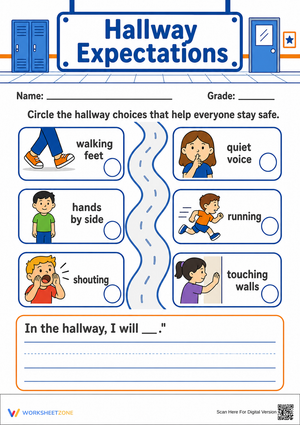
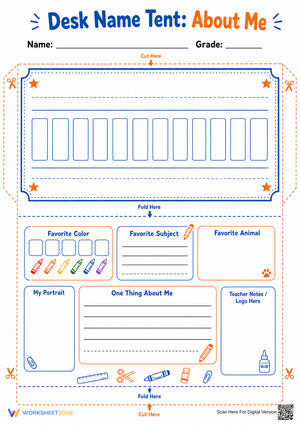
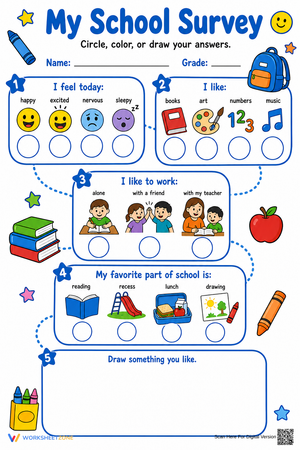
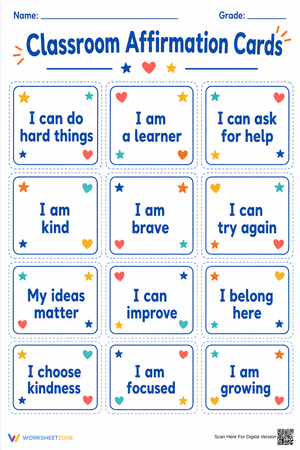
These social emotional learning printable pdf worksheets for 1st grade give teachers a structured set of activities matched to the most significant developmental window in early elementary: the stretch between six and seven years old when children begin grasping that other people hold feelings genuinely different from their own. Each worksheet targets a specific competency — naming emotions, choosing calming strategies, reading a peer's perspective, or resolving small conflicts — so teachers can select exactly what their class needs rather than working through a fixed sequence.
What Each Worksheet Covers
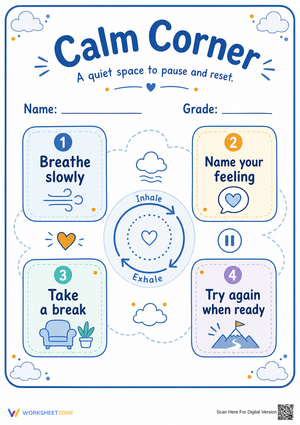
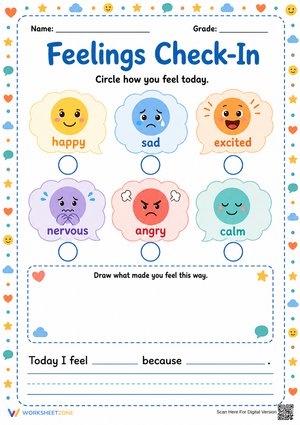
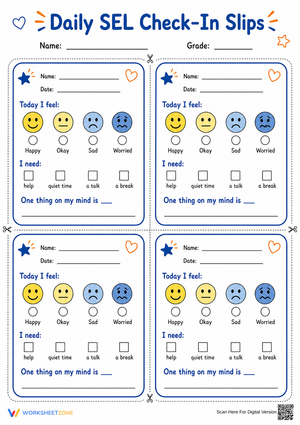
These social emotional learning printable pdf worksheets for 1st grade address all five CASEL competency areas in formats first graders can actually use. Self-awareness worksheets pair a feeling face with the emotion word beneath it, then ask students to trace the word and circle it in a short list — a sequence that locks vocabulary through image, gesture, and print together rather than through word lists alone. Self-management worksheets let each student build a personal calm-down menu by marking which strategies work for them: deep breaths, drawing, counting slowly, asking for a break. The finished page becomes a portable reference rather than a generic class poster.
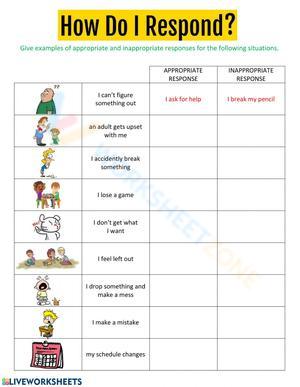
Social awareness activities use illustrated scenarios — a classmate dropping her crayons, a friend crying at his desk — and ask students to circle what the character probably feels, then draw what they would do. Relationship-skills worksheets introduce I-statements through a fill-in frame: "I feel ___ when ___ because ___." Responsible decision-making worksheets present a sorting task: students cut illustrated scenario cards and glue them into a big-problem column (find an adult) or a small-problem column (handle it yourself).
Why Grade 1 Is the Right Time for This Work
Six- and seven-year-olds are actively building theory of mind — the capacity to recognize that someone else's feelings, beliefs, or knowledge can differ from their own. The development is real but incomplete. A child who correctly identifies "my friend is sad" in a calm moment will still default to their own emotional frame under stress, insisting a peer "must be fine" because the child themselves would be fine. Repeated, concrete practice with images and scenarios gives students the repetitions needed to make perspective-taking reliable rather than effortful. The worksheet format works here because it makes the inference visible: students commit to an answer before moving on, and that pause creates the kind of conscious processing that, over time, becomes intuition.
Common Student Errors These Worksheets Help Surface
The most consistent confusion in first-grade SEL work is the conflation of angry and sad. When shown a scenario involving loss — a pet dies, a friend moves away — many six-year-olds circle "angry" because the physical activation they feel (tight chest, flushed face) registers as anger even when the situation is one of grief. These worksheets surface that confusion directly, and the feeling-face images give teachers a concrete visual to reference: "Look at the eyes on this face — they're drooping, not squinting. That's sadness, even though it feels intense."
The big-problem/small-problem sort produces its own predictable error. Students at this age almost universally classify "a broken pencil" as a big problem because it disrupts their immediate work and the frustration feels enormous in the moment. Watching which scenario cards a student misplaces tells a teacher exactly which students need explicit coaching on matching the size of a reaction to the size of a situation — more targeted information than general behavior data provides.
How to Work These Worksheets Into Your Week
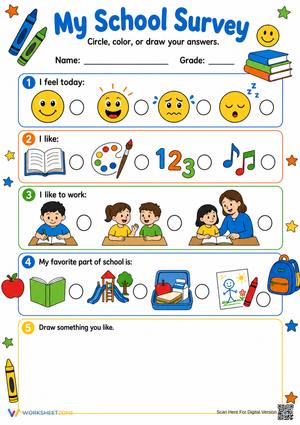
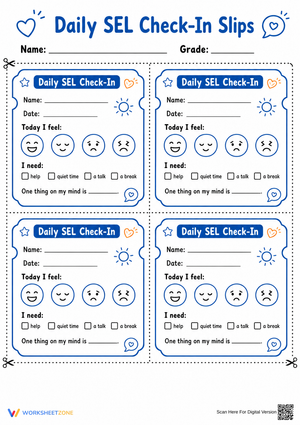
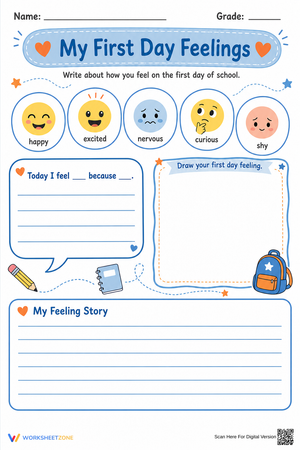
The most reliable entry point is the morning check-in. A feeling-face worksheet on each desk during morning meeting lets students circle their current emotion before the day begins and gives the teacher an immediate read on the room. The student who circles "worried" three mornings in a row is communicating something worth a quiet follow-up conversation. That same worksheet doubles as a discussion starter: "Turn and tell your partner what you circled and one reason why."
Post-recess re-entry is a second well-timed window. Conflicts that start on the playground walk back into the classroom, and having a short individual reflection worksheet ready — "What happened? How did it feel? What could you try next time?" — interrupts the escalation cycle before it reaches the lesson. A calm-down corner stocked with self-management printables from this set gives still-dysregulated students a focused, independent activity while the teacher addresses the rest of the class. These social emotional learning printable pdf worksheets for 1st grade work in that context because they give a child something concrete to do with their hands while their nervous system settles.
Standard Alignment
The worksheets address all five CASEL core competencies — self-awareness, self-management, social awareness, relationship skills, and responsible decision-making — which form the basis of SEL standards in more than 25 states. For teachers in Illinois, where the most fully codified state SEL standards exist, the set maps directly to Goal 1 (develop self-awareness and self-management skills) and Goal 2 (use social awareness and interpersonal skills to establish and maintain positive relationships), both benchmarked at the early elementary level. Illinois specifies that by the end of second grade, students should "identify and manage their emotions and behavior" and "recognize the thoughts and feelings of others" — targets these worksheets practice repeatedly through formats appropriate for emerging readers.
Adjusting the Worksheets for Mixed-Ability Classrooms
For students who are not yet reading independently, the illustrated formats — circling, matching, cutting and sorting — remain accessible without adult support. The main modification for these students is oral response: they point or speak their answer while a paraprofessional records it, or they draw rather than write in open-response fields. Students who need more challenge extend the I-statement worksheets by writing a short dialogue between two characters using at least two I-statements each, rather than completing the single fill-in frame. The big-problem/small-problem sort extends naturally as well: students who finish the cut-and-glue task write a one-sentence resolution plan for each small-problem card on the back.
For students receiving Tier 2 behavioral support, targeted use of the calm-down menu and feelings-identification worksheets — pulled individually and built into a check-in/check-out routine — turns these social emotional learning printable pdf worksheets for 1st grade into a functional component of a behavioral support plan, not just a whole-class instructional activity. That range of application matters in a real classroom where one set of materials has to serve several different needs at once.
Frequently Asked Questions
How do students who are not yet reading use these worksheets independently?
The set prioritizes visual response formats — circling, drawing, matching, sorting — so reading level does not determine access. For worksheets that include sentence starters, teachers read the prompt aloud during initial instruction, and most students retain it well enough to finish on their own. In classrooms with a significant number of non-readers, a brief audio recording of the instructions played through a listening station or tablet removes the barrier entirely without requiring adult proximity at each desk.
Where do these fit in a first-grade schedule that is already full?
Morning meeting is the most common integration point, but these worksheets also drop into the transition blocks most first-grade schedules already contain — the eight minutes between specials and lunch, the quiet independent time after recess. A single worksheet takes most first graders four to six minutes to complete. Teachers who use one per week during morning meeting report that by mid-year students begin applying the vocabulary in real conflict situations, which is the actual measure of whether the instruction is taking hold.
Can a school counselor use these in pull-out sessions?
Yes, and the single-skill format of each worksheet makes targeted selection straightforward. A counselor working with three students on anger management pulls the calm-down menu and the big-problem/small-problem sort without sorting through unrelated material. Finished worksheets give students a physical artifact to take back to the classroom and reference at their seats, extending the session's reach into the regular school day in a way that a verbal conversation alone rarely does.
What is the best way to introduce the I-statement worksheets to students who have never used this format?
Model one I-statement aloud using a real, low-stakes classroom scenario before distributing the worksheet: "I feel frustrated when someone takes my pencil without asking because then I can't finish my work." Write it on the board and point to each section of the frame, then complete the first line on the worksheet together as a class before releasing students to finish independently. Students who skip this modeling step almost always write "I feel like you were mean" — an accusation wearing the disguise of a feeling word, and the most predictable first attempt at this skill at this age.