


























Views
Downloads

First Day Feelings Check-In | Essential SEL Worksheet
Paste this activity's link or code into your existing LMS (Google Classroom, Canvas, Teams, Schoology, Moodle, etc.).
Students can open and work on the activity right away, with no student login required.
You'll still be able to track student progress and results from your teacher account.
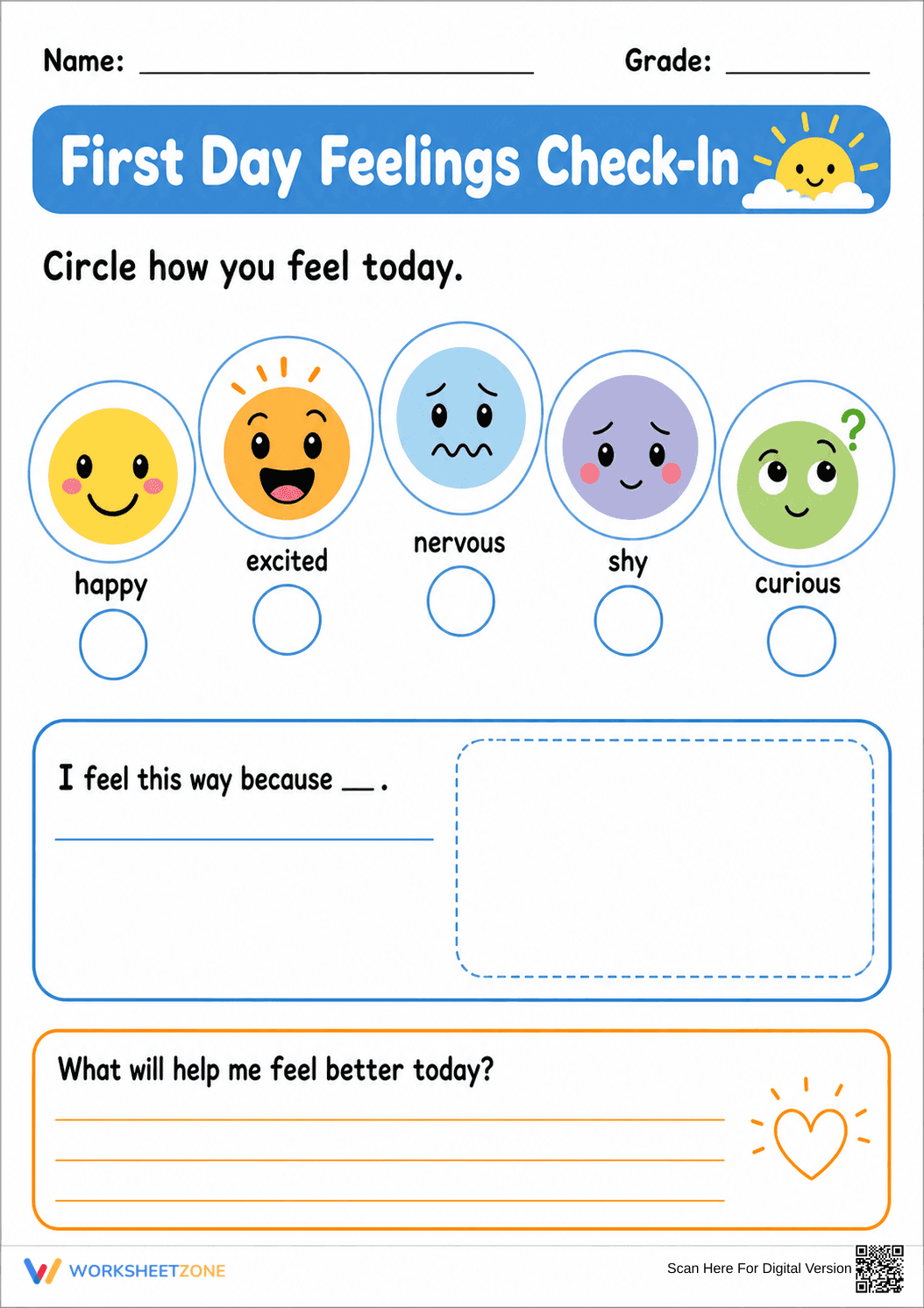
This Grade K-3 Social Emotional Learning worksheet provides a structured way for students to communicate their emotional state during the transition back to school. By identifying specific feelings and reflecting on their causes, students develop the self-awareness necessary for a successful day. This resource ensures every child feels heard from the first bell.
At a Glance
- Grade: K-3 · Subject: Social Emotional Learning
- Standard:
CCSS.ELA-LITERACY.SL.K.1— Participate in collaborative conversations about feelings and experiences.- Skill Focus: Emotional Identification
- Format: 1 page · 3 tasks · No-prep · PDF
- Best For: First day icebreaker and check-in
- Time: 10–15 minutes
The worksheet features five distinct, color-coded emotion icons—happy, excited, nervous, shy, and curious—to help students label their current mood. Below the selection area, a framed reflection box includes a sentence starter and a dedicated drawing space, ensuring that non-writers can participate fully. The final section provides a calming area for students to brainstorm support needs.
Zero-Prep Workflow
- Print (30 seconds): Select the single-page PDF and print enough copies for your morning meeting or arrival block.
- Distribute (30 seconds): Hand out the sheets as students enter the room or during a circle time transition.
- Review (1 minute): Briefly model how to circle an emoji and use the drawing box for those developing fine motor skills.
Total teacher prep time is under two minutes, making this an ideal solution for busy first-week schedules or sub plans.
The primary standard addressed is `CCSS.ELA-LITERACY.SL.K.1`, which focuses on participating in collaborative conversations with diverse partners about kindergarten topics. This worksheet supports the standard by providing the visual and written prompts necessary for students to share personal experiences. Both standard codes can be copied directly into lesson plans, IEP goals, or curriculum mapping tools.
Use this worksheet as a "bell-ringer" activity during the first week of school to gauge the emotional temperature of the room. It is effective during morning meetings; after students complete their individual sheets, invite them to share their chosen emotion with a partner. For a formative assessment, observe which students struggle to identify a cause for their feelings.
This resource is designed for early elementary students, including those in Pre-K and Kindergarten. The dual-modality response system makes it an excellent fit for English Language Learners. Pair this worksheet with a read-aloud about first-day jitters or an anchor chart displaying different facial expressions to reinforce the vocabulary and social-emotional concepts.
This resource facilitates emotional literacy by providing a structured framework for students to identify and articulate their internal states. According to Fisher & Frey (2014), the use of visual scaffolds and check-in routines is a foundational component of the gradual release of responsibility, particularly when transitioning students into new classroom environments. By aligning with CCSS.ELA-LITERACY.SL.K.1, this worksheet supports the development of collaborative communication skills, allowing young learners to practice expressing personal feelings through both verbal and non-verbal modalities. Research indicates that consistent emotional check-ins improve student engagement and decrease behavioral disruptions by validating the child's perspective early in the instructional day. This tool serves as a bridge between self-awareness and social communication, ensuring that educators can identify student needs immediately. The inclusion of drawing spaces accommodates varying developmental stages, making it an inclusive choice for diverse early childhood classrooms. Use this summary for curriculum mapping and IEP documentation.


