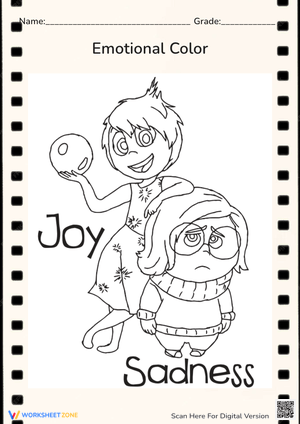
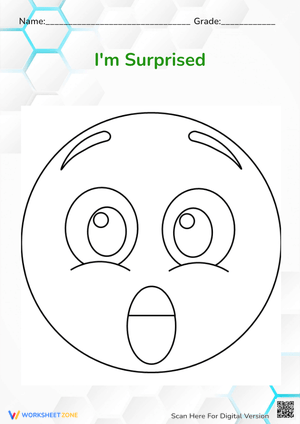
1st Grade Emotional Color Worksheets Printable
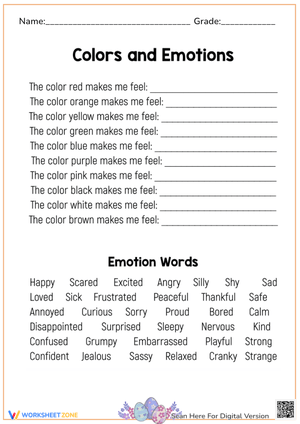
These 1st grade emotional color worksheets printable resources give teachers a concrete SEL entry point — something a six-year-old can hold and mark during morning meeting rather than being asked to verbalize feelings they don't yet have words for. The set covers daily mood tracking, scenario-based empathy practice, reflective drawing prompts, and vocabulary-building activities that connect color zones to precise emotion words. Every worksheet works as a standalone tool fitting into a 15-minute window without requiring a full curriculum relaunch.
What's Inside the Set
The core task across each worksheet is associating a color zone with an emotional state, but the execution varies enough to keep students genuinely engaged rather than going through motions. Mood tracker worksheets ask students to color a simple icon — a heart, a cloud, a small figure — at arrival, giving the teacher an immediate read of the room before the first transition of the day. Color-by-feeling activities mirror the color-by-number format students already know, but the cues are facial expressions or short emotion words: students identify the feeling, locate its assigned color, and fill the corresponding section. This format reinforces the color-emotion pairing without demanding heavy verbal output, which matters in September when emotional vocabulary is still thin.
Scenario-matching worksheets present brief, familiar situations — a friend takes your pencil without asking, you score a goal at recess, you can't find your backpack — and ask students to select the color that fits how they'd feel. These build perspective-taking alongside self-awareness because the scenario isn't always about the student themselves. The open-ended drawing prompts ask students to show what "green" feels like in their body or what "red" looks like in their chest. That creative latitude invites deeper personal processing, especially for students who find the more structured formats constraining.
Why Color-Based Activities Work at This Age
Children entering first grade are deep in what Piaget described as the concrete operational stage. Abstract emotion concepts — frustration, anxiety, contentment — don't yet have stable mental representations for most of them. Anchoring those concepts to a specific, visible color gives the brain a concrete hook. A child who stares blankly at "how do you feel?" will often point immediately to yellow when asked "which color is your body right now?" — and that yellow becomes the teacher's opening for a real conversation about excitement or worry that wouldn't have started otherwise.
The CASEL framework positions self-awareness as the foundational SEL competency — students must recognize their emotional state before they can regulate it. Color-coded worksheets reduce the language demand on that first recognition step. Once the color is identified, vocabulary work layers on naturally: the word "frustrated" lives next to the red zone on the worksheet's word bank, so students encounter it repeatedly in context rather than in a decontextualized list. That pairing accelerates the move from pointing to a color toward articulating a feeling, which is the actual developmental goal at this grade level.
Where These Worksheets Fit in the Instructional Week
Morning meeting is the most natural entry point. As students settle in, a mood tracker worksheet at each seat gives them something purposeful to complete in the first three minutes while attendance is taken. The teacher scans the room, notes who colored red or yellow, and decides whether a brief individual check-in is warranted before the first lesson. This isn't a separate SEL block — it's a two-minute ritual that yields actionable information about who walked in that morning carrying something heavy.
The Color Monster by Anna Llenas pairs naturally with the scenario-matching and drawing worksheets. The visual of a monster with tangled, blended colors resonates immediately with students who feel they have "too many feelings at once." Using a 1st grade emotional color worksheets printable that asks students to sort the character's feelings into labeled jars after the read-aloud serves two purposes: it functions as a comprehension anchor and introduces the color zone vocabulary before students apply it to their own experience. The calm-down corner is another strong placement — keeping a small stack of blank reflective drawing worksheets there gives a dysregulated student a structured outlet that doesn't require live teacher facilitation in the moment.
Errors and Confusions Students Commonly Show
The most consistent error pattern involves yellow. In the Zones of Regulation framework, yellow represents heightened states: excitement, silliness, anxiety, nervousness. Students initially resist lumping excitement and anxiety together because those feelings have opposite valence — one feels good, one feels bad. A student who is excited about the class party will argue that their yellow is "the happy kind" while an anxious classmate's yellow is "the bad kind." This is worth addressing directly rather than correcting away. Both states share the same physiological signature — racing heart, buzzing body — and helping students understand that is a meaningful insight, not a workaround.
A second pattern surfaces in before/during/after reflection worksheets used following a behavioral incident. Students frequently color all three circles red because they are still dysregulated when they sit down. This isn't a worksheet failure — it shows exactly what's happening in that student's nervous system. The fix is timing: give the student five quiet minutes first, then present the worksheet. The "before" circle often shifts to yellow, which opens a far more productive conversation about what triggered the escalation than asking "why did you do that?"
Standard Alignment
These worksheets align to the CASEL framework's Self-Awareness competency — specifically the subskills of identifying and naming emotions, connecting feelings to personal experience, and building accurate self-perception. Most state SEL standards at the K–2 band draw directly from CASEL, and this set addresses the "identifying and naming emotions" benchmarks that the majority of state frameworks place in kindergarten and first grade. For districts implementing the Zones of Regulation school-wide, each 1st grade emotional color worksheets printable in this set supports the introduction phase of that curriculum — giving students repeated, low-stakes exposure to the four-zone vocabulary before they are expected to apply it independently during stressful moments.
Adapting These Worksheets Across a Mixed-Ability Classroom
For students already fluent with the four-zone system, extend any scenario-matching worksheet by requiring one written sentence explaining their color choice rather than simply circling it. That single added demand shifts the task from recognition to production — a meaningful step up without redesigning the worksheet. Pair those students with more emotionally complex scenarios — "your best friend is moving to another school" rather than "you spilled your water" — to raise the cognitive demand without changing the format.
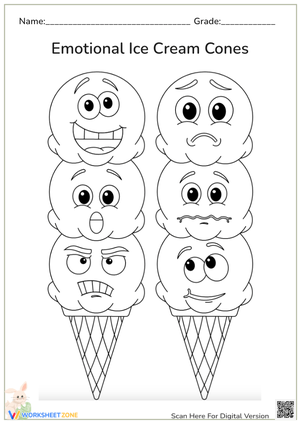
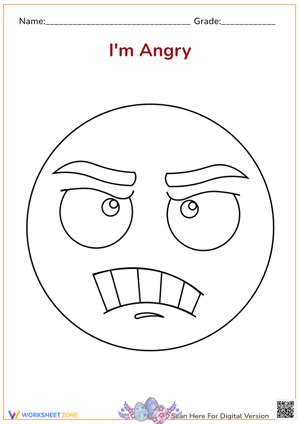
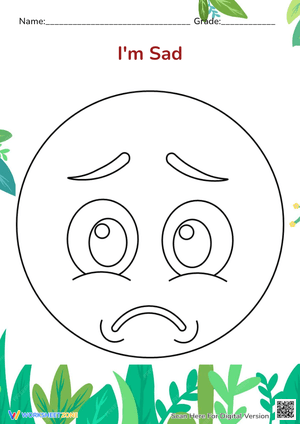
For students who are newer to English or working with limited emotional vocabulary in any language, reduce the text load and let the facial expression illustrations carry more weight. A student who doesn't know the word "frustrated" can still accurately identify the correct zone from a face clenched with effort. Students with color vision deficiency need an alternative coding system — adding a shape key (circle, triangle, square, star) alongside the zone labels makes each worksheet fully usable for the one or two students in most classrooms for whom color alone is not a reliable signal. That's a five-minute edit worth making before distributing the set.
Frequently Asked Questions
Do these worksheets work with kindergartners, or are they specifically calibrated for first grade?
The activity formats span the K–1 range, but the vocabulary-building worksheets — the ones pairing color zones with written emotion words — assume students can engage with print at an emergent level. For kindergartners, lean on mood trackers and color-by-feeling formats, which carry meaning through illustrations rather than text. Scenario-matching worksheets work with kindergartners when read aloud by the teacher. By first grade, most students can work through the full set independently or with brief support during small-group time.
What should I do when a student consistently colors red every morning regardless of context?
This pattern usually signals one of two things: the student is genuinely in an elevated state more often than peers, or they have learned that red generates adult attention. Either way, the worksheet is giving you data. If the pattern holds for two weeks straight, that's worth surfacing in a team meeting — a 1st grade emotional color worksheets printable isn't a diagnostic instrument, but it creates a consistent record that supports conversations with families and support staff far better than anecdotal memory does.
How do I introduce the color system so students internalize it quickly and reliably?
Anchor the introduction to both a read-aloud and physical objects at the same time. Read The Color Monster on day one, then show students four physical items — a red stress ball, a yellow feather, a green stuffed animal, a blue smooth stone — that live in the calm-down corner. When students have held the color before they ever see a worksheet, the association builds faster. Introduce one zone per day over four days before distributing worksheets that use all four zones simultaneously. Students who encounter the full system without that gradual buildup tend to collapse it into two categories — red for bad, green for good — and miss the nuance that yellow and blue zones specifically exist to capture.
Clear All