


























Views
Downloads
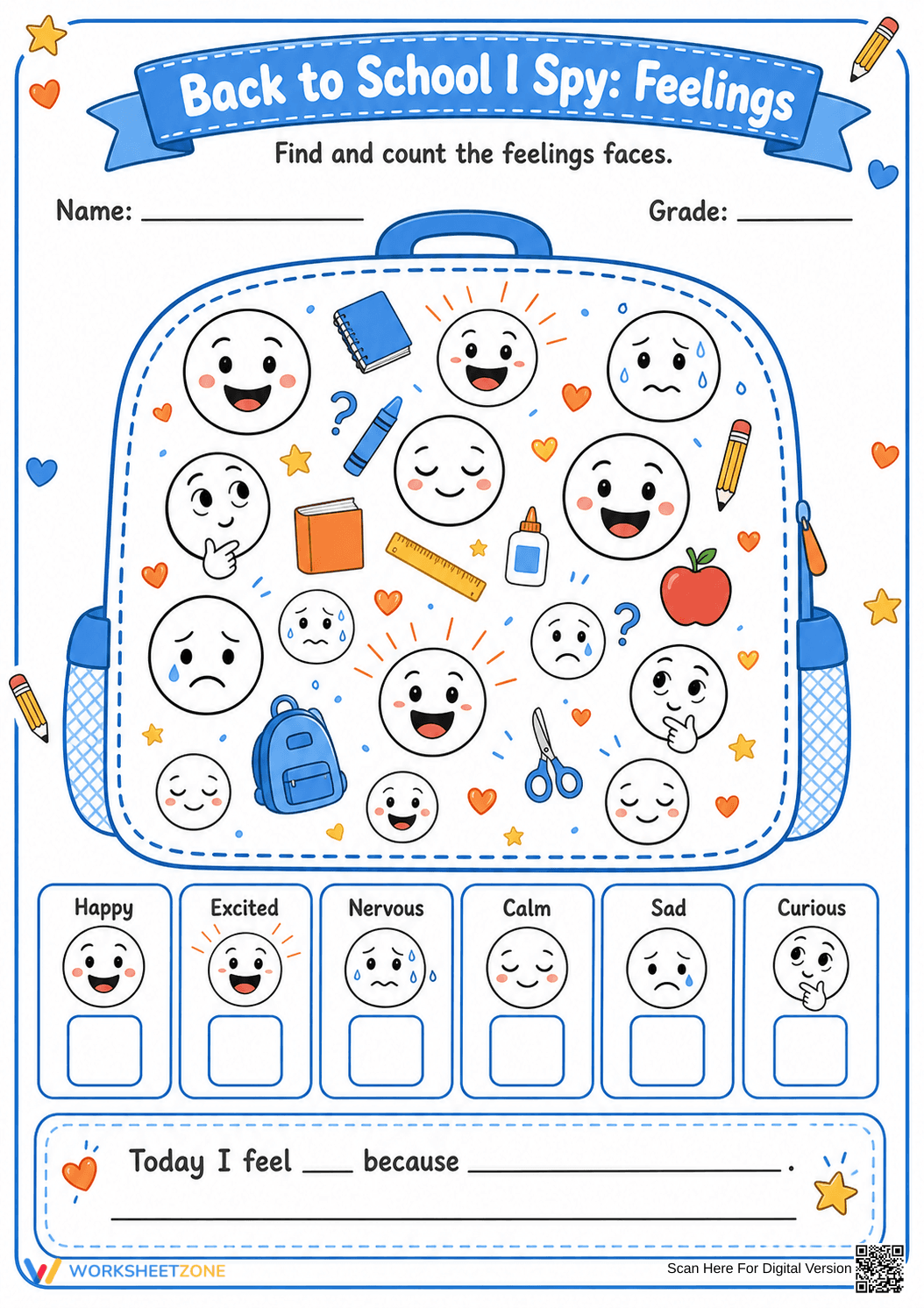

Back to School I Spy: Feelings | Essential Grade K-3 SEL
Paste this activity's link or code into your existing LMS (Google Classroom, Canvas, Teams, Schoology, Moodle, etc.).
Students can open and work on the activity right away, with no student login required.
You'll still be able to track student progress and results from your teacher account.
This Grade 1 Social Emotional Learning worksheet helps students identify and categorize six primary emotions through an engaging visual search activity. By finding and counting feelings faces within a school-themed backpack, learners build both visual discrimination skills and emotional vocabulary. The final reflection prompt encourages students to connect these abstract concepts to their own personal experiences.
At a Glance
- Grade: 1 · Subject: SEL & Math
- Standard:
CCSS.ELA-LITERACY.SL.1.4— Describe feelings and ideas clearly with relevant details and expressive language- Skill Focus: Emotion Recognition & Counting
- Format: 1 page · 7 tasks · Answer key included · PDF
- Best For: Morning meeting or transition activity
- Time: 10–15 minutes
The worksheet features a large, backpack-shaped I Spy window filled with expressive faces and school supplies. Students search for six specific emotions: happy, excited, nervous, calm, sad, and curious. Below the search area, a neat counting table provides space for students to record their findings. A dedicated reflection strip at the bottom includes a sentence starter for personalized writing and self-expression.
The zero-prep design allows for immediate implementation in any primary classroom. First, print the single-page PDF (30 seconds). Second, distribute the sheets to students during a morning meeting or as a calm-down activity (1 minute). Finally, review the counts as a whole group to facilitate a discussion about when students might feel curious or nervous (5 minutes). Total teacher preparation time is under 2 minutes.
The primary focus is `CCSS.ELA-LITERACY.SL.1.4`, which requires students to describe feelings and ideas clearly. By labeling and reflecting on emotions, students meet the descriptive requirements of the standard. Additionally, the counting component supports basic numeracy. Both standard codes can be copied directly into lesson plans, IEP goals, or district curriculum mapping tools.
Use this worksheet as a formative assessment during the first week of school to gauge student emotional literacy. It works exceptionally well during a Morning Meeting to set a reflective tone for the day. Observe how students identify the nervous versus excited faces to check for nuanced understanding. Expect students to complete the counting and reflection in approximately 12 minutes.
This resource is designed for early elementary students, school counselors, and special education teachers. It provides necessary scaffolding for students who struggle with abstract emotional concepts. Pair this worksheet with a read-aloud about school jitters or an anchor chart displaying various facial expressions to deepen the instructional impact and support diverse learners.
This educational resource leverages the visual scanning and categorization techniques essential for early childhood cognitive development. By integrating Social Emotional Learning (SEL) with basic numeracy, the worksheet addresses the dual needs of emotional literacy and mathematical fluency. According to Fisher & Frey (2014), the use of visual scaffolds and intentional reflection prompts supports the gradual release of responsibility, allowing students to move from guided identification to independent expression of internal states. The inclusion of the CCSS.ELA-LITERACY.SL.1.4 standard ensures that the activity remains grounded in academic expectations for oral language and descriptive communication. Research indicates that students who can accurately label and count emotional expressions demonstrate higher levels of self-regulation and social competence in classroom settings. This printable tool provides a structured environment for students to practice these critical life skills while meeting foundational curriculum requirements in a high-contrast, accessible format suitable for diverse learners.


