The Ultimate Guide to Teaching Narrative Structure: Story Elements worksheets
These story elements worksheets give teachers a print-ready set of graphic organizers and response formats for building narrative analysis skills from kindergarten through eighth grade. Each worksheet keeps its focus on one or two elements — character, setting, plot, conflict, or theme — which means students aren't asked to process every layer of a story at the same time. The set moves with your curriculum rather than dictating it.
What the Set Covers
The resources span the five core narrative elements, with worksheets at different complexity levels for each one. Here is what students actually do across the set:
- Character analysis — Students identify the protagonist and antagonist, list character traits, and explain how a character changes between the opening and resolution of the story. Upper-grade worksheets require textual evidence for each trait claim.
- Setting — Students record both where and when the story takes place in separate response fields. Separating these matters because students who correctly name the location routinely omit the temporal dimension entirely.
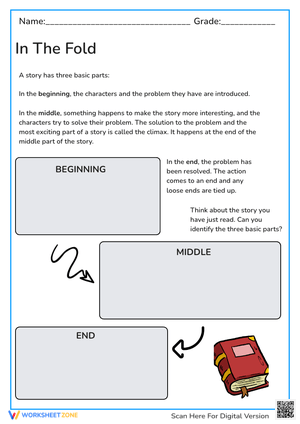
- Plot structure — Worksheets use a story arc format with labeled stages: exposition, rising action, climax, falling action, and resolution. Students write a brief description of events at each stage rather than restating a general summary.
- Conflict identification — Students name the conflict type (character vs. self, character vs. nature, character vs. society, character vs. character) and explain the underlying tension in their own words.
- Theme — Upper-grade worksheets ask for a theme written as a complete declarative sentence, supported by three specific events from the plot. Students who write one-word topics instead of full statements are prompted to revise before moving on.
Frequent Student Errors Worth Watching For
Theme is where students struggle most, and the error pattern is remarkably consistent across grade levels. Students write a topic word — "courage" or "friendship" — when the prompt asks for the theme of the story. When pushed to expand, they often slide into fable-moral phrasing: "don't give up" or "be kind to others." That approach works for Aesop but falls apart when applied to a novel where the author's message is embedded in consequences rather than stated outright. Worksheets that require students to complete a sentence frame — "In this story, a person who faces _______ learns that _______" — push students out of one-word shorthand and force an actual inference.
Setting is the second consistent gap. Third graders will write "a small town" and consider it complete, even when the text has clearly established that the story takes place during the Great Depression — a detail that appears twice in the opening pages. Worksheets that use separate labeled boxes for place, time period, and season or weather catch this far more reliably than open-ended prompts. A third error worth watching: students routinely confuse the conflict with the climax. They identify the most dramatic moment — the final confrontation, the moment everything breaks open — as the conflict itself, rather than naming the underlying tension that drives the entire narrative arc. That distinction is worth addressing directly before students begin any plot-structure worksheet.
How to Build These Worksheets Into Your Lesson Plans
The most reliable use pattern is during-reading rather than post-reading. Students who fill out the worksheet while reading stop at chapter breaks to update the plot arc, add a character trait they observed, or revise their conflict statement — which surfaces misreadings early, before they compound across multiple chapters. Waiting until the book is finished and then asking students to complete a graphic organizer turns the task into a memory exercise. That changes what the assessment actually tells you.
Monday read-aloud time is a natural modeling slot. Put the graphic organizer on the board, read aloud the first few pages, and complete the worksheet together before students move to independent reading with the same format. Small-group rotation works well for single-element practice — students who need extra work on conflict identification can move through two or three examples while the rest of the class operates at a different station. A story elements worksheets with a focused, narrow prompt also earns its place in the substitute folder. It requires no introduction, and a sub can run it without any background on your unit.
Standard Alignment
The worksheets in this set align with CCSS.ELA-LITERACY.RL standards across grade bands. Character analysis targets RL.3.3, which asks students to describe characters and explain how their actions contribute to the sequence of events, and extends through RL.8.3, which expects students to analyze how complex characters develop and interact to advance the plot or theme. Plot structure worksheets map directly to RL.5.5, which asks students to explain how chapters or sections fit into the overall structure of a story. Theme work addresses RL.4.2 and RL.6.2; the sixth-grade standard adds the expectation that students separate their thematic statement from personal opinion or unsupported assertion — a demand the evidence-based prompts here prepare students to meet. The story elements worksheets format fits naturally into any reading unit built on the Common Core ELA framework without replacing other comprehension instruction.
Adapting These Worksheets for Different Student Levels
For students still developing reading fluency, swap the source text rather than the worksheet itself. The graphic organizer stays the same; the book gets shorter and less complex. Early elementary worksheets in the set include dedicated drawing spaces alongside written response boxes, so students who aren't yet writing in full sentences can still document their understanding of character and setting visually. That preserves access to the analytical work without removing the expectation that students engage with the element.
Students working above grade level need source texts with more ambiguity — a story where the theme is never directly signaled, where the conflict is internal and subtle, where the setting's historical context shapes character decisions in ways that require inference to connect. Ask these students to complete theme worksheets on two different texts, then write a paragraph comparing what both authors seem to be arguing about the same human experience. Students working below grade level often move further on conflict identification when the answer format narrows slightly: offering three conflict types to circle rather than a blank line to fill in reduces the retrieval demand and keeps the analytical thinking front and center.
Frequently Asked Questions
Are these worksheets tied to specific books, or can I use them with whatever my class is reading?
The story elements worksheets in this set are fully text-neutral. Because character, setting, plot, conflict, and theme appear in virtually every work of narrative fiction, the worksheets work with picture books, classroom novels, short stories from an anthology, or any other narrative text. No specific titles are required or included.
Do these worksheets address point of view or author's purpose, or just the five core elements?
The set focuses on the five foundational narrative elements. Point of view and author's purpose are distinct skills with their own instructional logic, and layering them into these resources would dilute both. Teachers who want to address those skills can pair this set with separate point-of-view practice resources and use the story elements work as the comprehension anchor for the reading unit.
What is the best way to use these with English language learners?
The structured format — labeled boxes, separated response fields, and sentence frames in several worksheets — gives ELL students a clear organizational structure that open-ended journal prompts rarely provide. The main preparation step is pre-teaching the vocabulary for each story element label (protagonist, resolution, climax) before students work independently. Students at early English proficiency levels benefit most from seeing a completed example alongside the blank worksheet so they understand what a finished response looks like before they begin.
Clear All