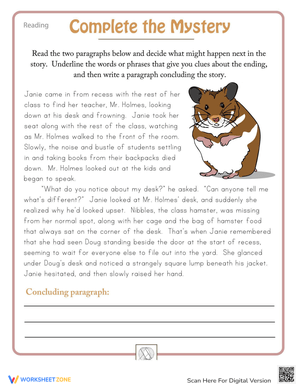
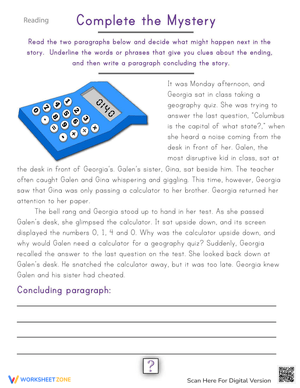
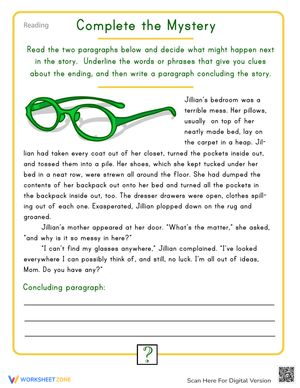
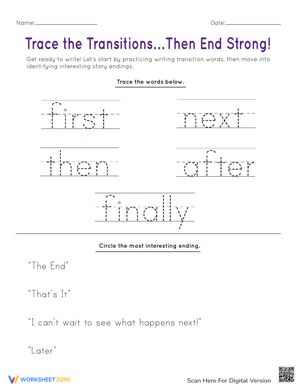
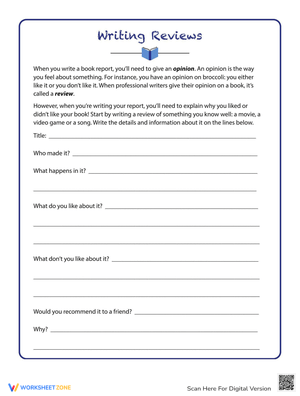
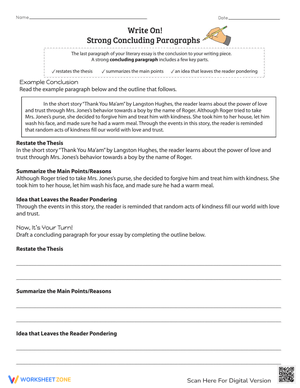
These writing a strong ending worksheets give students in grades 5 through 8 concrete tools for one of the most reliably neglected moves in composition — finishing the piece with genuine purpose rather than just trailing off. Most weak conclusions aren't a knowledge problem; they're a strategy problem. Students understand their topics, but the structural pivot a closing paragraph demands is rarely taught explicitly. The set addresses that gap directly, with exercises that isolate specific conclusion techniques before asking students to apply them on their own.
The Specific Skills Targeted
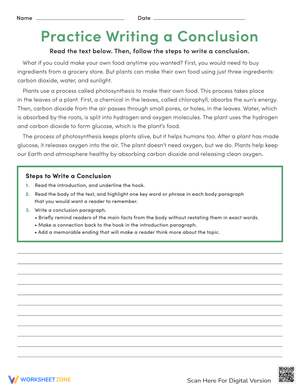
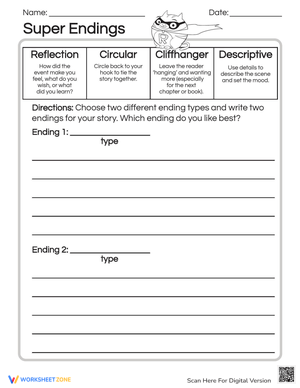
Across the set, writing a strong ending worksheets build five distinct conclusion strategies: call to action, broader implication (the "so what" move), circular return, prediction, and thought-provoking question. Students first identify each technique in mentor texts, then practice applying it in short, focused exercises — one strategy per worksheet so the concept has room to land before the next one arrives. Additional exercises address several related skills:
- Matching conclusion tone to genre — what works in a persuasive essay reads wrong in an objective research report
- Distinguishing new insight (encouraged) from new evidence (off-limits), a line most students don't realize exists
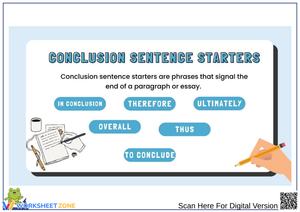
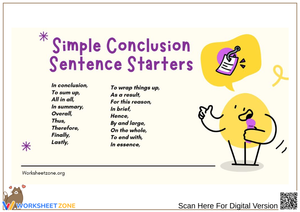
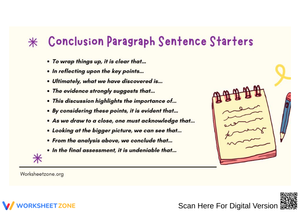
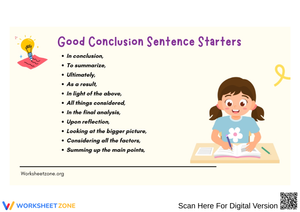
- Moving past clichéd openers: "in conclusion" and "to sum up" signal to readers that the writer ran out of ideas
- Sizing conclusions proportionally — for a standard five-paragraph essay, five to seven sentences is usually the right range
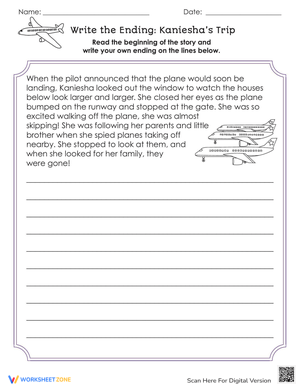
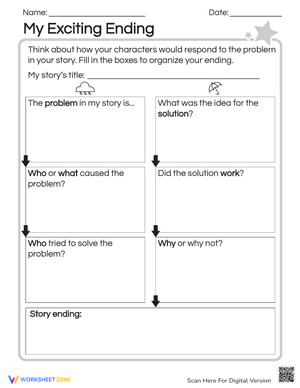
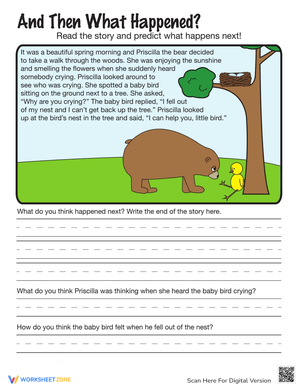
- Resolving narrative conflict without over-explaining what the story has already shown
Student Error Patterns Worth Anticipating
The most persistent error isn't the copy-paste thesis — though that appears constantly. The harder misconception is what I'd call overcompensation avoidance: students have been told so emphatically not to introduce new information that they won't offer any synthesis at all. They restate the topic sentence word for word and stop. When you explain that a new insight is structurally different from new evidence, the distinction lands with genuine surprise. Most of them didn't know that line existed.
A second pattern shows up specifically in narrative conclusions: the over-explained ending. A student writes a scene that clearly shows a character's change, then adds "and that is why this experience changed me forever" — summarizing what the story just demonstrated. Teaching students to exit a narrative before they fully explain it takes repeated practice. Trusting the reader feels genuinely risky to most middle schoolers, and that instinct to clarify everything is precisely what the narrative conclusion exercises in the set target.
How to Build These Worksheets Into Your Lesson Plans
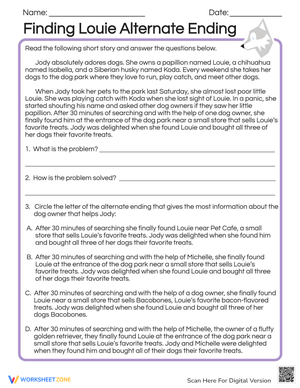
The comparative analysis exercises — students evaluate two different conclusions for the same passage and decide which is more effective — run in 8 to 12 minutes and prime students to make better choices in their own drafts that day. Use them at the start of a writing workshop block, not as a closing activity. Students need to carry that thinking into their own work while it's still fresh.
Using writing a strong ending worksheets as exit tickets during the revision phase works particularly well: provide a weak conclusion from an anonymous student sample, name one strategy, ask students to rewrite in eight minutes. That's a clean formative read on who has internalized the concept and who is still just restating. The other structural move worth emphasizing: introduce conclusion strategies mid-unit, not at the end. Teachers who embed this practice while students are still drafting body paragraphs report that students write stronger bodies because they're already thinking about where the piece needs to land. Saving it for the final class session leaves no time to apply anything.
Standard Alignment
These resources align with CCSS.ELA-LITERACY.W.6.1e, which requires students to provide a concluding statement or section that follows from the argument presented, and W.6.3e, which requires a conclusion that follows from and reflects on narrated experiences or events. The same thread runs through the W.7 and W.8 standards at increasing levels of sophistication. In classroom terms, that means the conclusion is assessed as a discrete component of the writing standard — not bundled into "organization" as a whole. Students who cannot name and apply a conclusion strategy lose points specifically on that element, which is why isolated practice matters.
Adjusting the Work for a Range of Learners
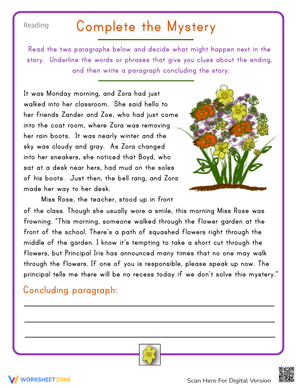
For students who freeze when facing a blank conclusion, start with the reverse-engineering exercises: give them the final sentence of a published conclusion and ask them to work backward — what would the preceding sentence need to say? Working back from a strong model removes the paralysis of the empty page and makes the structural logic visible in a way that forward drafting often doesn't.
Advanced writers benefit most from the comparison tasks extended into justification: instead of selecting which conclusion is stronger, they write a short argument for their choice. Moving from recognition to articulation is where the real analytical work happens at that level. For English language learners, sentence-stem frames built into several worksheets — pivots like "This matters because..." or "The question worth sitting with is..." — provide the transition language students need without writing the conclusion for them.
Frequently Asked Questions
Do the worksheets address both essay and narrative conclusions?
Yes, and they keep the two separate rather than treating them as a single skill. Essay conclusions synthesize an argument; narrative conclusions create emotional resonance. Treating them identically is one of the reasons students end stories with flat thesis-style summaries — which is precisely what writing a strong ending worksheets are built to correct.
When in a writing unit should I introduce conclusion strategies?
Mid-unit, not at the end. Students who understand where the piece needs to land before they finish drafting make more purposeful choices in the body paragraphs. Saving conclusion instruction for the final class session leaves too little time to apply anything meaningfully.
Can these be used for peer review?
The comparative analysis exercises adapt well to peer review: the reader identifies which strategy — if any — the writer used, notes whether the ending feels proportional to the rest of the piece, and flags any clichéd openers. It gives peer reviewers a concrete focus instead of the vague prompt "does this sound finished?"












 Interactive Worksheet Maker
 Quiz Maker
 Word Search Maker
 Crossword Puzzle Maker
 Word Scramble Generator
 Sentence Scramble Generator
 Handwriting Worksheet Generator
 Name Tracing Generator
 Fill In The Blank Generator