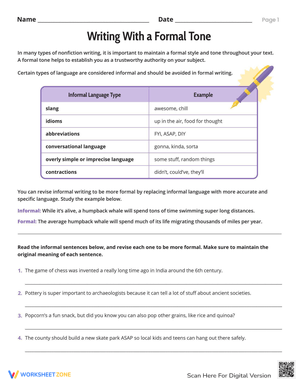
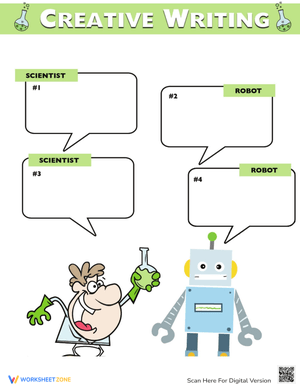
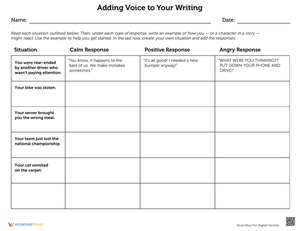
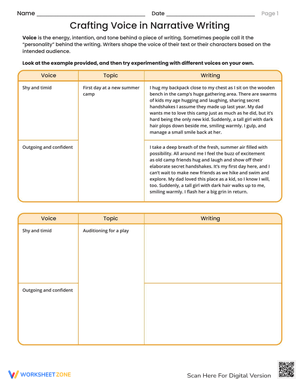
These voice in writing worksheets resources give middle and high school English teachers a printable set that breaks one of the most abstract instructional targets in ELA into work students can actually do at their desks. The set covers both authorial voice — the stylistic fingerprint of word choice, tone, and rhythm — and grammatical voice, meaning the active and passive constructions that determine how directly a sentence puts its subject in charge of the action. Both strands appear in state standards and student essays, but they require different instructional approaches, and each worksheet addresses them distinctly.
The Two Kinds of Voice — and Why the Distinction Matters
Teachers regularly find that students conflate authorial voice with grammatical voice because they share a name. They are not the same thing. Authorial voice is the personality on the page: why Hemingway's sentences feel blunt and McCarthy's feel relentless even though both writers use simple vocabulary. Grammatical voice is structural — in active constructions, the sentence's subject drives the action; in passive constructions, the subject receives it. Each type demands its own exercises, and conflating them in instruction produces confusion that shows up directly in essay feedback: students who correct passive verbs in revision but still produce writing that reads as flat and impersonal.
What Students Practice Across the Set
The exercises target both voice types with tasks that ask students to produce writing, not merely identify it. Specifically, students will:
- Identify active and passive constructions in sentences drawn from academic and literary contexts
- Convert passive sentences to active ones — including sentences where the agent has been deliberately omitted, which is the more demanding revision task
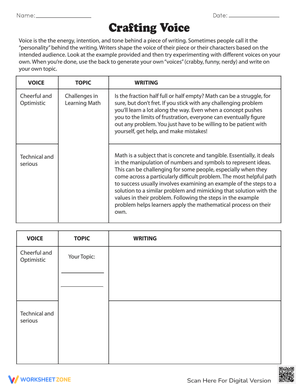
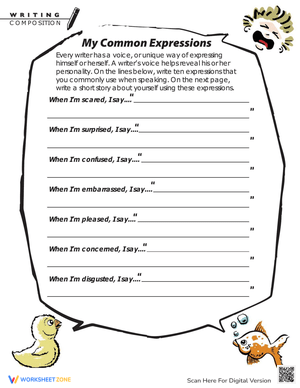
- Rewrite neutral paragraphs through persona shifts, adopting contrasting characters (an exhausted parent, a bored security guard) and examining how word choice and sentence rhythm change across versions
- Conduct adjective audits on their own prose, swapping general descriptors for synonyms with sharper connotative weight
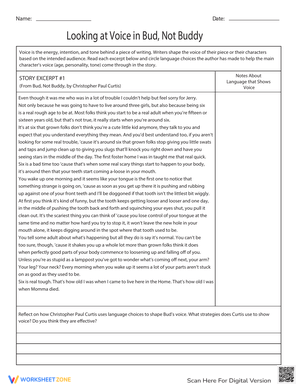
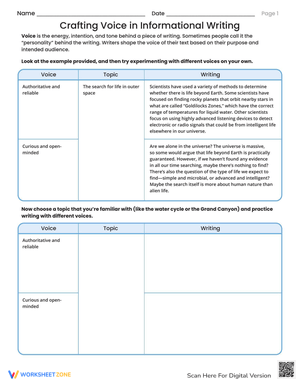
- Analyze published passages to name the specific words an author used to establish tone
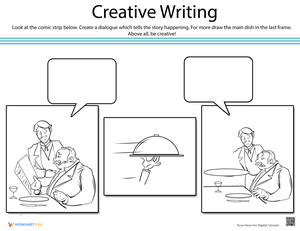
- Practice character voice in dialogue, making two speakers distinct without relying on dialogue tags
The persona shift work is where the real instructional payoff tends to appear. A student who rewrites "I waited in line at the store" from the perspective of an exhausted parent and then again from the perspective of an impatient teenager will discover — without being told — that vocabulary, sentence length, and verb choice each carry emotional register. That discovery is more durable when students arrive at it through the act of doing it twice on paper than when it arrives through lecture. Each voice in writing worksheets exercise in this strand is built to make that comparison visible rather than theoretical.
Building These Worksheets Into Your Lesson Plans
The most productive use pattern is brief whole-class modeling before independent work. For grammatical voice, put a passive sentence on the board — ideally one pulled from a text the class is already reading — and work through the revision together before students tackle the worksheet on their own. Pulling examples from shared texts matters because it shows students that passive construction is sometimes a deliberate choice (scientific writing, bureaucratic language, certain narrative effects) rather than a universal mistake.
For authorial voice, model a persona shift aloud first. Write two or three sentences describing the same mundane event in two different registers and read both versions out loud. Students hear the difference before they have to produce it. The ten minutes of setup makes the independent practice substantially more productive — students who go straight to the worksheet without that grounding frequently produce two paragraphs that sound almost identical. The worksheets then give them a structured task to replicate the experiment at their own pace.
A voice in writing worksheets set also works well as targeted review for students who score low on the "voice" dimension of a six-trait writing rubric. Pull one worksheet — the adjective audit, for instance — and use it during a small-group session while the rest of the class drafts independently. It gives you something concrete to do with students who need more practice without pulling them out of the writing sequence entirely.
Errors Students Make That These Worksheets Help You Catch
The most common mistake in active/passive conversion work is producing a grammatically active sentence that changes the original meaning. Students given "The policy was revised by the committee" will correctly write "The committee revised the policy" — but when given "Errors were made," they write "Someone made errors," which adds a vague agent the original sentence deliberately withholds. That choice is important in professional and political writing. Students need to understand that passive construction can be purposeful before they develop a blanket rule against it.
In persona shift exercises, the pattern we see most often is a strong opening sentence that captures the assigned character, followed by a gradual drift back to the student's own register by the third or fourth sentence. The student starts as a gruff detective but by the end of the paragraph is writing like a seventeen-year-old explaining a homework assignment. Worksheets that include a brief self-review prompt — asking students to circle any sentence that "sounds like you instead of the character" — catch that drift before it calcifies into a habit.
One subtler error: students frequently equate active voice with short sentences. They convert passive constructions correctly but also strip out subordinate clauses and qualifying language in the process, producing writing that is technically active but reads as choppy and underdeveloped. Worth naming explicitly during whole-class review.
Standard Alignment
The grammatical voice exercises align directly with CCSS.ELA-LITERACY.L.8.1.B, which requires students to form and use verbs in active and passive voice and to understand the effect of each. The authorial voice strand connects to CCSS.ELA-LITERACY.W.7.3.D at the middle school level, which asks students to use precise words and sensory language to convey experiences, and to CCSS.ELA-LITERACY.W.9-10.3.D at the high school level, which asks students to use precise language to manage the tone and voice of narrative writing. In practical lesson-planning terms, the grammatical voice worksheets belong in a grammar or conventions unit, while the authorial voice work fits most naturally inside a narrative or argument writing unit where students are also drafting for a real audience.
Adjusting the Worksheets for Different Student Levels
For students who are still building foundational grammar knowledge — particularly those who struggle to identify subjects and verbs reliably — the active/passive identification exercise works better as a sentence-sorting step before any writing begins. Give students a set of sentence strips and have them sort the strips into "active" and "passive" groups, then debrief as a class. The physical sorting reduces the mental load of simultaneously holding the concept, applying it, and producing written output, which is a lot to manage at once for students still internalizing the grammar.
Advanced students benefit from a constraint added to the adjective audit: the replacement word must shift the tone of the sentence in a specific direction without altering its literal meaning. "The old house stood on the hill" becomes a different exercise when the target is making it threatening rather than nostalgic. That constraint demands the kind of deliberate vocabulary control that corresponds to the highest score bands on state writing assessments — and it pushes students who would otherwise breeze through a straightforward synonym swap.
English language learners often bring the sharpest instincts for grammatical voice because many have formally studied active and passive construction in their home language. Their challenge in persona shift exercises is more often at the level of idiomatic phrasing — a character voice that reads as natural to a native speaker may be difficult to replicate. Pairing an ELL student with a strong language model for the initial persona draft, then having them complete the revision independently, keeps intellectual demand high while reducing the production barrier during the first attempt. Each voice in writing worksheets exercise in the authorial strand leaves enough open space in the response area that students can draft in shorter bursts rather than committing to a full paragraph at once, which helps here.
Frequently Asked Questions
What is the actual difference between authorial voice and grammatical voice, and do these worksheets teach both?
Authorial voice is the personality a writer projects through diction, sentence rhythm, and perspective — it's why you can identify a Didion essay from its first paragraph. Grammatical voice describes the structural relationship between the subject and the verb: whether the subject acts (active) or is acted upon (passive). Each worksheet in the set focuses on one type as its primary target, so teachers can assign them separately depending on which concept a lesson addresses.
Are these exercises appropriate for both middle school and high school, or is this a middle school resource?
The set works across both levels, but the exercises are not developmentally interchangeable — sequence matters. Middle school students typically start with active/passive identification and the most concrete persona shift prompts. High school students are ready for the agent-omission passive conversion tasks and the analytical work of examining published passages for authorial voice. Assigning the high school exercises to seventh graders without the prerequisite grammar foundation tends to produce frustration rather than growth.
How do these printable worksheets work alongside digital grammar tools?
A quiz platform is fast and useful for whole-class formative checks — two minutes of active/passive identification at the start of class tells you quickly who needs more practice. The printable worksheets do the slower, deeper work: revision, production, and extended writing. Use the digital tool to triage, then use the printed exercises for substantive follow-up. They serve different instructional purposes and work best together rather than as substitutes for each other.
What if students can identify active and passive voice correctly but still overuse passive construction in their own essays?
Recognition and production are genuinely different skills, and this gap is one of the most common frustrations in grammar instruction. A student who scores well on an identification drill can write three passive sentences in a row in the next paragraph of an essay because recognition does not automatically transfer to self-monitoring during drafting. The conversion and extended-writing exercises in this set specifically target that transfer — students practice rewriting under controlled conditions before they are asked to catch and correct their own phrasing independently in a full draft.












 Interactive Worksheet Maker
 Quiz Maker
 Word Search Maker
 Crossword Puzzle Maker
 Word Scramble Generator
 Sentence Scramble Generator
 Handwriting Worksheet Generator
 Name Tracing Generator
 Fill In The Blank Generator