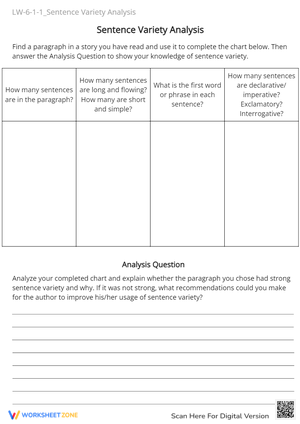
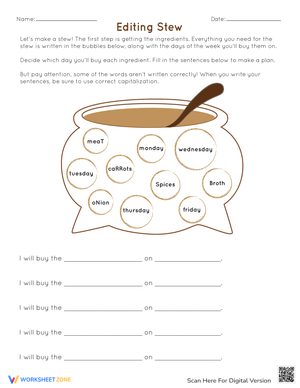
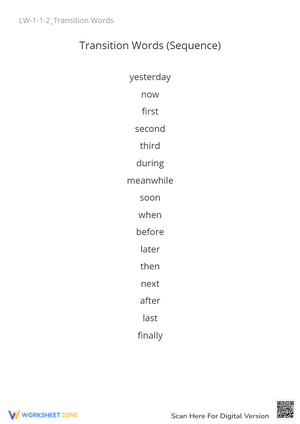
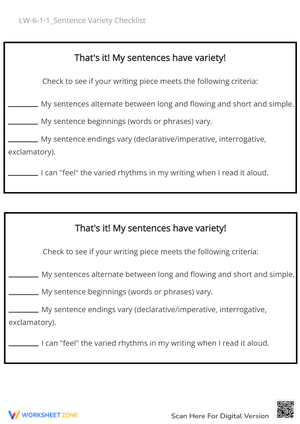
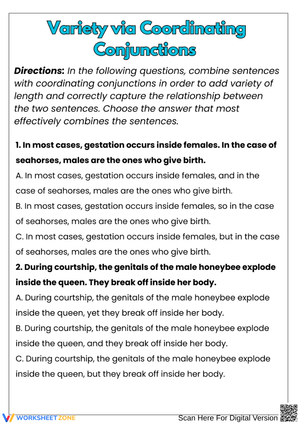
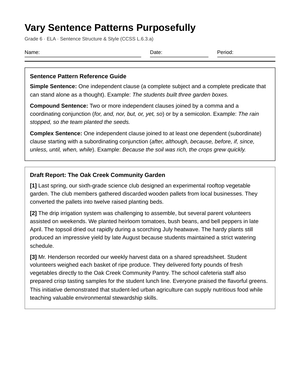
These sentence variety worksheets give writing teachers a targeted set of exercises built around the specific syntactic habits students fall into without deliberate instruction — subject-first constructions at nearly identical lengths, with clause patterns that rarely venture past simple or compound. Each worksheet targets one or two concrete aspects of syntactic diversity: sentence combining, opening variation, clause identification, or full structural revision. The set includes answer keys and runs cleanly as warm-up material, small-group practice, or a dedicated revision unit inside a larger writing sequence.
The Syntactic Territory These Worksheets Cover
Students work through four distinct skill areas across the set.
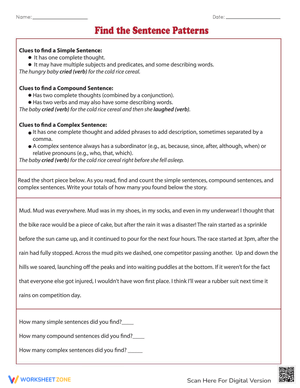
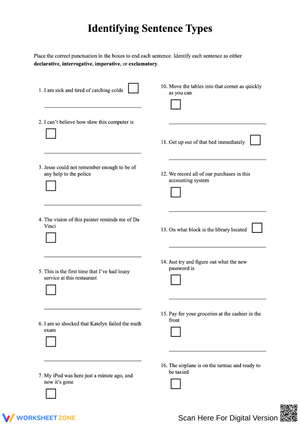
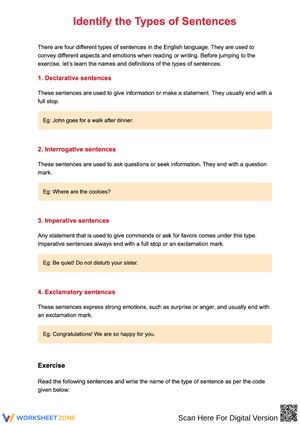
- Sentence type identification: Students read short paragraphs and label each sentence as simple, compound, complex, or compound-complex. The labeling work matters because writers who can't name what they're producing can't deliberately choose it.
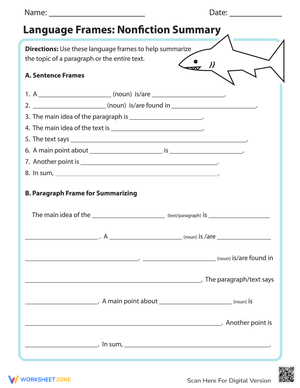
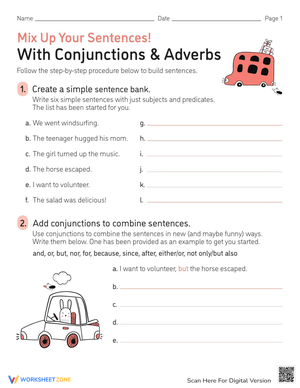
- Sentence combining: Two or three short sentences appear together; students merge them into a single fluid statement. Because there are multiple valid ways to combine, these exercises open naturally into class discussion about how different grammatical choices shift emphasis.
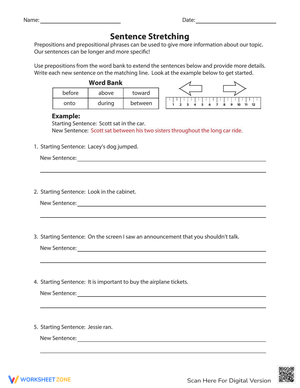
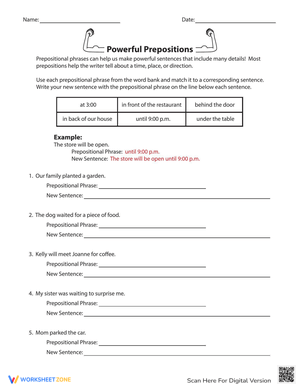
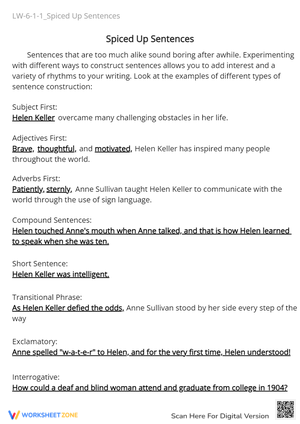
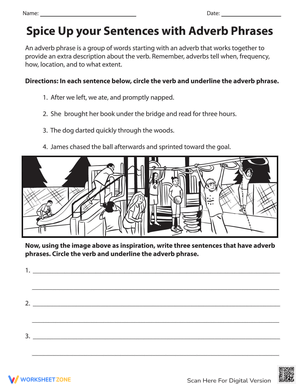
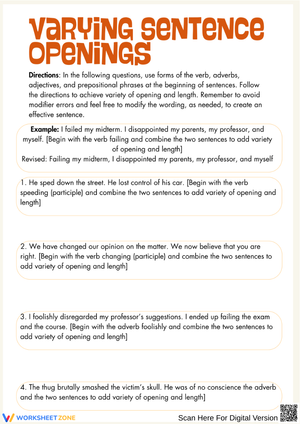
- Opening variation: Students rewrite subject-first sentences using a designated opener — a prepositional phrase, a participial phrase, or a subordinating clause. The constraint forces real experimentation with phrasing students wouldn't reach for on their own.
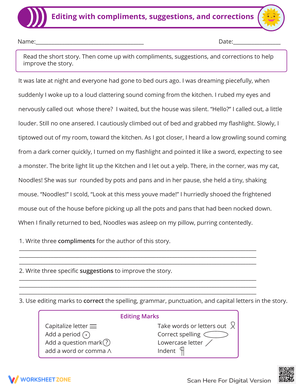
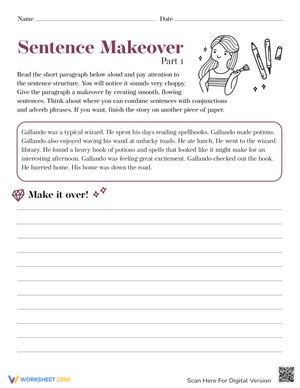
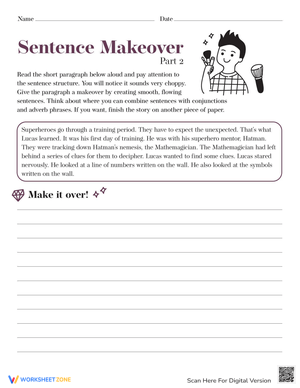
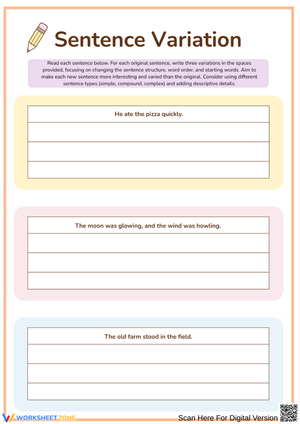
- Structural revision: Students receive a full paragraph and revise it for sentence variety, then compare their version to a model. This is the most cognitively demanding task in the set and works best after students have practiced the three skills above.
Student Errors Worth Catching Before They Calcify
The most persistent problem isn't starting sentences with "The" or "I" — it's uniform breath. A student paragraph where every sentence runs eight to twelve words creates the same monotony whether the sentence openings differ or not. These worksheets expose that pattern explicitly, but teachers should be ready for students who correct their openings successfully and still produce a paragraph that reads like a list. Sentence length is half the equation, and students rarely think about it without direct prompting.
A specific pattern surfaces regularly in middle grades: a student successfully converts "The scientist ran the experiment twice. She recorded the results carefully. The data showed a clear pattern." into "Running the experiment twice, the scientist carefully recorded results that showed a clear pattern." That's genuine progress. But the same student, left to revise a full paragraph, will often make every sentence begin with a participial phrase — swapping one repetitive structure for another. The exercises include a sentence-mapping step after revision, where students tally their sentence lengths and check for clustering. That step catches the substitution error before students consider the paragraph finished.
Compound sentences also produce a reliable error. Students who learn to join ideas with coordinating conjunctions will produce comma splices when working quickly — connecting independent clauses with only a comma and no conjunction. The answer keys flag this explicitly, making each worksheet useful for reinforcing punctuation conventions alongside syntactic variety.
Building These Exercises Into the Weekly Writing Routine
The most productive placement is the first five to eight minutes of class on days when students are actively drafting or revising. That timing is deliberate: the exercises prime syntactic thinking immediately before students open their own writing. A student who has just spent seven minutes combining three pairs of choppy sentences is more likely to notice the same pattern in their draft.
Whole-class debriefs after warm-up use are where most of the learning happens. Teachers display one item from the current worksheet and ask two or three students to share their revisions. The variation in student answers — one writer starts with a prepositional phrase, another uses a subordinate clause — becomes the instructional moment. The class hears how different grammatical choices produce different emphases even when the underlying idea is identical. Two minutes of that comparison is worth more than five minutes of additional worksheet time.
When a cluster of students shares a specific structural gap, small-group work is faster than returning to whole-class instruction. Pulling four students whose drafts rely almost entirely on simple sentences and working through one worksheet together allows teachers to address the gap directly and observe where each student's understanding breaks down. The sentence variety worksheets format supports this use well — the tasks are self-contained enough that a small group can work through them without prior setup beyond a brief introduction to the target structure.
Standard Alignment
Most exercises in the set address CCSS Language Standard L.3-12.3, which expects students to use knowledge of language conventions to achieve specific effects — including sentence-level variety and deliberate stylistic choices. The standard spans grades 3 through 12, a range that reflects how long it actually takes for syntactic decision-making to become automatic rather than effortful. The sentence combining tasks also connect to W.3-12.5, which covers revision for clarity and coherence. Opening variation exercises reinforce L.6.1 and L.7.1 when students practice rewriting with phrases and clauses. These aren't incidental alignments; this is where sentence-level revision actually sits in most district scope-and-sequence documents.
Adjusting the Work for Students at Different Points in Their Syntactic Development
These sentence variety worksheets accommodate a range of readiness levels without requiring entirely separate materials for each group.
Students still working primarily with simple and compound sentences get the most from the combining tasks. Those exercises build complexity without requiring students to generate new content, which keeps the structural work in focus. Students at this stage often succeed with combining but stall on the opening-variation exercises — that's a useful diagnostic signal rather than a reason to push forward. Pause at combining until clause-level thinking is steadier.
Students who already write compound-complex sentences with some regularity are ready for the structural revision tasks. Ask them to revise a paragraph twice — once for opening variety and once for length variation — then compare which version reads better and explain why. That comparison exercise builds the metacognitive awareness that makes the practice transfer to independent writing rather than staying locked inside the worksheet.
Students who struggle to read the model paragraphs fluently need the identification tasks first, with teacher support during reading. Labeling sentence types in a paragraph heard aloud, rather than read independently, removes a barrier and keeps the syntactic work accessible without watering down the actual skill being practiced.
Frequently Asked Questions
Do I need to teach sentence types before using these worksheets?
The identification exercises work best when taught concurrently with their use — students can label sentence types while learning what distinguishes them. That said, students who have no exposure to terms like independent clause or subordinating conjunction will move slowly through the first worksheet. A fifteen-minute direct-instruction segment before the first session is worth the time.
Are answer keys included?
Yes. Each worksheet includes a full answer key. For combining and revision exercises, the key provides two or three acceptable versions, since those tasks have multiple correct answers. That flexibility matters when students work through the exercises independently in centers or at home.
Can I use these with both middle and high school students?
The set works across grades 5 through 10 without adjustment, though the revision paragraphs in later worksheets use academic vocabulary that's more familiar to older students. Younger students benefit from having the teacher read model paragraphs aloud before attempting the revision task.
How are these worksheets formatted and delivered?
Each download delivers the sentence variety worksheets as printable files with clear task instructions, enough white space for student handwriting, and a labeled answer key on a separate sheet. Nothing is crammed — students who need additional room can continue responses on the back.












 Interactive Worksheet Maker
 Quiz Maker
 Word Search Maker
 Crossword Puzzle Maker
 Word Scramble Generator
 Sentence Scramble Generator
 Handwriting Worksheet Generator
 Name Tracing Generator
 Fill In The Blank Generator